On this page
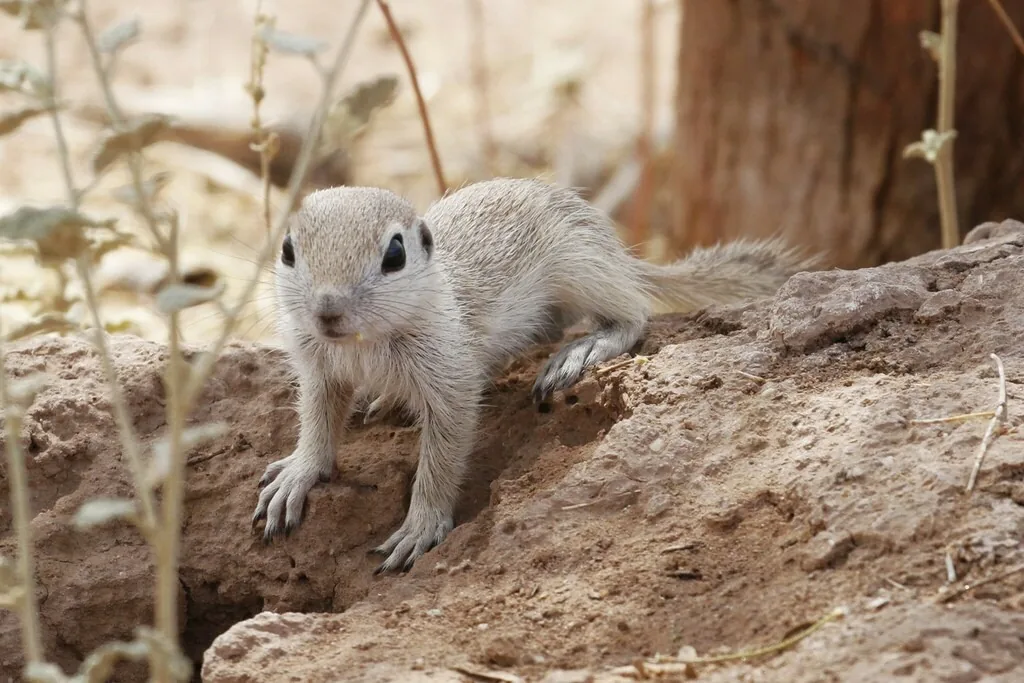
How to identify it
Look-alikes
| Look-alike | How to tell them apart |
|---|---|
| Antelope ground squirrels | Antelope ground squirrels have stripes along the sides; round-tailed ground squirrels have no stripes or spots.[1] |
Where it lives
Found below about 3,200 feet in the hot, dry Sonoran Desert of Arizona, Nevada, southeastern California and northwestern Mexico.[1]
Biology and life cycle
They live in colonies of several adults, subadults and young, are active by day from about March to September, and dig their own burrows.[1]
Damage and signs
Health risk
They can host fleas and other parasites and could carry plague or other diseases during contact with people.[1]
Control
Keep them out
Protect favorite plants with small-mesh hardware cloth buried a few inches into the soil, and cover the barrier or line it with flashing or another slick material, since the squirrels also climb.[2]
Sanitation
Systematically remove the cover and habitat they use around the yard.[2]
Traps and physical control
Trapping reduces numbers; at an Arizona archaeological site, monitoring combined with trapping and repellents lowered squirrel activity, but where they are common they can be contained rather than eliminated.[1][2]
Common questions
- How do I get rid of ground squirrels in my desert yard?
- You can contain them but not eliminate them: combine habitat removal, trapping, and barriers of buried hardware cloth with a slick top edge.[2][1]
- Do round-tailed ground squirrels carry disease?
- They can host fleas and other parasites and could carry plague, so avoid handling them.[1]
Sources
- University of California, Vertebrate Pest Conference (eScholarship), “Integrated Pest Management Strategies for Round-tailed Ground Squirrels (Proceedings of the 29th Vertebrate Pest Conference, Paper 61, December 2020; University of Arizona and National Park Service authors).” escholarship.org/content/qt8n2100g9/qt8n2100g9.pdf (accessed 2026-10-17)
- Arizona Daily Star (This Is Tucson), “You can contain ground squirrels (Garden Sage, P. L. Warren, Pima County Cooperative Extension).” thisistucson.com/you-can-contain-ground-squirrels/article_b4b8cd9a-9f9d-11e6-bf23-7f0767feb571.html (accessed 2026-10-17)
- iNaturalist, “Xerospermophilus tereticaudus taxon page (order and family).” www.inaturalist.org/taxa/179993 (accessed 2026-10-06)