On this page
How to identify it
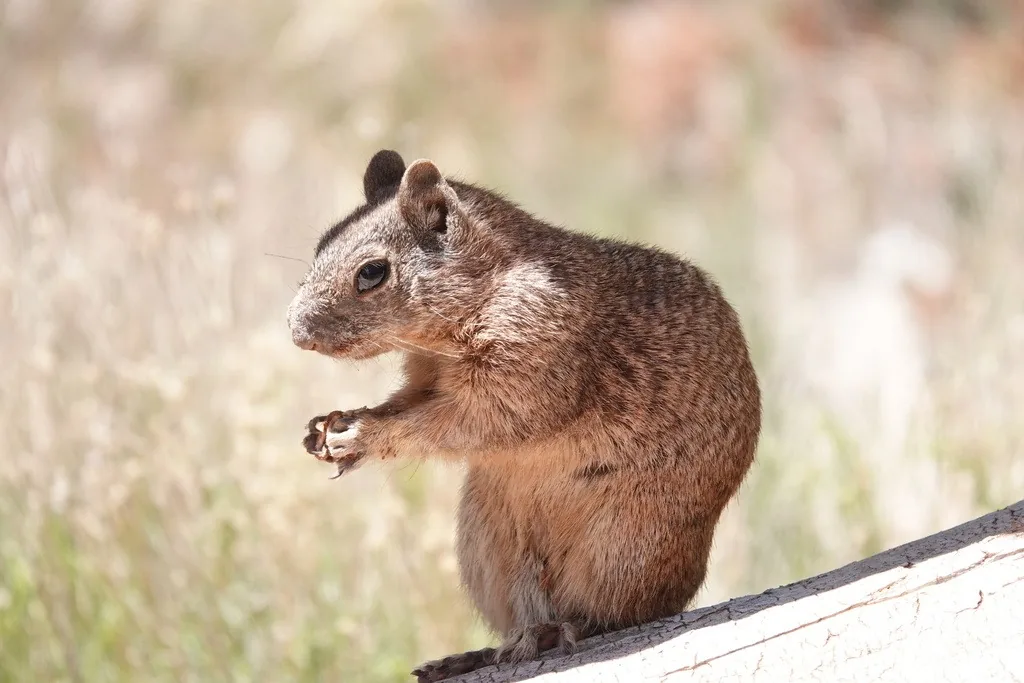
- It is big for a ground squirrel: the head and body are about 10.5 inches long, with a bushy tail about 8 inches long, and the fur is brownish gray mottled with white spots.[1][2]
- Its ears stick up above the top of the head, and it lives in open burrows rather than the closed tunnel systems of gophers.[1][2]
Where it lives
Found from Mexico north to northern Utah and Colorado, across nearly all of Arizona and New Mexico except the highest elevations.[1][3]
Biology and life cycle
Mating runs from March to July, and after about a 30-day pregnancy a litter of 5 to 7 young is born.[2]
They need little free water and use cheek pouches to carry and cache food.[2]
Damage and signs
Health risk
University of Arizona Extension notes that rock squirrels are associated with transmission of bubonic plague to people; wear disposable gloves when handling dead squirrels and be aware of local plague reports.[2]
Control
Prevention
Frightening devices and repellents usually don't deter them, and once squirrels have been removed, destroy the burrow system to prevent new ones moving in.[2]
Keep them out
New Mexico State says a 4-foot fence of small wire mesh topped with a smooth sheet-metal band 16 to 20 inches wide may keep them out of small garden areas, since they climb well; University of Arizona Extension finds fences generally ineffective against ground squirrels.[1][2]
Sanitation
Remove debris piles, stacked irrigation pipe, pallets and rock piles that give them places to burrow and hide.[2][1]
Traps and physical control
Live or lethal traps baited with nuts, orange slices or melon work best on small populations; check state and local laws before trapping.[2][1]
Common questions
- How can I tell a rock squirrel from other squirrels?
- Rock squirrels are large, gray-brown ground squirrels mottled with white, with a long bushy tail, and they live in burrows among rocks rather than in tree nests.[1][2]
- Are rock squirrels dangerous?
- They are associated with transmission of bubonic plague, so avoid handling them and use gloves with dead squirrels.[2]
Sources
- New Mexico State University Cooperative Extension Service, “Controlling Rock Squirrel Damage in New Mexico (Circular 574).” pubs.nmsu.edu/_circulars/CR574/ (accessed 2026-10-17)
- University of Arizona Cooperative Extension, Yavapai County, “Rock Squirrels (Backyard Gardener, J. Schalau).” extension.arizona.edu/sites/extension.arizona.edu/files/attachment/RockSquirrels.pdf (accessed 2026-10-17)
- Utah State University Extension, “Rock Squirrels (fact sheet, July 2015).” digitalcommons.usu.edu/extension_curall/743 (accessed 2026-10-17)
- iNaturalist, “Otospermophilus variegatus taxon page (order and family).” www.inaturalist.org/taxa/180008 (accessed 2026-10-06)