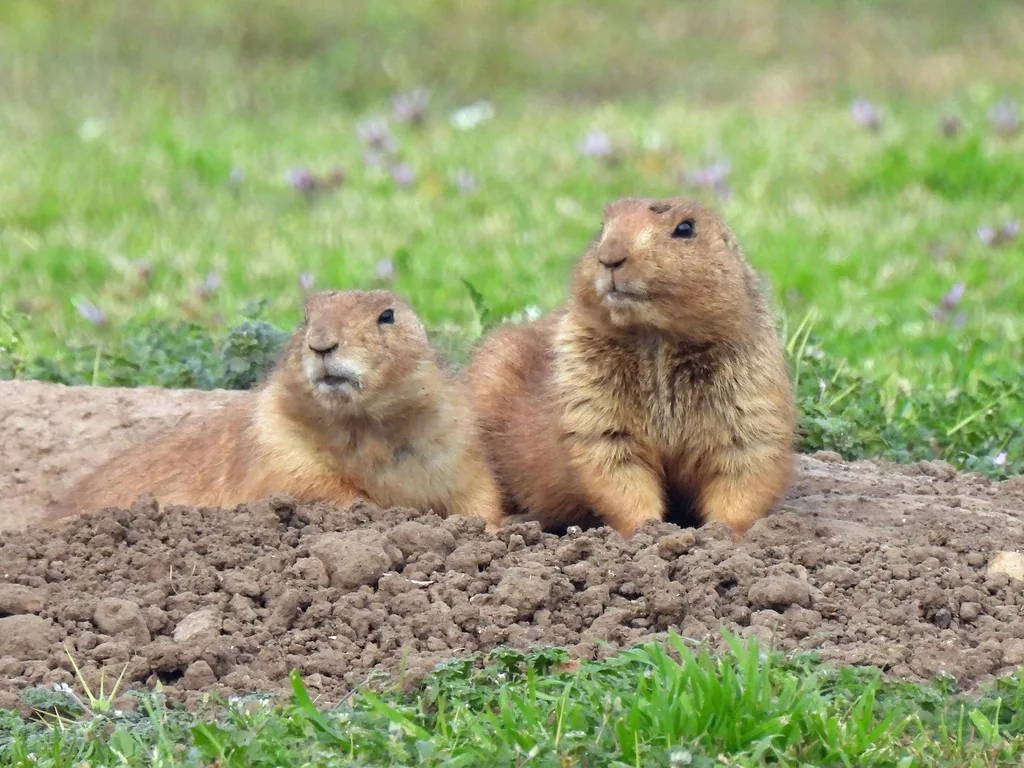
How to identify it
- A stocky, tan to reddish-tan ground squirrel weighing about 1 to 3 pounds, with large eyes, small ears, short legs and a black tip on the tail.[1][2]
- Lives in colonies with many burrow openings, each with a crater-like mound of soil that serves as a lookout.[1][2]
- Prairie dogs often sit upright at the burrow entrance, and a series of warning barks sends the whole colony underground.[1][2]
Look-alikes
| Look-alike | How to tell them apart |
|---|---|
| Ground squirrels | Prairie dogs are larger, stockier relatives that live in dense colonies of mounded burrows in Great Plains grassland.[1][2] |
| Pocket gophers | Prairie dogs are active above ground in daylight, feeding and keeping watch from the soil mounds around their open burrow entrances.[1][2] |
Where it lives
Five prairie dog species live in North America; the black-tailed prairie dog is the most common and is the only one in Kansas and Nebraska, where it occupies the western two-thirds of each state.[2][1]
Biology and life cycle
Colonies are made of family groups called coteries, usually one adult male, a few adult females and their young.[1][2]
They breed once a year in late winter; litters of about 3 to 8 pups are born in March or April and first come above ground at 5 to 6 weeks old.[1][2]
Burrows commonly run 3 to 14 feet deep and 10 to 100 feet or more long, with one to three entrances.[2][1]
They are active by day and stay somewhat active through winter, though they may stay underground during cold, cloudy spells; they are not true hibernators.[2][1]
They eat grasses, sedges and broadleaf plants, shift to seeds and roots in fall and winter, and get almost all the water they need from food.[1][2]
Yearling males disperse up to several miles, and a colony can expand its area by up to half in a year.[2][1]
Damage and signs
- They clip grass to less than an inch tall and graze year-round, which can cut forage for livestock and weaken desirable grasses over time.[1]
- Losses vary widely by site, rainfall and grazing history, and some studies found improved forage quality from regrowth, so effects are not always negative.[2][1]
- Near farms and homes they may eat sprouting corn and soybeans, and burrows near roads or dams can raise erosion and structural concerns.[1]
Health risk
CDC lists prairie dogs among the many animals that can be affected by plague, which people usually get from the bite of an infected rodent flea or by handling an infected animal.[3]
Control
Prevention
Manage grazing so grass stays tall: prairie dogs favor overgrazed areas, so fit stocking rates to the range, spread grazing pressure, and use rotational or deferred grazing.[1][2]
Move salt and minerals away from areas where livestock gather, since towns often start where cattle congregate.[1]
Traps and physical control
Shooting is selective but rarely eliminates a colony; use non-lead ammunition so eagles, hawks and other scavengers aren't poisoned.[1][2]
Pesticides
Zinc phosphide and anticoagulant baits such as chlorophacinone and diphacinone are registered for prairie dogs, but they are Restricted Use Pesticides for certified applicators and must follow strict label timing and placement.[1][2]
Burrow fumigants are usually saved for follow-up because they are labor-intensive and kill any animal in the burrow, including burrowing owls and endangered black-footed ferrets.[1][2]
When to call a professional
Local extension offices and USDA APHIS Wildlife Services can advise landowners, and in Nebraska Wildlife Services offers on-site help.[1]
Check for black-footed ferrets and burrowing owls first
The endangered black-footed ferret lives in prairie dog towns and eats almost nothing but prairie dogs, so inspect towns for ferret sign before control.[1][2]
Pre-control ferret surveys may be required in some cases, and the U.S. Fish and Wildlife Service can explain when and how to survey.[1]
Burrowing owls nest in prairie dog burrows; avoid fumigating occupied burrows, identified by white droppings, pellets and feathers at the entrance.[1][2]
What doesn't work
Visual barriers, live trapping, predator attraction and vacuuming or flooding burrows have proven costly, unreliable or both.[2][1]
Explosive devices are illegal in some states, and vehicle exhaust or anhydrous ammonia have worked poorly while endangering the person applying them.[1][2]
Legal status and plague precautions
Rules differ by state: Nebraska treats the black-tailed prairie dog as unprotected nongame, while Kansas requires a state permit to use burrow fumigants.[1][2]
Before walking through a town, put insect repellent on socks and pant cuffs and tuck pants into boots.[2]
Wear gloves when handling animals that might be infected, and ask your local health department how to dispose of dead animals.[4]
Common questions
- Do prairie dogs carry plague?
- They can. CDC lists prairie dogs among the animals affected by plague, mainly in the rural western U.S., and fleas spread it to people.[3]
- Can I just poison prairie dogs myself?
- Not as a typical landowner. Prairie dog baits and phosphide fumigants are Restricted Use Pesticides that require applicator certification.[1][2]
- Will removing prairie dogs bring my pasture back?
- Not by itself. Range recovery also needs mound leveling, rest from grazing and good long-term grazing management.[2][1]
Sources
- University of Nebraska-Lincoln Extension, “Prairie Dogs and Their Control, NebGuide G2101 (August 2011).” extensionpubs.unl.edu/publication/g2101/2011/html/view (accessed 2026-10-06). Co-authored with the director of USDA APHIS Wildlife Services in Nebraska.
- Kansas State University Research and Extension, “Prairie Dog Management, MF2702 (July 2019).” bookstore.ksre.ksu.edu/download/prairie-dog-management_MF2702 (accessed 2026-10-06)
- Centers for Disease Control and Prevention, “How Plague Spreads (updated May 15, 2024).” www.cdc.gov/plague/causes/index.html (accessed 2026-10-06)
- Centers for Disease Control and Prevention, “Preventing Plague (updated March 5, 2025).” www.cdc.gov/plague/prevention/index.html (accessed 2026-10-06)
- iNaturalist, “Cynomys ludovicianus taxon page (order and family).” www.inaturalist.org/taxa/46179 (accessed 2026-10-06)