The short answer
- Work out which squirrel you have. Gray and fox squirrels are active by day; flying squirrels are active only at night, and Virginia's wildlife agency says they are the most common squirrels in attics there.[5][6][8]
- Check for young before you close anything. ICWDM says young may be present from February through August, and the Pennsylvania Game Commission advises letting young leave a maternity den, a good bet being to wait until fall, before excluding the family.[4][11]
- Find the entry hole. ICWDM says gray and fox squirrels use holes about the size of a baseball, red squirrels a golf ball, and flying squirrels a quarter.[3]
- Let them out, don't let them back in: fit a one-way door or an 18-inch section of 4-inch plastic pipe over the main hole, pointing down at a 45-degree angle, after securing vents and chimneys.[4][6]
- Seal every other opening with sheet metal, aluminum flashing or heavy hardware cloth, and set a baited trap inside afterward in case a squirrel was shut in.[5][4][6]
- Trim tree limbs back 6 to 8 feet from the roof so squirrels can't jump on.[4][6]
- Check your state's rules before trapping. Some states, including New York and California, bar releasing a trapped squirrel elsewhere, and no poisons are registered for tree squirrels.[9][5][4]
Squirrel profiles
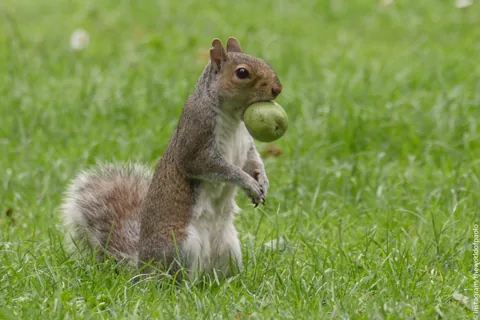 Tree squirrels (eastern gray and fox squirrels)
Sciurus species (shown: eastern gray squirrel, S. carolinensis)
Tree squirrels such as the eastern gray squirrel and fox squirrel are bushy-tailed, daytime rodents. Around homes they raid fruit, nuts and bird feeders, dig up lawns and gardens, and chew their way into attics.
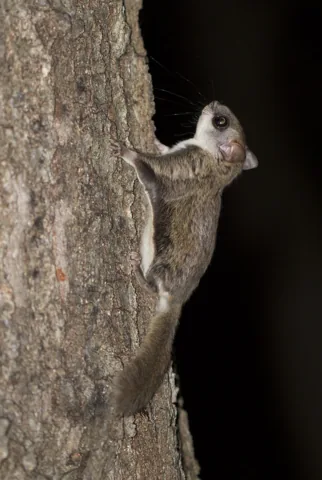 Southern flying squirrel
Glaucomys volans
The southern flying squirrel is a small, night-active squirrel that glides between trees on folds of skin. Most complaints come from homeowners with flying squirrels living in the house, where they get in through small holes around dormers, ridge vents, eaves and attic vents.
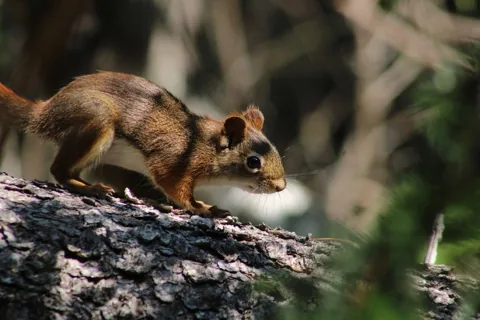 American red squirrel (pine squirrel)
Tamiasciurus hudsonicus
The American red squirrel is a small, rusty-red tree squirrel of conifer and mixed forests across the North and the mountains. It is noisy and territorial, and it can move into attics and other parts of buildings, sometimes filling them with stored pine cones.
Which squirrel is in your attic?
Penn State Extension says eastern gray squirrels and flying squirrels are usually the culprits when squirrels damage buildings. The species matters because it tells you when the squirrels come and go, how big the entry hole is, which traps work and what the law allows.[6]
- Eastern gray squirrel: usually gray with a white belly, though some are reddish and black ones are common in the north. ICWDM gives a length of 16 to 20 inches and a weight of 1¼ to 1¾ pounds; Penn State gives 16 to 24 inches and 15 to 24 ounces.[1][6]
- Fox squirrel: larger than a gray squirrel at 18 to 27 inches and about 1¾ to 2¼ pounds, per ICWDM, with very variable color; Penn State notes the tan belly versus the gray squirrel's white one. In California, UC IPM calls the introduced eastern fox squirrel by far the most serious tree squirrel pest of homes and gardens.[1][6][5]
- Red squirrel (pine squirrel): red-brown above and white below, often with a black stripe along the side and small ear tufts; Penn State gives 9 to 13 inches and 4 to 8 ounces. Red squirrels store food in one place, and ICWDM says it's not unusual to find trash-bag-sized piles of pine cones in attics or gutters.[1][6][2]
- Flying squirrels (southern and northern): small, soft gray-brown fur with white underparts, large dark eyes, a flat tail and a fold of loose skin between the front and hind legs that they glide on. Connecticut DEEP gives the southern flying squirrel 8 to 10 inches and 1.8 to 2.5 ounces; the northern is slightly larger and darker.[7][1]
- Day or night: tree squirrels other than flying squirrels are active by day, most active in early morning and late afternoon per UC IPM. Flying squirrels are the only squirrels active at night.[5][2][6]
- Groups: flying squirrels are highly sociable and den together, especially in harsh weather. Penn State notes that many mountain cabins have groups of flying squirrels living in closets and between walls.[7][6]
Signs of squirrels in the attic
- Noise at the hours the species is active: daytime scurrying and gnawing points to gray, fox or red squirrels, and noise after dark to flying squirrels.[5][6]
- Entry holes chewed in siding or under the eaves. Penn State says squirrels chew siding and eaves to make openings for nests, and UC IPM says that once they find even a small opening they can enlarge it by gnawing. Look at about the height of utility lines and fence tops, which they travel along.[6][5]
- Small holes around dormers, ridge vents, eaves and attic vents are the usual flying squirrel entries, per Connecticut DEEP.[7]
- Urine and droppings staining the siding below an attic vent where flying squirrels go in and out.[3]
- Nests of leaves and debris in soffits or the attic, and piles of pine cones from red squirrels.[2]
- Chewed insulation and chewed coverings on wires.[6][3]
- Squirrels on power lines next to the house; ICWDM notes they travel lines and can short out transformers.[3]
Birthing seasons and why timing matters
Closing up an attic while young squirrels are inside causes two problems: the young die in the attic, and the mother chews a new way in to reach them. Connecticut DEEP says adults can cause severe damage chewing to get back to their young, and ICWDM shows half-inch plywood gnawed through by a gray squirrel trying to reach hers.[7][4]
Squirrels are active all year and don't hibernate, so they can be dealt with any time they cause damage, but ICWDM warns against abandoning young during the period young may be present, which can run from February through August because some species mate twice a year.[5][4]
- Gray and fox squirrels: breed in mid-December or early January, and some breed again in June. Gestation is 42 to 45 days and litters average about 3. Penn State says gray squirrels usually have two litters of one to eight. Young are weaned at 10 to 12 weeks according to ICWDM, or after about two months according to Penn State, and begin exploring outside the nest around weaning.[2][6]
- Red squirrels: Penn State gives a breeding season of February through September, with two litters of one to seven young that disperse after nine weeks.[6]
- Flying squirrels: mate in late winter and again in summer, per Connecticut DEEP, with an average of three to four young after a 40-day gestation. The young can forage on their own by about six weeks old. Penn State says the young may stay with the mother through the winter.[7][6]
- In California, UC IPM says tree squirrels breed in late winter or spring and have one or two litters a year of three to five young, depending on species.[5]
- What to do with that: if you find squirrels in spring or summer, assume there may be young. The Pennsylvania Game Commission's advice for maternity dens of squirrels and other mammals is to let the young leave, waiting until fall if needed, and then block access to the den.[11]
- A quick check for activity: stuff a hole loosely with newspaper. UC IPM says squirrels still inside will push the plug out to get out; ICWDM uses the same test to tell whether a hole is in use.[5][4]
Step 1: Let them out with a one-way door or pipe excluder
A one-way door lets squirrels leave the attic but not get back in. ICWDM says one-way doors can work well when young are not a concern, and Penn State lists them as a way to let squirrels out and keep them from returning.[4][6]
- Secure vents and chimneys first, and close the other openings, so the evicted squirrel can't simply use a second entrance.[4]
- Pipe excluder: mount an 18-inch section of 4-inch plastic pipe over the opening, pointing down at a 45-degree angle. Penn State and ICWDM both describe this improvised excluder.[6][4]
- Commercial one-way doors: ICWDM recommends spring-loaded doors set in a large apron, at least 1 foot square, around the hole to cut down on chew-ins.[4]
- Expect chew-ins. ICWDM says some squirrels fight harder than others to get back in, and they may chew a new hole beside the door. One-way doors work best on a sound structure.[4]
- Watch the weather: freezing rain can freeze a door shut or open.[4]
- Smaller squirrels are easier: flying and red squirrels lack the jaw strength of larger squirrels, so they are easier to exclude.[4]
- Nudging them out: Penn State suggests watching where squirrels enter, putting a sticky polybutene deterrent near the entrance and lights in the attic, then excluding once they seem to have left. Virginia's wildlife agency says a radio playing talk or loud music in the attic may encourage squirrels to leave.[6][8]
Step 2: Seal the house
UC IPM says it is relatively easy to keep squirrels out of buildings, compared with keeping them out of a yard. The work is finding every gap: small gaps under the eaves, overlapping roof sections and knotholes, as well as the main hole. Where there's no obvious entrance, squirrels can gnaw their own way into an attic.[5]
- Materials: UC IPM lists sheet metal or 1/4-inch hardware cloth. Penn State and ICWDM say heavy 1/2-inch wire mesh, and ICWDM adds aluminum flashing.[5][6][4]
- Chimneys: ICWDM lists installing chimney caps.[4]
- Don't seal a squirrel in. ICWDM says trapped squirrels may do a great deal of damage chewing out. After closing openings, put a baited trap inside as a precaution; Penn State calls this last step very important.[4][6]
- If chewing persists at a sealed spot, Connecticut DEEP suggests temporarily covering the area with heavy, half-inch wire mesh.[7]
- Fix what invites them. The Pennsylvania Game Commission lists warped or loose soffits or siding, open unscreened attic windows and missing chimney caps among the features that draw wildlife to a house.[11]
Step 3: Cut off the routes onto the roof
- Trim tree limbs to 6 to 8 feet from buildings so squirrels can't jump onto the roof, and cut back ivy and other plants they climb.[4][6]
- Isolated trees: a 2-foot-wide metal collar wrapped around the trunk 6 feet off the ground keeps squirrels from climbing it. Fasten it with wires held by springs so the tree can grow.[4][6]
- Wires: 2-foot sections of lightweight 2- to 3-inch plastic pipe, slit and slipped over a wire, spin and tumble squirrels off. ICWDM says never to put these guards on or near electrical lines; only electricians and power company workers should handle power lines, and the power company should be asked before anything goes on a pole.[4][6]
- Bird feeders: ICWDM lists removing them, and Virginia's wildlife agency suggests placing feeders at least 15 feet from anything squirrels can jump from, with a metal baffle on the post.[4][8]
Trapping: what works and what the law allows
Trapping removes the squirrels that are there, but it doesn't keep others out. Connecticut DEEP says trapping can solve a persistent problem only temporarily because other squirrels soon move in, and UC IPM says new squirrels fill the gap. Pair trapping with sealing.[7][5]
- Cage traps: ICWDM recommends cage or box traps of at least 5 x 5 x 18 inches, with 1/2- x 1-inch mesh to limit damage from a trapped squirrel. Secure traps so they can't fall, since most will be off the ground.[4]
- Placement and numbers: put traps near den holes or on travel routes rather than relying on bait. ICWDM suggests at least 3 traps for gray and fox squirrels and 5 or more for smaller species.[4]
- Pre-bait: Penn State says to tie the doors open for two to three days so squirrels get used to feeding in the traps; UC IPM says to bait without setting for several days.[6][5]
- Baits: orange and apple slices, shelled walnuts or pecans, and peanut butter, or familiar foods like corn and sunflower seeds. ICWDM says nuts rarely work in fall when natural food is plentiful.[6][4]
- Check traps often: Penn State says twice daily, morning and evening; the Pennsylvania Game Commission requires traps to be checked daily.[6][11]
- Snap traps: ICWDM says rat-sized snap traps are very effective on red and flying squirrels, used indoors or in boxes where birds can't reach. UC IPM says rat snap traps are often not strong enough to kill mature tree squirrels and are best not used on them.[4][5]
- Kill traps for larger squirrels must be set so they don't catch pets or other animals. UC IPM suggests placing them in a tree, on a rooftop, or inside a box with entrances no larger than 3 inches across.[5]
- Not recommended: ICWDM advises against glue traps and against foothold traps because of the risk to other animals and humaneness concerns.[4]
- Handling: UC IPM says to wear rubber, latex, nitrile or plastic gloves to handle dead squirrels and to seal them in a plastic bag to contain fleas and other parasites.[5]
State rules on trapping and relocating squirrels
Rules differ a lot by state and by species. ICWDM says fox and gray squirrels are usually game animals, that trapping permits may be required from the state wildlife agency, and that it typically isn't legal to kill flying squirrels or tassel-eared squirrels. Check with your state wildlife agency before you trap. These examples show how far the rules vary:[1][4]
- New York: DEC says it is illegal to move a trapped animal off your property; you can't release it in a park, on state land or anywhere but where it was caught. To have an animal removed, DEC says to contact a licensed Nuisance Wildlife Control Operator. Red and flying squirrels may be taken when they are a nuisance; gray, black and fox squirrels need a DEC permit if they are only a nuisance but may be taken if they are damaging property, and outside hunting season the animal must be buried or cremated immediately.[9]
- California: tree squirrels are game mammals. UC IPM says eastern fox squirrels damaging property can be controlled by the owner or tenant without a permit, gray squirrels need a California Department of Fish and Wildlife permit, releasing any tree squirrel elsewhere is illegal without a CDFW permit, and poison baits are illegal for all tree squirrels.[5]
- Pennsylvania: the Game Commission says landowners should contact their region office before trapping nuisance wildlife, traps must be checked daily, live wildlife may be relocated to a natural setting but not kept, sold or given away, and any wildlife killed must be reported. Penn State Extension says a squirrel removed from a building may be released in the yard once the entry holes are closed.[11][6]
- Missouri: the Department of Conservation says property owners may trap most damage-causing wildlife on their own property without a permit, must report animals taken to the Department within 24 hours, and does not recommend relocation. Its reasons: moving animals can spread disease, a strange squirrel can upset the local squirrel population, a relocated animal may starve because it doesn't know where to find food, and you may simply create a problem for someone else.[10]
- Virginia: the Department of Wildlife Resources says no kill permit from the agency is needed when a landowner kills squirrels for their own use during the closed season, and refers people to their county or city Commonwealth's Attorney's office for legal removal methods, noting that local ordinances are usually stricter than state law.[8]
- Most federal, state and local agencies bar releasing wildlife on land they own or manage, according to Missouri's Department of Conservation.[10]
Repellents and scare devices: weak evidence
The sources give repellents and scare devices little credit against squirrels, and no toxicants are registered for tree squirrels.[4][6][5]
- Mothballs (naphthalene): ICWDM says naphthalene may temporarily discourage squirrels in attics and enclosed spaces, but it is not recommended in the attics of occupied buildings because it can cause people severe distress.[4]
- Registered repellents: UC IPM calls their effectiveness questionable. Penn State says taste repellents with denatonium saccharide have had very limited success, and that capsaicin repellents vary depending on what other food is available.[5][6]
- Sticky polybutene coatings can keep squirrels from climbing railings and downspouts and are best used to stop gnawing; they are messy, so ICWDM and Penn State recommend masking tape underneath.[4][6]
- Lights and noise: UC IPM says tree squirrels get used to visual and sound frightening devices and ignore them after a couple of days. ICWDM says no frightening devices are proven, though strobe lights show some promise.[5][4]
- Poison: none is registered for tree squirrels, per ICWDM and Penn State, and UC IPM says poison baits are illegal for all tree squirrels in California.[4][6][5]
Damage, fire risk and disease
- Wiring and fire: Penn State says nesting squirrels chew insulation and the insulation around wires, which is dangerous because bare wires may cause a fire. ICWDM also says squirrels chewing on electrical lines can lead to fires.[6][3]
- Structure: ICWDM says that if left long enough, squirrel gnawing can weaken rafters.[3]
- Power outages: squirrels travel power lines and can short out transformers. ICWDM cites 177 squirrel-caused outages in Lincoln, Nebraska, in 1980, 24% of all outages.[3][4]
- Parasites and disease: UC IPM says tree squirrels carry diseases such as tularemia and ringworm that can spread to people, and are often infested with fleas and mites.[5]
- Flying squirrels and typhus: CDC says rare US cases of epidemic typhus, called sylvatic typhus, occur when people are exposed to flying squirrels and their nests. CDC advises avoiding contact with flying squirrels and their nests and telling your healthcare provider about that contact if you get sick.[12]
- Pets: ICWDM says squirrels don't pose a threat to pets.[3]
A squirrel stuck in the chimney
During mating season, males searching for females often fall into chimneys and can't climb the smooth flue tiles. ICWDM says a squirrel trapped in a chimney rarely survives more than 3 days and that the noise drops as it weakens.[4]
- Give it a rope: Connecticut DEEP suggests lowering a heavy rope down the chimney so the squirrel can climb out, with the other end dropped to the ground so you don't need a second trip to the roof. ICWDM describes a 1-inch-thick hemp rope hung in the flue; it works only if the squirrel is healthy enough to climb.[7][4]
- Don't open the damper into the room: Connecticut DEEP says not to remove a squirrel through the fireplace because it may escape into the room. ICWDM's alternative is to close off the fireplace opening, set a baited trap and then open the damper, wearing a cap, safety glasses, a dust mask and heavy gloves because of the risk of bites.[7][4]
- Once the squirrel is out, fit a chimney cap, which ICWDM lists among its exclusion steps.[4]
When to hire a wildlife control operator
Penn State says licensed wildlife pest control operators work throughout Pennsylvania and most will trap and remove squirrels for homeowners. Consider one when:[6]
- Your state doesn't let you move the animal: New York DEC says to contact a licensed Nuisance Wildlife Control Operator when a wild animal needs removing from your property.[9]
- The squirrels are flying squirrels or another species you may not be allowed to kill, per ICWDM's note on legal status.[1]
- Young may be in the attic and you can't wait for them to leave, or a squirrel is stuck in a chimney, where ICWDM notes the main risk of removal is being bitten.[4][11]
- Foothold or body-gripping traps seem needed: Missouri's Department of Conservation says most people lack the skill to use these properly and suggests asking the local conservation agent for a trapper referral.[10]
- You need help finding one: Connecticut DEEP's Wildlife Division gives referrals to licensed Nuisance Wildlife Control Operators, and in other states the wildlife agency or county extension office is the place to ask.[7][6][4]
Common questions
- When is the best time to get squirrels out of the attic?
- When no young are in the nest. ICWDM says young may be present from February through August, and the Pennsylvania Game Commission advises letting young leave a maternity den, waiting until fall if needed, before you block access.[4][11]
- Will a one-way door work on squirrels?
- Often, if the rest of the house is sealed first and no young are inside. ICWDM recommends a spring-loaded door with an apron at least 1 foot square, warns that some squirrels chew a new hole beside it, and says flying and red squirrels are easier to exclude than gray and fox squirrels.[4]
- Can I trap a squirrel and release it somewhere else?
- It depends on your state, and often the answer is no. New York forbids moving trapped animals off your property, California forbids releasing tree squirrels elsewhere without a permit, and Missouri's conservation department recommends against relocation even though Pennsylvania allows release in a natural setting.[9][5][10][11]
- Do mothballs or ultrasonic devices get rid of squirrels?
- Not reliably. ICWDM says naphthalene may discourage squirrels only temporarily and isn't recommended in the attics of occupied homes because of its effect on people. UC IPM says squirrels get used to sound and visual scare devices within a couple of days.[4][5]
- Are squirrels in the attic dangerous?
- They can be. Squirrels chew wire insulation, and Penn State and ICWDM say this can lead to fires. CDC links rare cases of sylvatic typhus to contact with flying squirrels and their nests, and UC IPM says tree squirrels can carry tularemia and ringworm.[6][3][12][5]
Photo credits
- Tree squirrels (eastern gray and fox squirrels): (c) Paolo Zucca, some rights reserved (CC BY) — via iNaturalist, CC BY 4.0
- Southern flying squirrel: (c) Kristof & Yulia, some rights reserved (CC BY) — via iNaturalist, CC BY 4.0
- American red squirrel (pine squirrel): (c) oksanaetal, some rights reserved (CC BY) — via iNaturalist, CC BY 4.0
Sources
- Internet Center for Wildlife Damage Management, “Tree Squirrels: Identification.” icwdm.org/species/rodents/tree-squirrels/ (accessed 2026-11-10)
- Internet Center for Wildlife Damage Management, “Tree Squirrel Biology.” icwdm.org/species/rodents/tree-squirrels/tree-squirrel-biology/ (accessed 2026-11-10)
- Internet Center for Wildlife Damage Management, “Tree Squirrel Damage Identification.” icwdm.org/species/rodents/tree-squirrels/tree-squirrel-damage-identification/ (accessed 2026-11-10)
- Internet Center for Wildlife Damage Management, “Tree Squirrel Damage Prevention and Control Methods.” icwdm.org/species/rodents/tree-squirrels/tree-squirrel-damage-prevention-and-control-methods/ (accessed 2026-11-10)
- University of California Statewide IPM Program, “Pest Notes: Tree Squirrels.” ipm.ucanr.edu/home-and-landscape/tree-squirrels/ (accessed 2026-11-10)
- Penn State Extension, “Tree Squirrels.” extension.psu.edu/tree-squirrels (accessed 2026-11-10)
- Connecticut Department of Energy and Environmental Protection, Wildlife Division, “Flying Squirrels (Wildlife in Connecticut fact sheet).” portal.ct.gov/-/media/deep/wildlife/pdf_files/outreach/fact_sheets/flysqrlpdf.pdf (accessed 2026-11-10)
- Virginia Department of Wildlife Resources, “Problems with Squirrels.” dwr.virginia.gov/wildlife/nuisance/squirrels/ (accessed 2026-11-10)
- New York State Department of Environmental Conservation, “Remove or "Take" Nuisance Animals Legally.” dec.ny.gov/nature/animals-fish-plants/nuisance-wildlife-species/remove-take-legally (accessed 2026-11-10)
- Missouri Department of Conservation, “Wildlife Control Guidelines.” mdc.mo.gov/wildlife/nuisance-problem-species/wildlife-control-guidelines (accessed 2026-11-10)
- Pennsylvania Game Commission, “Nuisance Wildlife.” www.pgc.pa.gov/Wildlife/Pages/NuisanceWildlife.aspx (accessed 2026-11-10)
- U.S. Centers for Disease Control and Prevention, “About Epidemic Typhus.” www.cdc.gov/typhus/about/epidemic.html (accessed 2026-11-10)