The short answer
- Time it right. In Ohio the ideal periods are April 1 to May 15 and August 1 to October 15; New Jersey allows exclusions April 1 to 30 and August 1 to October 15; Wisconsin bars them from June 1 through August 15.[1][3][4]
- Find every exit by watching the building at sunset or just before sunrise for several nights. Guano piled on the ground below an opening, and stains from bats' body oils, help.[4][5][9]
- Over each active exit, hang lightweight plastic netting with mesh 1/6 inch or smaller, fastened at the top and sides, open at the bottom and extending at least 2 feet below the hole, or fit a tube.[4][2]
- Leave the one-way doors up 5 to 7 days, because not all bats leave every night, then remove them and seal the openings the same day. Seal every gap: Delaware says bats need only 1/8 inch to get back in, and the CDC says they fit through openings as small as 1/4 inch.[2][1][9][5]
- Never seal bats in, and don't use glue traps, poisons, foggers or trap-and-relocate. Bats are protected by law, and some species are endangered.[1][3][2][6]
- If anyone may have touched a bat or woken up with one in the room, don't release it. Call your local health department first; the CDC says bat bites can be tiny enough to miss and that a bat found in the home should be captured for rabies testing.[9][12]
Related pest profiles
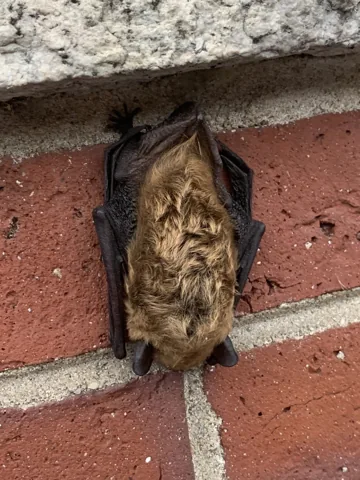 Bats (big brown bat and little brown bat)
Eptesicus fuscus and Myotis lucifugus (shown: big brown bat)
Bats are flying, insect-eating mammals that sometimes roost in attics, walls and other parts of buildings. They are valuable insect eaters, but colonies leave droppings and odor, and any bite or bare-hand contact is a potential rabies exposure.
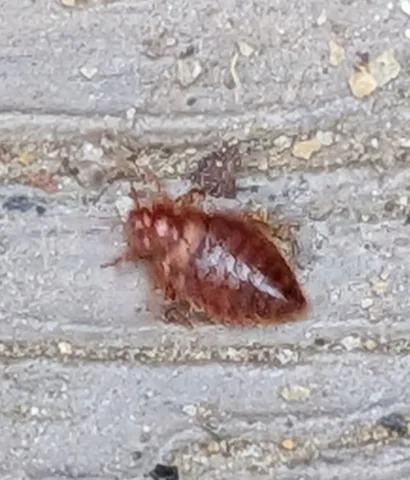 Bat Bugs
Cimex adjunctus (eastern bat bug) and Cimex pilosellus (western bat bug)
Bat bugs are close relatives of bed bugs that feed on the blood of roosting bats. They turn up in homes that have bats in the attic or walls, and they may bite people when the bats leave or are shut out.
Why exclusion is the only real fix
Bats aren't rodents and won't chew their way in; they use existing openings. Killing the bats you find doesn't solve the problem, because the rest, and future bats, will keep getting in until every access point is found and sealed. ICWDM calls eviction followed by exclusion the gold standard for getting bats out of buildings and keeping them out.[4][7]
Trapping and relocating doesn't work either. Bats have a strong homing instinct and return to their roost, and trapping can kill them if traps are left unattended or get overcrowded. Ultrasonic devices, chemical repellents and smoke don't evict bats or give a permanent solution. UC IPM says all ultrasonic sound generators that have been tested proved ineffective at repelling bats.[2][5][7]
Bats are protected. All of Ohio's bat species are protected by law, four are state-endangered, and the state reports bat population declines of over 90 percent since white-nose syndrome appeared; Ohio makes it illegal to kill a bat unless a bite or possible rabies exposure has occurred. New Jersey protects all its native nongame wildlife and says no lethal means should be used on any bats. Federally, the northern long-eared bat and the Indiana bat are listed as endangered, and other species are listed state by state, so ICWDM advises learning your federal and state rules before doing anything to bats.[1][3][6]
Bats are worth keeping nearby. A single bat can eat 1,000 or more mosquito-sized insects in an hour, and Wisconsin's bat program recommends giving an evicted colony a bat house so it stays nearby.[4]
When you can exclude bats
Two seasons are off limits. In early summer, mothers leave the roost at night but their flightless young stay behind, so an exclusion starves the pups, and mothers trying to get back to them can find their way into living spaces. In winter, bats hibernating in a building may die if they leave in freezing weather and can't get back to their shelter.[1][3][2][4][7][5]
- Ohio: restricted from May 16 through July 31 when five or more bats are present, and from October 15 through March 31 if any bats are present. Exclusion during those periods needs written permission from the Division of Wildlife; the ideal periods are April 1 to May 15 and August 1 to October 15.[1]
- New Jersey: exclusions only from April 1 to 30 and from August 1 to October 15, and none from May 1 to July 31 while nursery colonies are active. A second restriction runs from October 16 to March 31 to protect bats that overwinter in buildings; exclusion can go ahead then only if bats are shown to be absent.[3]
- Delaware: no complete exclusions from May 15 to August 31, and especially not in May and June. September and October are the best time; in winter, exclude only if you can confirm no bats are hibernating inside.[2]
- Wisconsin: no bat exclusions from June 1 through August 15.[4]
- General guidance where no state rule applies: ICWDM says eviction generally should not be attempted between May 15 and August 15, nor in winter in buildings used for hibernation. UC IPM puts the flightless-young period at usually May through September in California and calls winter, after most bats have left, an ideal time. The CDC calls fall and winter the best times and warns against trapping young bats inside if you work between May and August.[7][5][9]
- Elsewhere, check with your state wildlife agency before you start; the four states above set different dates and permit rules.[1][3][2][4]
Any time of year: block the way into living space
You don't have to wait to keep bats out of the rooms you live in. Ohio allows interior routes, such as an attic access into a bedroom, to be sealed at any time without a permit. New Jersey calls sealing or screening gaps under the attic door, vents and other openings in floors, ceilings and walls the most important step during the restricted season, and Delaware says exclusion from the living space can and should be done at any time of year.[1][3][2][7][12]
What that looks like: seal around the attic door, add weather stripping or a draft guard under it, caulk and flash gaps, and screen vents. ICWDM suggests treating attic and basement doors whenever the gap is more than 1/4 inch, and the CDC lists screens, chimney caps and draft guards on attic doors.[12][7][9]
If bats may be hibernating in the building, a visual check isn't enough to rule them out. New Jersey describes acoustic detectors left in the roost for at least 3 straight weeks, and Delaware advises planning the exclusion for early spring, once it's warm enough for bats to hunt insects but before births, which there means before May 15.[3][2]
Step 1: Find every opening
At sunset or just before sunrise, put one or more people around the house where they can see the whole structure without turning their heads, because bats exit and fly off in seconds. Watch for several nights to catch all or most of the exits. The New Jersey Department of Health suggests watching from half an hour before until half an hour after sundown, and the CDC suggests counting the bats as they leave.[4][12][9]
Check the usual entry spots: corners, eaves, louvers, loose siding, window air conditioners, loose or damaged screens, ridge caps, flashing, peeling shingles, fascia boards, soffits, windowsills, chimneys and the gap between house and chimney. UC IPM adds air and plumbing vents, loose boards, roof caps and holes that squirrels or other animals have made.[4][5]
Look down as well as up. Guano concentrated on the ground next to the foundation often marks an opening above it, and bats' body oils stain the main access points, though the staining isn't always obvious. ICWDM also lists rub marks and odor. UC IPM notes that bat droppings crumble easily and show shiny bits of insect, unlike mouse droppings, and are never white or chalky like bird droppings.[4][7][5]
Finding every opening can take a second season of watching, and not all bats leave the roost every night.[4][2]
Step 2: Seal the secondary gaps
Seal the unused and secondary cracks and holes on the outside before installing one-way doors, leaving open only the exits the bats are using. Delaware recommends bat-proofing the whole structure during the job rather than treating only the obvious exits.[3][2][7]
Use caulk, wood or other construction materials suited to the gap. Agencies give different minimum gaps, so seal small cracks too: Delaware says bats need only 1/8 inch to get back in, the CDC and UC IPM say 1/4 inch, the New Jersey Department of Health says 3/8 of an inch, and New Jersey's wildlife agency says a half-inch crack or a hole smaller than a nickel.[2][3][9][5][12]
ICWDM's sealing target, apart from the holes bats are actively using, is every gap of 1/4 by 1 1/2 inches and every opening 5/8 by 7/8 inch or larger. It lists caulk for gaps up to 0.4 inch, plus flashing, screening, weather stripping, knitted-wire mesh and oakum. The CDC suggests steel wool or caulk around electrical and plumbing holes and caulking anything larger than a dime.[7][9]
Spray foam is where the sources split. Delaware doesn't approve spray foam insulation as a sealant in most situations, because bats that touch it can be injured or die, and it should never be used while bats are present. ICWDM lists self-expanding foam for openings larger than 3 inches, applied carefully so it doesn't lift siding or shingles, and UC IPM and New Jersey list foam among the materials for sealing once the bats are out.[2][7][5][3]
Chimneys: ICWDM suggests enclosing the top of the flue with a rust-resistant spark arrester or pest screen that is not screwed down, so it can come off fast in a chimney fire, and checking fire codes first. UC IPM suggests 1/2-inch or smaller welded wire mesh and checking local spark-arrester rules with the fire department.[7][5]
Closing the secondary openings while bats still come and go through a main entrance isn't an exclusion by itself. Ohio counts only devices or materials that let bats out one way.[1]
Step 3: Install one-way doors
Put a one-way door on every active exit.[2][7]
- Netting: use lightweight plastic (polypropylene) netting with mesh 1/6 inch or smaller. Cover the opening completely and let the netting hang at least 2 feet below it. Fasten the top and side edges to the building with staples or duct tape, and leave the bottom edge open.[4][2]
- Tension: you should be able to slide your hand into the open bottom, but the netting shouldn't be so loose that bats can easily crawl back up under it.[4]
- Sizes differ between agencies. Wisconsin and Delaware use netting with mesh 1/6 inch or smaller, while UC IPM describes 1/2-inch polypropylene bird netting. For length, Wisconsin says at least 2 feet below the hole, UC IPM says attach it 12 inches above the exit and let it extend 12 inches past the sides and bottom, and ICWDM says about 3 feet below the lowest exit, standing 3 to 5 inches out from the wall.[4][2][5][7]
- Don't lay the netting flat against the wall: ICWDM says that stops bats getting out, and UC IPM says the bottom must hang free so bats can drop down and leave. UC IPM also suggests netting or fabric that lets light through, so the bats can still see their exit.[7][5]
- Plastic sheeting can be hung the same way as netting.[4][2][9]
- Tubes: for a small or oddly shaped hole, insert a piece of PVC pipe about the size of a caulk tube into the opening and seal around the outside of the pipe, so the only way out is through it. UC IPM describes a 2-inch plastic pipe with a tube of collapsible material such as plastic tarp attached to its end, so returning bats can't fly back in.[4][5]
Step 4: Wait, then seal
Leave the one-way doors in place 5 to 7 days; Ohio requires at least a week. Not all bats leave the roost each night, and the wait helps make sure they're all out. Other agencies set different minimums: New Jersey a week that includes at least 3 nights in a row above 50°F with winds below 10 mph and no steady rain, UC IPM 7 days, and ICWDM at least 3 to 5 days, longer in rainy weather.[2][1][4][3][5][7]
New Jersey says to watch the exits at dusk on the last night before sealing to confirm that all the bats have gone.[3]
If bats are still present after that, look for other exits and repeat the process for them.[2]
Once all the bats are out, remove the devices and seal the entrances the same day, so bats can't get back in.[1]
Don't skip the one-way doors by waiting for bats to fly out for the night and then sealing up. That often traps adults or young inside.[2]
After the bats are out
Put up a bat house. Evicted bats look for another roost nearby, sometimes a neighbor's home, and a bat box installed before the exclusion gives them time to find it. For a fall exclusion, Wisconsin's bat program suggests installing it a year ahead or at the start of summer. ICWDM suggests putting it up a few months to a year before the exclusion and near the old roost.[3][4][2][7]
Don't count on a bat house too heavily. ICWDM says there's no guarantee bats will use one, though research shows they can be occupied during and after an eviction. UC IPM says bat houses aren't likely to keep bats out of nearby buildings, can stay empty for a year or more, and haven't been clearly shown to cut garden insect problems.[7][5]
Tell your neighbors. The CDC notes that bat-proofing can lead to more bat sightings nearby, and ICWDM points out that excluded bats may move to another building close by.[9][7]
Clean up the guano with care. Wisconsin's program advises a face mask and gloves, washing all clothes and equipment afterward, or hiring a professional cleaning service. For a large buildup, our droppings cleanup guide covers respirators and wet cleanup. ICWDM adds that cleanup goes along with exclusion and doesn't replace it.[4][8]
Parasites left behind soon die without their hosts. Delaware says chemicals can't be used on bats or where bats haven't been properly excluded; insecticides for leftover pests come only after the exclusion is complete.[5][2]
What not to do
- Don't seal entry points while bats are inside, and don't use glue traps, chemicals, toxicants or foggers on bats; Ohio makes all of these illegal. ICWDM notes that no toxicants are registered for controlling bats.[1][7]
- Don't put glue boards or fly paper anywhere bats might touch them. A bat found alive on a glue trap may still have wing damage that keeps it from flying.[3][12]
- Don't trap and relocate bats; they return to their roost.[2][7][8]
- Don't count on ultrasonic devices, repellents or smoke.[2][5][7]
- Don't rely on mothballs. Naphthalene is the only repellent the EPA has registered for indoor bat control, but ICWDM says bats return when the odor fades and breathing the vapor for long periods may be hazardous, the New Jersey Department of Health calls it no substitute for bat-proofing, and UC IPM says no pesticides or chemical repellents are registered for bats in California.[7][12][5]
- Don't shoot bats. ICWDM says it isn't practical and is illegal in many states.[7]
- Don't use spray foam where bats could still be present.[2]
A single bat in the house
A single bat in a living area can be caught and released outside near where it was found at any time of year. Delaware says most single bats in a house, especially in July and August, are young bats just learning to fly that lost their way. UC IPM likewise describes a bat flying in living space as usually a lost young one trying to get out.[2][5]
Stay calm and keep it in sight. UC IPM and ICWDM suggest closing it into one room, shutting other doors, and opening windows or outside doors so it can leave on its own; New Jersey says that usually takes under 15 minutes.[5][8][3]
If it lands, put on leather gloves, cover it with a box, coffee can or plastic container, and slide a piece of cardboard or a lid underneath. New Jersey's wildlife agency suggests gently brushing a sick or injured bat that is crawling on the ground into a coffee can with air holes punched in the lid.[5][8][3]
To release it, ICWDM suggests a tree or other surface at least 5 feet off the ground on the same property, and New Jersey says an elevated spot or the base of a tree, because bats have trouble taking off from the ground. A bat found sluggish in cool weather may be torpid rather than sick; UC IPM says to let it warm up in a covered container before releasing it, which can take an hour or more.[8][3][5]
Release only when nobody could have had contact with it. The rabies steps below come first.[9][12]
If a bat may have touched someone
In the United States bats are the most commonly reported rabid animal, and the CDC says at least 7 in 10 people who die of rabies here were infected by bats. The New Jersey Department of Health says fewer than 1 percent of bats carry rabies, but because bat bites can be small and hard to find, it says to avoid contact with any bat, even one acting normally.[9][11][12]
Never touch a bat with bare hands. If you know you were bitten or scratched, wash the wound with soap and water and get medical help right away; the CDC's rabies prevention page says to wash for 15 minutes. If bat saliva gets into the eyes, nose, mouth or an open wound, the CDC says to see a health care provider urgently.[9][10][12]
Don't release the bat until you've talked with a public health expert. The CDC says to call animal control or your health department to capture a bat found in the home for testing, and to report any contact with a bat to the health department to find out whether you need care. The New Jersey Department of Health says to consult the health department and have the bat tested when it may have bitten, scratched or touched a person or pet, or was in a room where someone was sleeping. That is stricter than the wildlife agencies' release advice above, which assumes no one had contact.[9][12]
Capture the bat without damaging its head, so it can be tested, using heavy gloves and a securely covered container, and let the health department arrange testing. The New Jersey Department of Health says post-exposure rabies treatment should be considered after any physical contact with a bat when a bite, scratch or saliva contact can't be ruled out.[12][9]
If your dog or cat tangled with a bat, follow the same steps and call the health department. Keeping pets up to date on rabies vaccination is the best protection.[12][10]
Common questions
- Can I just seal the holes at night after the bats fly out?
- No. Not all bats leave each night, and sealing without one-way doors often traps adults or young inside; in Ohio it's illegal to seal all the exits while bats are inside.[2][1]
- How long do one-way doors need to stay up?
- Five to seven days in Delaware's and Wisconsin's guidance, and at least a week in Ohio and New Jersey; UC IPM says 7 days and ICWDM at least 3 to 5, longer in wet weather. If bats are still there, look for more exits and repeat.[2][4][1][3][5][7]
- Will bats chew a new way in after I seal up?
- No. Bats use only existing openings, but once the main entries are closed they may try other holes, so seal every gap they could use. Delaware says they need only 1/8 inch; the CDC and UC IPM say 1/4 inch.[4][2][9][5]
- What kind of netting should I use for a one-way door?
- Lightweight plastic netting or plastic sheeting, hung loose with the bottom open. Wisconsin and Delaware specify polypropylene netting with mesh 1/6 inch or smaller, UC IPM describes 1/2-inch bird netting, and the CDC says plastic sheeting or bird netting. Let it hang well below the hole: at least 2 feet in Wisconsin's guidance, about 3 feet in ICWDM's.[4][2][5][9][7]
- I woke up with a bat in my bedroom. What should I do?
- Don't release it. Close the door, capture it if you can do so safely with gloves and a container, and call your local health department. The New Jersey Department of Health says the bat should be tested when it was in a room where people were sleeping, and the CDC says not to release a bat found in the home until you've talked with a public health expert.[12][9]
Photo credits
- Bats (big brown bat and little brown bat): (c) Thomas Irvine, some rights reserved (CC BY) — via iNaturalist, CC BY 4.0
- Bat Bugs: (c) Jason Hill, some rights reserved (CC BY) — via iNaturalist, CC BY 4.0
Sources
- Ohio Department of Natural Resources, Division of Wildlife, “Bat Exclusion Guidelines.” dam.assets.ohio.gov/image/upload/ohiodnr.gov/documents/wildlife/permits/Bat-Exclusion-Guidelines.pdf (accessed 2026-11-10)
- Delaware Department of Natural Resources and Environmental Control, Division of Fish and Wildlife, “Best Management Practices for Bat Exclusions (December 2010).” documents.dnrec.delaware.gov/fw/conservation/bats/Best%20Management%20Practices%20for%20Bat%20Exclusions%20-%20Dec%202010.pdf (accessed 2026-11-10)
- New Jersey Division of Fish and Wildlife, Endangered and Nongame Species Program, “Nuisance Wildlife Control Guidelines for Bats (updated February 13, 2019).” nj.gov/dep/fgw/ensp/pdf/bat_control.pdf (accessed 2026-11-10)
- Wisconsin Bat Program, Wisconsin Department of Natural Resources, “Bat Exclusion: A Proven Solution (method used by the Wisconsin Bat Program).” www.wiatri.net/inventory/bats/aboutBats/pdf/BatExclusion.pdf (accessed 2026-11-10). The wiatri.net bat program pages now point to dnr.wisconsin.gov.
- University of California Statewide IPM Program, “Pest Notes: Bats (Publication 74150).” ipm.ucanr.edu/home-and-landscape/bats/ (accessed 2026-11-10)
- Internet Center for Wildlife Damage Management, “Bats.” icwdm.org/species/bats/ (accessed 2026-11-10)
- Internet Center for Wildlife Damage Management, “Bat Damage Prevention and Control Methods.” icwdm.org/species/other-mammals/bats/bat-damage-prevention-and-control-methods/ (accessed 2026-11-10)
- Internet Center for Wildlife Damage Management, “Bat Handling.” icwdm.org/species/other-mammals/bats/bat-handling/ (accessed 2026-11-10)
- U.S. Centers for Disease Control and Prevention, “Preventing Rabies from Bats.” www.cdc.gov/rabies/exposure/animals/bats.html (accessed 2026-11-10)
- U.S. Centers for Disease Control and Prevention, “Rabies Prevention and Control.” www.cdc.gov/rabies/prevention/index.html (accessed 2026-11-10)
- U.S. Centers for Disease Control and Prevention, “About Rabies.” www.cdc.gov/rabies/about/index.html (accessed 2026-11-10)
- New Jersey Department of Health, “What You Should Know About Bats (revised April 2014).” www.nj.gov/health/cd/documents/topics/rabies/what_to_know_about_bats--REV--04152014.pdf (accessed 2026-11-10)