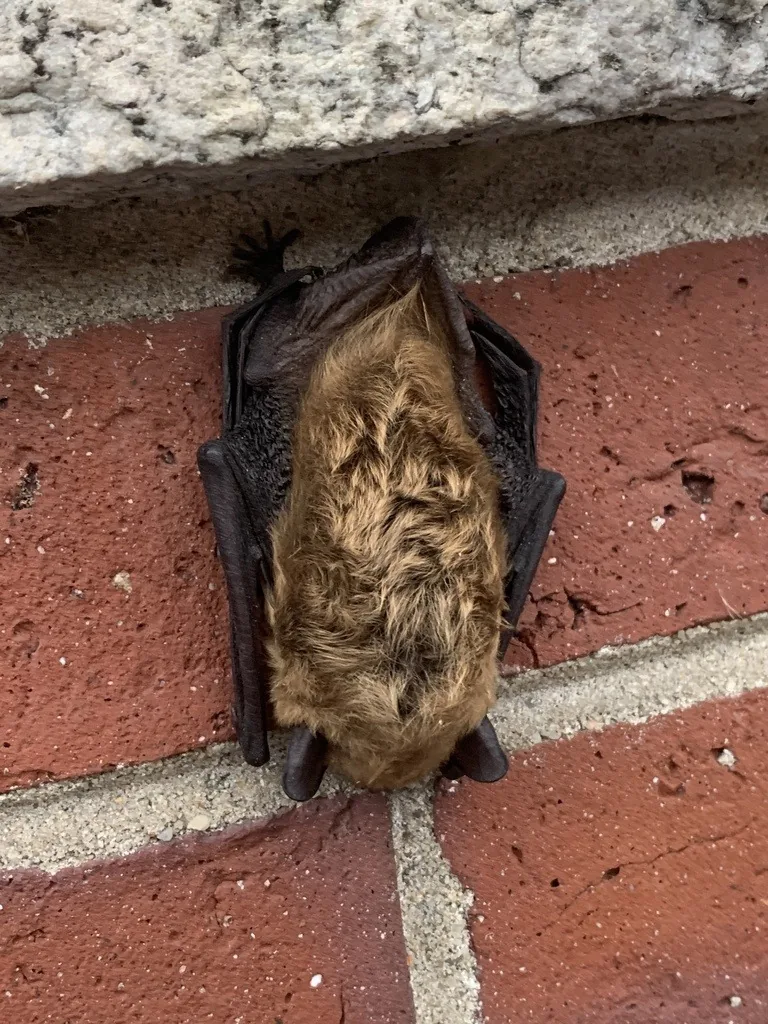
How to identify it
- Small furred mammals with wings of skin stretched between long fingers; they are the only mammals capable of true flight.[3][2]
- The big brown bat has a body about 11 to 13 centimeters long, thick glossy brown fur and black wings, and a wide, hairless, flattened-looking muzzle.[7]
- Connecticut wildlife biologists note that a bat found in a house there is most likely a big brown bat; the much smaller little brown bat has a furred, more pointed muzzle.[7]
- Bat droppings are segmented and crumble into powder with shiny insect bits; they collect below roosts and entry holes.[5][2]
- Active entry holes often show greasy yellow-brown to blackish rub marks, along with droppings and urine stains on walls below.[5][2]
Look-alikes
| Look-alike | How to tell them apart |
|---|---|
| House mouse (droppings) | Mouse and rat droppings are harder, taper at the ends and do not turn to powder when crushed, and they lack the shiny insect fragments found in bat guano.[5][2] |
| Bird droppings | Bird droppings contain white chalky material; bat droppings never do.[5][2] |
| Bat bugs | Bat bugs are insects that live with bat colonies and look almost identical to bed bugs; they can bite people but cannot reproduce without bats.[2][5] |
Where it lives
About 47 bat species live north of Mexico, and only a few cause problems for people; the big brown bat is found across most of the United States, Mexico and southern Canada.[3][7]
Biology and life cycle
Females gather in spring and early summer in maternity colonies, which may form in buildings, behind chimneys or under bridges; bats do not build nests.[4][7]
Pups are born from about May through early July, usually one or two per big brown bat female, and can fly within three to five weeks.[4][7]
Bats are long-lived for their size, reproduce slowly, and the little brown bat can live about 30 years.[2]
North American bats eat flying insects; big brown bats prefer beetles, including crop pests such as cucumber beetles and stink bugs.[4][7]
In the North, bats hibernate in caves, crevices or buildings from late fall to early spring; big brown bats sometimes fly during warm winter spells.[4][7]
Damage and signs
- Guano and urine build up in attics and wall spaces, staining ceilings and siding and producing a strong, musty odor that can be noticed from outside.[5][2]
- Heavy guano piles can make floors and ladders slippery, and their weight can damage ceilings.[5]
- Long-term colonies attract other pests, including dermestid beetles, cockroaches and bat bugs, which may later wander into living space.[5]
- Bats make scratching and squeaking noises, especially on hot days and when leaving at dusk or returning at dawn.[5]
- Bats do not chew holes or gnaw wiring; they use existing gaps as small as about 1/4 inch.[2][1]
Health risk
Bats are the most commonly reported rabid animals in the United States, and most U.S. rabies deaths follow exposure to a rabid bat. Bat bites can be tiny, so wash any bite or scratch with soap and water and get medical help right away.[1]
Control
Prevention
Never handle a bat with bare hands, teach children never to touch a bat, dead or alive, and keep dogs and cats vaccinated against rabies.[2][1][5]
Bright lights and fans in an attic can make a roost less attractive, though light may push bats deeper into wall voids.[6][2]
Keep them out
Find entry points by watching where bats leave at dusk, then seal every unused gap with caulk, screening, flashing or 1/4-inch hardware cloth.[2][6]
Over active holes, hang netting or tubes as one-way exits so bats can leave but not return; leave them up several days to a week before sealing for good.[6][2][1]
Cap chimneys with removable screens, keep dampers closed outside heating season, and make sure exterior doors and screens fit tightly.[6][1][2]
Traps and physical control
For a single bat indoors, close interior doors, open windows, and let it leave; if it lands, cover it with a container, slide cardboard underneath and wear leather gloves.[2][1]
Pesticides
No toxicants are registered for bats. Naphthalene is the only registered repellent, works only temporarily, and its vapors can be hazardous to people.[6][2]
When to call a professional
If anyone may have had contact with the bat, do not release it; contact your local health department to have the bat tested and to decide on medical care.[1][5]
Timing: don't trap pups inside
Avoid evicting a colony while flightless young are present; ICWDM advises against eviction between May 15 and August 15, and CDC warns against trapping young bats when bat-proofing from May through August.[6][1]
Trapped pups starve and cause odor and fly problems, and mothers may try to reach them through the living space.[2][6]
Also avoid evicting bats from a building they use for winter hibernation; late summer or early fall, after the young can fly, is usually the window.[6][4]
Cleaning up guano safely
Bat and bird droppings can support the fungus that causes histoplasmosis, which people catch by breathing spores from disturbed, dry droppings.[2][5]
Clean up only after the bats are gone, dampen droppings to keep dust down, and wear a respirator that filters particles as small as 2 microns.[5][2]
Legal status
Some states specifically protect bats, and two species, the Indiana bat and northern long-eared bat, are federally endangered; check with your state wildlife agency before acting.[3]
Shooting bats is impractical and illegal in many states, and trapping bats is not recommended because exclusion works without handling them.[6]
Common questions
- I woke up and found a bat in my bedroom. What should I do?
- Treat it as a possible rabies exposure. Safely capture the bat without crushing its head, keep it, and call your health department; bat bites can be too small to notice.[5][1]
- When is the best time to get bats out of my attic?
- After the pups can fly in late summer and before bats settle in for winter, using one-way exits and then sealing the holes.[6][1][2]
- Do bat houses keep bats out of my home?
- Not reliably. UC IPM notes bat houses are unlikely to stop bats from roosting in nearby buildings, though one put up well before an eviction may give bats another place to go.[2][6]
Sources
- Centers for Disease Control and Prevention, “Preventing Rabies from Bats (last reviewed July 1, 2025).” www.cdc.gov/rabies/exposure/animals/bats.html (accessed 2026-10-06)
- University of California Statewide IPM Program, “Bats (Pest Notes, Home and Landscape).” ipm.ucanr.edu/home-and-landscape/bats/ (accessed 2026-10-06)
- Internet Center for Wildlife Damage Management, “Bats: Identification.” icwdm.org/species/other-mammals/bats/ (accessed 2026-10-06). Run by university wildlife damage specialists (maintained at the University of Wisconsin-Stevens Point); species modules are based on Prevention and Control of Wildlife Damage (University of Nebraska Cooperative Extension, 1994).
- Internet Center for Wildlife Damage Management, “Bat Biology.” icwdm.org/species/other-mammals/bats/bat-biology/ (accessed 2026-10-06). Run by university wildlife damage specialists (maintained at the University of Wisconsin-Stevens Point); species modules are based on Prevention and Control of Wildlife Damage (University of Nebraska Cooperative Extension, 1994).
- Internet Center for Wildlife Damage Management, “Bat Damage Identification.” icwdm.org/species/other-mammals/bats/bat-damage-identification/ (accessed 2026-10-06). Run by university wildlife damage specialists (maintained at the University of Wisconsin-Stevens Point); species modules are based on Prevention and Control of Wildlife Damage (University of Nebraska Cooperative Extension, 1994).
- Internet Center for Wildlife Damage Management, “Bat Damage Prevention and Control Methods.” icwdm.org/species/other-mammals/bats/bat-damage-prevention-and-control-methods/ (accessed 2026-10-06). Run by university wildlife damage specialists (maintained at the University of Wisconsin-Stevens Point); species modules are based on Prevention and Control of Wildlife Damage (University of Nebraska Cooperative Extension, 1994).
- Connecticut Department of Energy and Environmental Protection, Wildlife Division, “Wildlife in Connecticut: Big Brown Bat (fact sheet, 9/2021).” portal.ct.gov/-/media/deep/wildlife/pdf_files/outreach/fact_sheets/bigbrownbat.pdf (accessed 2026-10-06)
- iNaturalist, “Eptesicus fuscus taxon page (order and family).” www.inaturalist.org/taxa/40509 (accessed 2026-10-06)