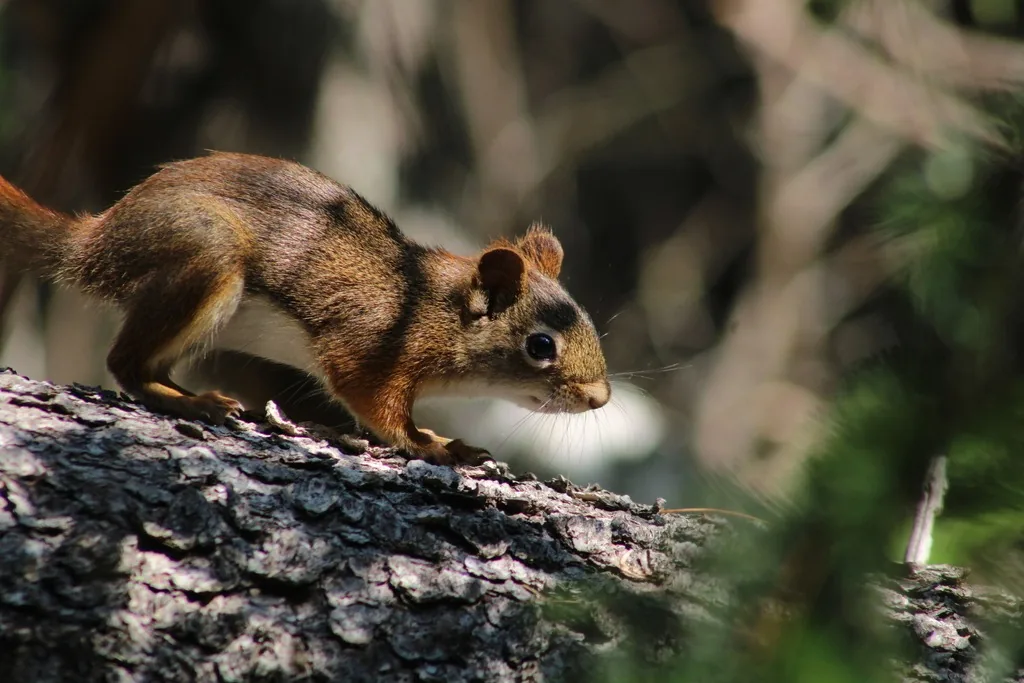
How to identify it
- Small for a tree squirrel: about 10 to 15 inches long including the tail and roughly half the size of a gray squirrel.[1][5]
- Rusty red-brown above and white below, often with a black stripe along each side separating the two, most visible in summer.[5][1]
- Small ear tufts, most noticeable in winter.[1][7]
- A loud, harsh chattering or scolding call when disturbed.[6][7][5]
- Piles of shredded cones, husks and hulls on stumps, logs or rocks, sometimes more than a foot high.[7][6]
Look-alikes
| Look-alike | How to tell them apart |
|---|---|
| Eastern gray and fox squirrels | Much larger squirrels that use entry holes about the size of a baseball, compared with golf-ball-size holes for red squirrels.[1][3] |
| Flying squirrels | Active at night, with gliding skin between the legs and a flattened tail; red squirrels are active by day.[1][2][6] |
| Chipmunks | Smaller, with stripes on the back and face and spending most of their time on the ground; red squirrels are larger, bushier-tailed, unstriped and spend much of their time in trees.[9] |
Where it lives
Found across the northern U.S. and Canada, south through the Appalachians, and in the Rocky Mountains south to Arizona and New Mexico, mostly where spruce, fir, hemlock or pine grow.[5][1][7]
Biology and life cycle
Red squirrels feed mainly on conifer seeds, along with buds, nuts, fruit, mushrooms, maple sap and occasionally insects and bird eggs.[6][5][7]
Unlike gray squirrels, which scatter nuts, red squirrels store food in one central cache, which can end up in an attic or gutter.[2][5]
They mate in late winter; about 3 to 6 young are born after roughly 36 to 40 days, and some areas see a second litter in late summer.[5][6]
They nest in tree cavities, ground burrows and ball-shaped leaf nests, and are active year-round, mostly by day.[5][7][6]
They are highly territorial and aggressive toward other squirrels, including their own kind.[5]
Damage and signs
- They chew into buildings through golf-ball-size holes and nest in attics, eaves and wall spaces.[3][5]
- Trash-bag-size piles of pine cones carried into attics or gutters are a telltale sign of red squirrels.[2]
- Squirrels in attics can damage insulation and electrical wiring, and long-term gnawing can weaken rafters.[5][3]
- Red squirrels may chew holes in maple sap tubing and strip bark from pines and paper birch.[3]
- They are known to raid bird feeders.[6]
Health risk
The main safety concern is chewed electrical wiring, which can lead to fires; squirrels do not threaten pets but do eat bird eggs and nestlings.[3]
Control
Prevention
Trim tree limbs, shrubs and vines back 6 to 8 feet from the roof and walls so squirrels can't jump onto the building.[4][5]
Keep them out
Close openings with heavy 1/2-inch wire mesh or aluminum flashing, add chimney caps, and secure vents.[4][5]
Make sure no squirrels are inside before sealing; a squirrel shut away from its young will chew new holes to get back in.[5][4]
A one-way door over the main hole works well for red squirrels, which lack the jaw strength of larger squirrels, but only when the rest of the building is sound.[4]
Traps and physical control
Live trapping with box traps is often the most effective removal method; bait with apple, peanut butter or nuts and place traps on travel routes, rooftops or inside the attic.[5][4]
Rat-size snap traps are very effective on red squirrels when set inside boxes or indoors where birds can't reach them; use five or more traps for small squirrels.[4]
Timing and young
Young may be present from February through August, so check for babies before exclusion to avoid trapping them inside.[4]
If a squirrel is loose in a room, open a door or window to the outside, then leave the room so it can find its way out.[5]
What doesn't work
No frightening devices have been proven effective, and no toxicants are registered for tree squirrels.[4]
Naphthalene (mothballs) only discourages squirrels briefly and is not recommended in attics of occupied buildings because it can cause severe distress to people.[4]
Legal status
Squirrel rules vary by species and state, and trapping or shooting may require a permit, so check with your state wildlife agency first.[1][4]
Common questions
- Why is there a pile of pine cones in my attic?
- That is a classic red squirrel sign. Red squirrels store food in one place, and big piles of cones in attics or gutters are common.[2]
- How big a hole does a red squirrel need?
- About the size of a golf ball, smaller than the baseball-size holes used by gray and fox squirrels.[3]
- Are red squirrels easier to keep out than gray squirrels?
- Yes, generally. Red squirrels lack the jaw strength of larger squirrels, so sound exclusion and one-way doors work well.[4]
Sources
- Internet Center for Wildlife Damage Management, “Tree Squirrels: Identification.” icwdm.org/species/rodents/tree-squirrels/ (accessed 2026-10-06). Run by university wildlife damage specialists (maintained at the University of Wisconsin-Stevens Point); species modules are based on Prevention and Control of Wildlife Damage (University of Nebraska Cooperative Extension, 1994).
- Internet Center for Wildlife Damage Management, “Tree Squirrel Biology.” icwdm.org/species/rodents/tree-squirrels/tree-squirrel-biology/ (accessed 2026-10-06). Run by university wildlife damage specialists (maintained at the University of Wisconsin-Stevens Point); species modules are based on Prevention and Control of Wildlife Damage (University of Nebraska Cooperative Extension, 1994).
- Internet Center for Wildlife Damage Management, “Tree Squirrel Damage Identification.” icwdm.org/species/rodents/tree-squirrels/tree-squirrel-damage-identification/ (accessed 2026-10-06). Run by university wildlife damage specialists (maintained at the University of Wisconsin-Stevens Point); species modules are based on Prevention and Control of Wildlife Damage (University of Nebraska Cooperative Extension, 1994).
- Internet Center for Wildlife Damage Management, “Tree Squirrel Damage Prevention and Control Methods.” icwdm.org/species/rodents/tree-squirrels/tree-squirrel-damage-prevention-and-control-methods/ (accessed 2026-10-06). Run by university wildlife damage specialists (maintained at the University of Wisconsin-Stevens Point); species modules are based on Prevention and Control of Wildlife Damage (University of Nebraska Cooperative Extension, 1994).
- Connecticut Department of Energy and Environmental Protection, “Red Squirrel Fact Sheet (Wildlife in Connecticut).” portal.ct.gov/DEEP/Wildlife/Fact-Sheets/Red-Squirrel (accessed 2026-10-06)
- Maine Department of Inland Fisheries and Wildlife, “Red Squirrel (Species Information).” www.maine.gov/ifw/fish-wildlife/wildlife/species-information/mammals/red-squirrel.html (accessed 2026-10-06)
- North Dakota Game and Fish Department, “Red Squirrel (Fact Sheet).” gf.nd.gov/wildlife/id/rodents/red-squirrel (accessed 2026-10-06)
- iNaturalist, “Tamiasciurus hudsonicus taxon page (order and family).” www.inaturalist.org/taxa/46260 (accessed 2026-10-06)
- Internet Center for Wildlife Damage Management, “Chipmunks: Identification.” icwdm.org/species/rodents/chipmunks/ (accessed 2026-10-06). Run by university wildlife damage specialists (maintained at the University of Wisconsin-Stevens Point); species modules are based on Prevention and Control of Wildlife Damage (University of Nebraska Cooperative Extension, 1994).