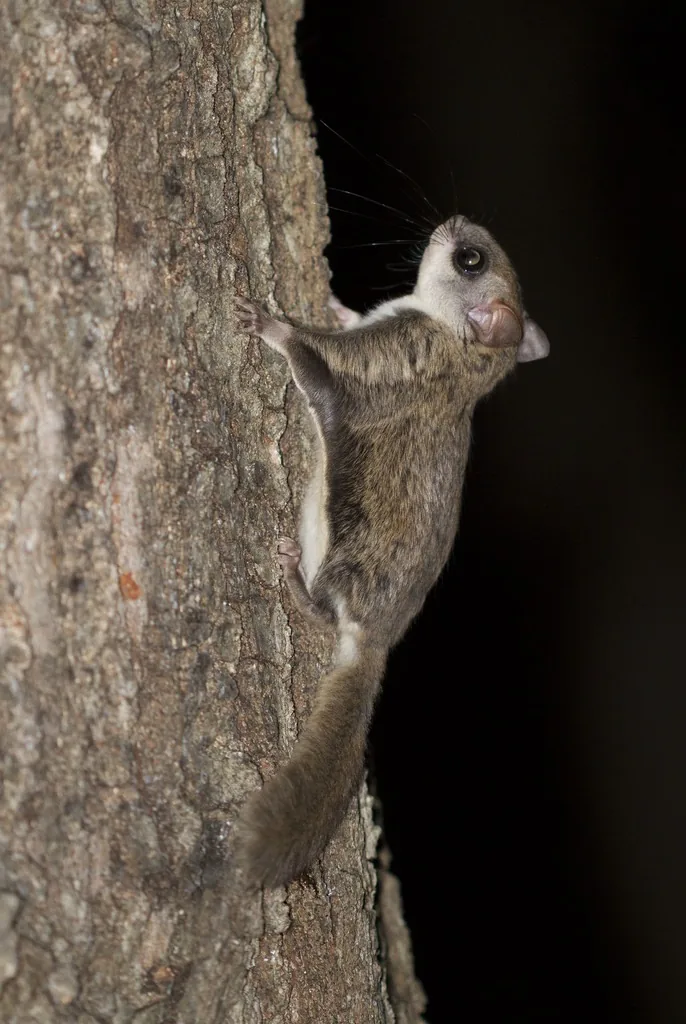
How to identify it
- Soft gray-brown fur on the back and sides, white underparts, large dark eyes and a flattened tail.[1][2]
- Broad folds of skin connect the front and hind legs at the wrists; stretched out, they let the squirrel glide rather than truly fly.[1][2]
- Southern flying squirrels are 8 to 10 inches long including the tail and weigh only about 2 to 2.5 ounces.[1][2]
- They use entry holes about the size of a quarter, much smaller than the baseball-sized holes of gray and fox squirrels.[4]
- Urine and droppings can stain areas below the attic vent or gap the squirrels use to come and go.[4]
Look-alikes
| Look-alike | How to tell them apart |
|---|---|
| Gray, fox and red squirrels | These squirrels are active by day and are larger, with bushier tails; flying squirrels are active at night and have gliding skin folds and a flat tail.[3][2] |
| Northern flying squirrel | Slightly larger, about 10 to 12 inches, and a bit darker and redder; the two species are hard to tell apart and their ranges overlap.[1][2] |
| Bats | Bats also come and go from attics at night, but flying squirrels are furry rodents with a flat tail that glide down rather than fly.[1][3] |
Where it lives
The southern flying squirrel is found from southern Canada to southern Florida and west to Minnesota and eastern Texas, overlapping the range of the northern flying squirrel.[1][2]
Biology and life cycle
Flying squirrels are active at night, while other North American tree squirrels are active mainly during the day.[3]
They can glide 150 feet or more from a height of 60 feet, steering with their legs, body and tail.[1]
Mating takes place in late winter, with a second breeding period in summer; after about 40 days, an average of three to four young are born.[1]
They are active all year and highly social, often feeding and denning together, especially in harsh weather.[1]
They eat acorns, nuts, seeds, berries and mushrooms, and are the most carnivorous tree squirrels, also taking insects, bird eggs and nestlings.[1][3]
Damage and signs
- Flying squirrels nest in attics and other sheltered parts of buildings when they can find a way in.[1][4]
- Like other squirrels, they gnaw on wires, and their mixed urine and droppings can leave stains.[4]
- A parent shut out of a building can do severe damage chewing back in to reach its young.[1]
- They are small enough to enter most birdhouses and are likely to eat nestling birds.[4]
Health risk
In the United States, rare cases of epidemic typhus, called sylvatic typhus, have occurred in people exposed to flying squirrels and their nests, so the CDC advises avoiding contact with them.[6]
Control
Prevention
Trim shrubs, vines and overhanging tree limbs; keeping limbs 6 to 8 feet from the house stops squirrels from jumping onto the roof.[1][5]
Keep them out
Close holes around dormers, ridge vents, eaves and attic vents with heavy half-inch wire mesh, aluminum flashing or other solid repairs.[1][5]
Make sure no squirrels are shut inside before sealing; young may be present from February through August, so avoid trapping mothers away from their litters.[1][5]
When no young are present, a one-way door over the main entry lets squirrels leave but not return; secure other vents and the chimney first.[5]
Traps and physical control
Where trapping is legal, place several traps near the entry, since flying squirrels often live in groups; trapping alone won't last if openings stay unsealed.[5][1]
When to call a professional
Because rules on handling flying squirrels vary, check with your state wildlife agency or hire a licensed nuisance wildlife control operator.[2][1]
Legal status
It typically is not legal to kill flying squirrels, so check with state or local wildlife authorities on their legal status before removing them.[2]
No toxicants are registered for tree squirrel control.[5]
What doesn't work
No frightening devices have been proven effective against squirrels.[5]
Naphthalene (mothballs) is not recommended in the attic of an occupied home because the fumes can cause severe distress to people.[5]
Common questions
- What is making noise in my attic at night?
- If it is a squirrel, it is likely a flying squirrel, since they are the only North American tree squirrels active at night; they enter through small gaps around dormers, vents and eaves.[3][1]
- Can I just trap the flying squirrels?
- Trapping alone gives only temporary relief, because other squirrels soon move in; sealing the entry holes is the long-term fix.[1]
- Are flying squirrels dangerous?
- The CDC links rare cases of sylvatic typhus to contact with flying squirrels and their nests, so avoid handling them or their nesting material.[6]
Sources
- Connecticut Department of Environmental Protection, Wildlife Division, “Flying Squirrels (Wildlife in Connecticut Informational Series).” portal.ct.gov/-/media/deep/wildlife/pdf_files/outreach/fact_sheets/flysqrlpdf.pdf (accessed 2026-10-06)
- Internet Center for Wildlife Damage Management, “Tree Squirrels: Identification.” icwdm.org/species/rodents/tree-squirrels/ (accessed 2026-10-06). Run by university wildlife damage specialists (maintained at the University of Wisconsin-Stevens Point); species modules are based on Prevention and Control of Wildlife Damage (University of Nebraska Cooperative Extension, 1994).
- Internet Center for Wildlife Damage Management, “Tree Squirrel Biology.” icwdm.org/species/rodents/tree-squirrels/tree-squirrel-biology/ (accessed 2026-10-06). Run by university wildlife damage specialists (maintained at the University of Wisconsin-Stevens Point); species modules are based on Prevention and Control of Wildlife Damage (University of Nebraska Cooperative Extension, 1994).
- Internet Center for Wildlife Damage Management, “Tree Squirrel Damage Identification.” icwdm.org/species/rodents/tree-squirrels/tree-squirrel-damage-identification/ (accessed 2026-10-06). Run by university wildlife damage specialists (maintained at the University of Wisconsin-Stevens Point); species modules are based on Prevention and Control of Wildlife Damage (University of Nebraska Cooperative Extension, 1994).
- Internet Center for Wildlife Damage Management, “Tree Squirrel Damage Prevention and Control Methods.” icwdm.org/species/rodents/tree-squirrels/tree-squirrel-damage-prevention-and-control-methods/ (accessed 2026-10-06). Run by university wildlife damage specialists (maintained at the University of Wisconsin-Stevens Point); species modules are based on Prevention and Control of Wildlife Damage (University of Nebraska Cooperative Extension, 1994).
- Centers for Disease Control and Prevention, “About Epidemic Typhus (updated May 15, 2024).” www.cdc.gov/typhus/about/epidemic.html (accessed 2026-10-06)
- iNaturalist, “Glaucomys volans taxon page (order and family).” www.inaturalist.org/taxa/46272 (accessed 2026-10-06)