How to identify it
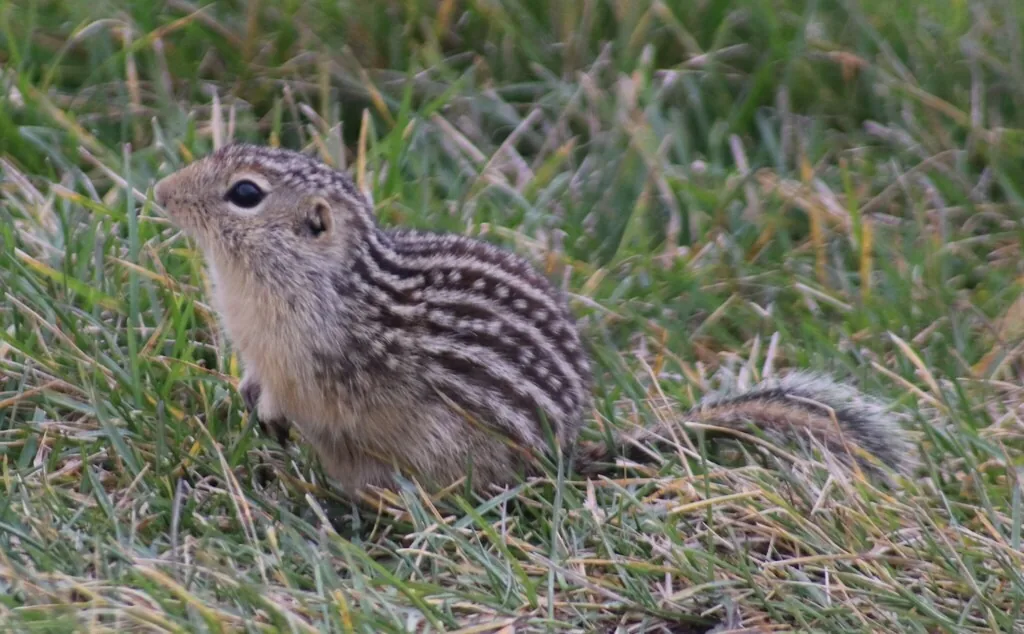
- Thirteen stripes run the length of the body; five of the light stripes break into rows of spots along the back and rump.[1][5]
- The cheeks, body and legs are yellowish or tan with an orange cast, and the belly is thinly furred and light tan.[1]
- Adults weigh about 8 ounces and are about 10 to 11 inches long, including the tail.[1][5]
- Burrow openings are about 2 inches across, often hidden in grass, and rarely have soil scattered around them.[2]
- When startled, it runs to the nearest burrow with its tail held flat along the ground.[1][2]
Look-alikes
| Look-alike | How to tell them apart |
|---|---|
| Eastern chipmunk | A startled chipmunk carries its tail upright, while a thirteen-lined ground squirrel holds its tail level with the ground.[1] |
| California ground squirrel | Much larger, at 14 to 20 inches with the tail, with mottled brown fur, a white ring around each eye and a somewhat bushy tail; it lives in California and nearby western states.[6] |
| Black-tailed prairie dog | A stocky, tawny, unstriped rodent of 2 to 3 pounds with a black-tipped tail, living in colonies with raised burrow mounds.[7] |
Where it lives
Originally a Great Plains prairie species, it spread as forests were cleared and now ranges from the Canadian prairie provinces south to Texas and from central Ohio west to Colorado.[1]
Biology and life cycle
Active by day, it comes above ground when the sun is high and warm and rarely ventures out on damp or overcast days.[2]
It hibernates from about September or early October until late March to early May in the north, and mates within two weeks of emerging.[2]
Females have one litter a year, averaging about 10 young after a 28-day gestation.[2]
It eats seeds, green shoots, vegetables, fruits and grain, plus insects such as grasshoppers and beetle and moth larvae, which can make up half its summer diet.[2]
Adults can reach 10 per acre, and numbers rise sharply when young emerge.[2]
Damage and signs
- It digs up newly planted seeds, eats sprouting seeds, clips emerging shoots and damages garden vegetables, often wasting more than it eats.[3][5]
- It invades golf courses, parks, lawns, athletic fields, cemeteries and similar short-grass sites, where burrowing and feeding can cause major damage.[3][5]
- It is not known to damage structures and poses minimal threat to livestock and pets.[3]
- It may gnaw woody stems, but winter gnawing damage is more likely from voles, since ground squirrels are hibernating then.[5]
Health risk
It generally poses no direct threat to people or pets and usually flees, though it can contract plague.[3]
Control
Prevention
Let grassy areas grow as tall and dense as land use allows, and plant crops before ground squirrels emerge from hibernation.[4]
Use bird feeders that catch fallen seed, don't stack firewood against buildings, and avoid continuous plantings linking wooded areas to the foundation.[4]
Keep them out
Protect vegetable beds with hardware cloth extending about 18 inches above ground and 6 inches below, or fence individual plants with 1/4-inch mesh.[5][4]
Traps and physical control
Rat-sized snap traps set beside active burrows and covered with a box that keeps out birds and other wildlife are efficient; cage traps baited with peanut butter or seeds also work.[5][4]
Trapping is practical for areas under about an acre; follow-up trapping may be needed as new squirrels move in.[4]
Pesticides
Zinc phosphide baits and burrow fumigants are used in agricultural settings, but zinc phosphide is restricted use in most states and fumigants must never be used near buildings.[4]
What doesn't work
No frightening devices are effective, and repeatedly filling burrow holes won't make ground squirrels leave.[4]
Repellents are of limited value; Illinois has none registered for this species, so check your state's rules.[5][4]
Legal status and relocation
It isn't federally protected, but some states regulate it or require a permit to kill nongame animals, so check state rules first.[1]
University of Illinois Extension rarely recommends relocating wildlife, which can be crueler than humane euthanasia.[5]
Common questions
- Is it a chipmunk or a thirteen-lined ground squirrel?
- Look at the back and tail: some of the ground squirrel's pale stripes break into rows of spots, and it runs with its tail flat, while a chipmunk holds its tail up.[1]
- Why are there ground squirrels in my lawn?
- They prefer short-mown grass they can see over, which is why lawns, golf courses, parks and cemeteries attract them.[2][5]
- Should I try to get rid of all of them?
- Extension specialists advise managing numbers to a tolerable level rather than eliminating them, because they eat many crop-damaging insects.[3]
Sources
- Internet Center for Wildlife Damage Management, “Thirteen-lined Ground Squirrels: Identification.” icwdm.org/species/rodents/thirteen-lined-ground-squirrels/ (accessed 2026-10-06). Run by university wildlife damage specialists (maintained at the University of Wisconsin-Stevens Point); species modules are based on Prevention and Control of Wildlife Damage (University of Nebraska Cooperative Extension, 1994).
- Internet Center for Wildlife Damage Management, “Thirteen-lined Ground Squirrel Biology.” icwdm.org/species/rodents/thirteen-lined-ground-squirrels/thirteen-lined-ground-squirrel-biology/ (accessed 2026-10-06). Run by university wildlife damage specialists (maintained at the University of Wisconsin-Stevens Point); species modules are based on Prevention and Control of Wildlife Damage (University of Nebraska Cooperative Extension, 1994).
- Internet Center for Wildlife Damage Management, “Thirteen-lined Ground Squirrel Damage Identification.” icwdm.org/species/rodents/thirteen-lined-ground-squirrels/thirteen-lined-ground-squirrel-damage-identification/ (accessed 2026-10-06). Run by university wildlife damage specialists (maintained at the University of Wisconsin-Stevens Point); species modules are based on Prevention and Control of Wildlife Damage (University of Nebraska Cooperative Extension, 1994).
- Internet Center for Wildlife Damage Management, “Thirteen-lined Ground Squirrel Prevention and Control Methods.” icwdm.org/species/rodents/thirteen-lined-ground-squirrels/thirteen-lined-ground-squirrel-prevention-and-control-methods/ (accessed 2026-10-06). Run by university wildlife damage specialists (maintained at the University of Wisconsin-Stevens Point); species modules are based on Prevention and Control of Wildlife Damage (University of Nebraska Cooperative Extension, 1994).
- University of Illinois Extension, “Managing thirteen-lined ground squirrel (Good Growing, October 14, 2022).” extension.illinois.edu/blogs/good-growing/2022-10-14-managing-thirteen-lined-ground-squirrel (accessed 2026-10-06)
- University of California Statewide IPM Program, “Pest Notes: Ground Squirrel, Publication 7438 (revised June 2025).” ipm.ucanr.edu/legacy_assets/PDF/PESTNOTES/pngroundsquirrel.pdf (accessed 2026-10-06)
- University of Nebraska-Lincoln Extension, “Prairie Dogs and Their Control, NebGuide G2101 (August 2011).” extensionpubs.unl.edu/publication/g2101/2011/html/view (accessed 2026-10-06). Co-authored with the director of USDA APHIS Wildlife Services in Nebraska.
- iNaturalist, “Ictidomys tridecemlineatus taxon page (order and family).” www.inaturalist.org/taxa/179988 (accessed 2026-10-06)