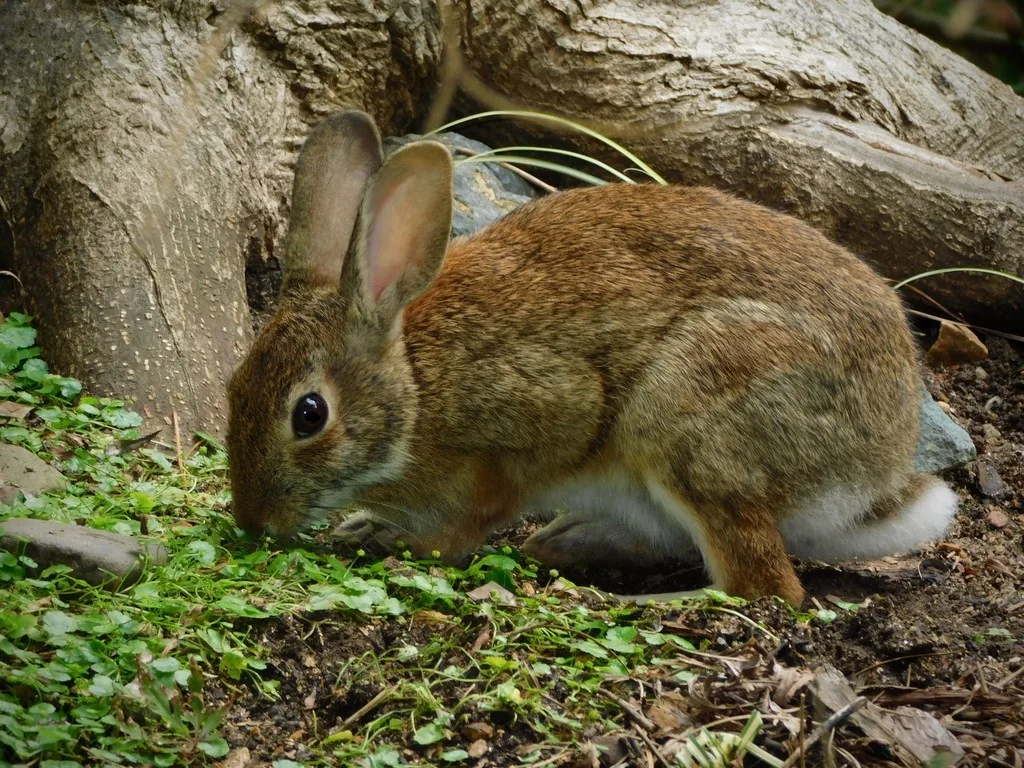
How to identify it
- Gray to gray-brown fur with a rusty-brown patch on the back of the neck, large ears, big hind feet and a short tail that is white underneath.[2]
- Eastern cottontails are 15 to 19 inches long and weigh 2 to 4 pounds; jackrabbits and other hares are larger with longer ears.[2][1]
- Droppings are round pellets in small piles, about 1/4 inch across for cottontails.[2][1]
- Twigs and stems are clipped cleanly at a sharp 45-degree angle, as if cut with a knife.[1][4]
- Tracks in snow or soft soil show a 1-1-2 pattern.[2]
Look-alikes
| Look-alike | How to tell them apart |
|---|---|
| Deer browsing | Deer lack upper front teeth and leave ragged, torn twig ends, often above the roughly 2-foot height rabbits can reach; rabbits leave clean, angled cuts.[1][4] |
| Jackrabbits (hares) | Jackrabbits are larger, with long black-tipped ears, live in open country, and travel far into open fields to feed; cottontails stay near brushy cover.[1][2] |
Where it lives
Nine cottontail species live in the U.S. The eastern cottontail ranges from southern New England west to eastern Montana and south into Mexico, while desert and mountain cottontails are most common in the West.[2]
Biology and life cycle
Cottontails do not dig their own burrows; they rest in shallow surface hollows called forms, brush piles, or burrows dug by other animals.[3]
They favor brushy fence rows, field edges, brush piles and backyards with lots of landscaping, and rarely live in dense forest or open grassland.[3][1]
Most spend their lives in 10 acres or less, and they feed mostly from dusk through the night into early morning.[3][1]
Females usually have 2 to 3 litters a year in the North and up to 5 or 6 in the South; gestation is only about 28 to 29 days.[3]
Young are born nearly hairless with eyes closed in a shallow nest on the ground and leave the nest in 2 to 3 weeks.[3][1]
Most rabbits live only 12 to 15 months, but high birth rates let populations rebound quickly, so removed rabbits are soon replaced.[3][5]
Damage and signs
- In spring and summer rabbits eat flowers such as tulips and vegetables such as peas, beans, beets, lettuce and carrots, often clipping plants to the ground.[3][4][1]
- In fall and winter they gnaw bark from young trees and shrubs and can girdle and kill them, especially when deep snow lets them reach higher.[3][4]
- Apple trees, raspberries and blackberries are often damaged, along with maples, oaks, willows, roses, dogwoods and sumac.[3][4]
- Rabbits also chew plastic drip irrigation tubing; hang it out of reach or run it through 3/4-inch PVC pipe.[1]
- Some crops, such as corn, squash, cucumbers, tomatoes and potatoes, seem to be largely spared.[3]
Health risk
Rabbits can carry tularemia (rabbit fever), which people can get from handling an infected rabbit, from tick or flea bites, or from undercooked rabbit meat. Wear gloves and avoid rabbits that are dead or acting sick.[1][4]
Control
Prevention
Plant daffodils and other resistant spring bulbs in place of tulips, which rabbits favor.[5]
Keep them out
Fence gardens with chicken wire of 1-inch mesh or smaller, at least 2 feet high, with the bottom buried a few inches or staked tight to the ground.[5][1]
UC IPM suggests burying the fence bottom 6 to 10 inches and bending it outward, and raising the fence to 3 feet where jackrabbits occur.[1]
Wrap young trees with cylinders of hardware cloth that stand 1 to 2 inches from the trunk and reach about 20 inches above expected snow depth.[5][1]
Sanitation
Remove brush piles, rock piles, weed patches and debris where rabbits hide, and screen off the space beneath sheds that sit on low raised platforms.[5][1]
Traps and physical control
Where legal, box or cage traps about 9 by 10 by 24 inches, baited with apples, carrots or corn and set near cover, work well in towns.[5][1]
Pesticides
Taste or odor repellents, such as those based on putrescent egg solids, dried blood, capsaicin or thiram, can reduce browsing on trees and ornamentals; most cannot be used on food plants.[1][5]
Apply repellents before damage starts and reapply after rain, irrigation or new growth; they often fail in vegetable gardens full of favorite foods.[1][5]
What doesn't work
Pinwheels, pie pans, jars of water, noisemakers, flashing lights and ultrasonic devices do not keep rabbits away.[5][1]
No toxicants are registered for rabbit control around homes, and paper tree wraps can be chewed through.[5]
Removing a few rabbits gives only short-term relief because others move in to fill the space.[5][3]
Legal status
Rabbits are game animals in most states and protected outside hunting season, though some states let property owners remove rabbits causing damage.[2][5]
Releasing trapped rabbits elsewhere may be illegal; California, for example, requires a written permit, so check your state wildlife agency first.[1][2]
Common questions
- How can I tell rabbit damage from deer damage?
- Look at the cut and the height. Rabbits clip stems cleanly at a 45-degree angle within about 2 feet of the ground; deer leave ragged, torn ends higher up.[1][4]
- How tall does a rabbit fence need to be?
- Cottontails will not jump a 2-foot fence, so 2 feet of 1-inch mesh is usually enough, as long as rabbits cannot slip under the bottom.[1][5]
- Can I get sick from a rabbit?
- Possibly. Rabbits can carry tularemia, so wear gloves and avoid touching rabbits that are dead or acting sick.[1][4]
Sources
- University of California Statewide IPM Program, “Rabbits (Pest Notes, Home and Landscape).” ipm.ucanr.edu/home-and-landscape/rabbits/ (accessed 2026-10-06)
- Internet Center for Wildlife Damage Management, “Rabbits: Identification.” icwdm.org/species/other-mammals/rabbits/ (accessed 2026-10-06). Run by university wildlife damage specialists (maintained at the University of Wisconsin-Stevens Point); species modules are based on Prevention and Control of Wildlife Damage (University of Nebraska Cooperative Extension, 1994).
- Internet Center for Wildlife Damage Management, “Rabbit Biology.” icwdm.org/species/other-mammals/rabbits/rabbit-biology/ (accessed 2026-10-06). Run by university wildlife damage specialists (maintained at the University of Wisconsin-Stevens Point); species modules are based on Prevention and Control of Wildlife Damage (University of Nebraska Cooperative Extension, 1994).
- Internet Center for Wildlife Damage Management, “Rabbit Damage Identification.” icwdm.org/species/other-mammals/rabbits/rabbit-damage-identification/ (accessed 2026-10-06). Run by university wildlife damage specialists (maintained at the University of Wisconsin-Stevens Point); species modules are based on Prevention and Control of Wildlife Damage (University of Nebraska Cooperative Extension, 1994).
- Internet Center for Wildlife Damage Management, “Rabbit Damage Prevention and Control Methods.” icwdm.org/species/other-mammals/rabbits/rabbit-damage-prevention-and-control-methods/ (accessed 2026-10-06). Run by university wildlife damage specialists (maintained at the University of Wisconsin-Stevens Point); species modules are based on Prevention and Control of Wildlife Damage (University of Nebraska Cooperative Extension, 1994).
- iNaturalist, “Sylvilagus floridanus taxon page (order and family).” www.inaturalist.org/taxa/43111 (accessed 2026-10-06)