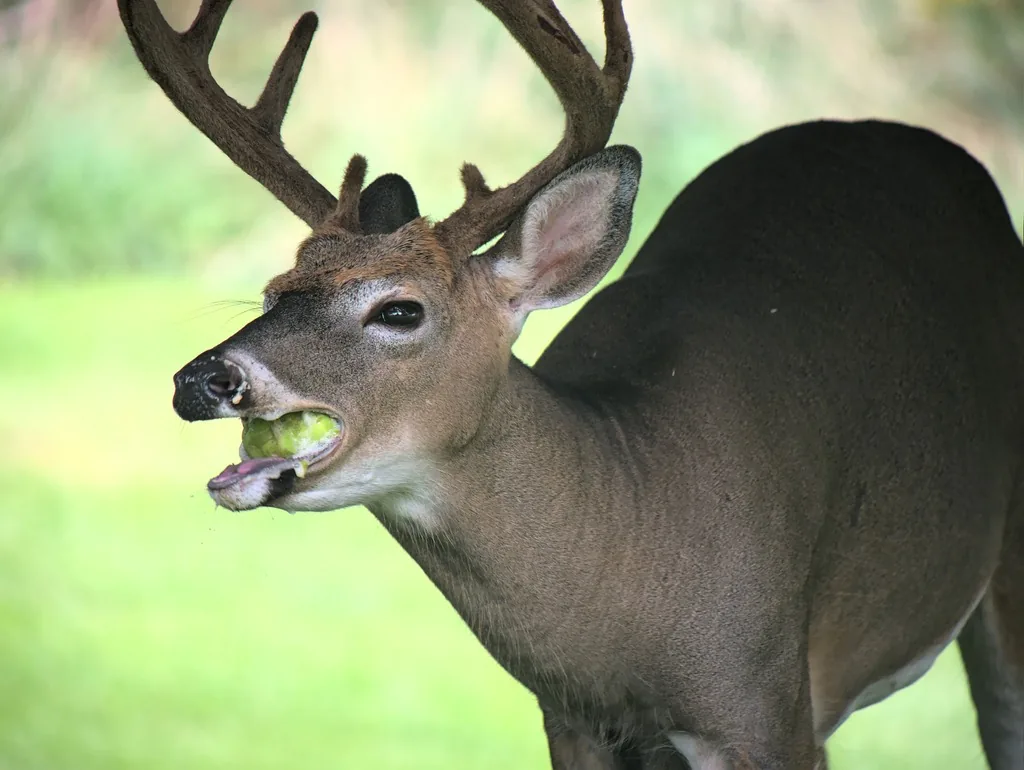
How to identify it
- Reddish-brown in summer and grayish-brown in winter, with white under the tail, on the belly, chin and throat; fawns are rust-colored with white spots.[2]
- Bucks grow antlers from about April to August; white-tailed deer antler tines rise from a central beam, while mule deer antlers fork.[2]
- Hoofprints are 2 to 3 inches long, split down the middle, pointed at the front and rounded at the back.[1][2]
- Droppings are piles of small, jellybean-shaped pellets, and one white-tailed deer can leave about 25 piles a day.[1][2]
- Browsed twigs and leaves have ragged, torn ends, because deer have no upper front teeth.[1][6]
Look-alikes
| Look-alike | How to tell them apart |
|---|---|
| Rabbit damage | Rabbits clip twigs cleanly at a 45-degree angle and rarely reach above about 2 feet; deer leave ragged ends, often higher up.[6][1] |
Where it lives
White-tailed deer live in almost every state except Alaska and Hawaii; mule deer and black-tailed deer are found across the West, including much of California.[2][1]
Biology and life cycle
Deer browse leaves, stems and buds of woody plants year-round and also eat flowers, grasses, fruit, nuts and garden vegetables.[3][1]
They feed mostly in late evening and early morning, but in suburbs where they are used to people they may be active all day.[1]
Ideal habitat is forest edge, and many deer populations do well in towns with irrigated landscaping and few predators.[3][1]
White-tailed deer breed from October to January, and fawns, often twins, are born in May or June.[3]
A home range covers several hundred acres, and northern deer may travel up to 100 miles to gather in winter cover.[3]
In the wild, a deer that reaches 10 years old is above average.[3]
Damage and signs
- Deer strip leaves and tender shoots from roses, fruit trees and other shrubs, and they can eat or trample leafy vegetables, beans, ground covers and flowers.[1][4]
- Browsing can stunt newly planted fruit and nut trees and vines and delay their first crop by years.[1]
- Where deer are numerous, a browse line forms on trees and shrubs about 4 to 5 feet up, as high as they can reach.[1]
- Bucks rub their antlers on saplings, small limbs and fence posts to remove velvet, which can badly damage or kill young trees.[1][2]
- Deer seldom damage buildings, though they occasionally break through fences and plate-glass windows.[4]
Health risk
Collisions with vehicles are the main danger, killing 100 to 200 people in the U.S. each year. Deer also help move and support ticks that carry Lyme disease, ehrlichiosis and babesiosis.[4]
Control
Prevention
Choose plants deer tend to avoid, using local extension or nursery lists, but expect hungry deer to eat even deer-resistant plants.[1][5]
Keep them out
A well-built, well-maintained fence 7 to 8 feet high is the most effective protection; on slopes it may need to be taller.[1][5]
Deer often crawl under or through fences rather than jumping, so fit the fence tight to the ground and run an extra wire along the bottom.[1]
Most existing fences can be made deer-proof by adding 3 to 4 feet of mesh or smooth wire above them.[1]
For small gardens, an electric fence baited with peanut butter teaches deer to stay away after a nose-to-wire shock; inspect it weekly.[5]
Protect young trees with woven-wire or plastic cylinders until branches grow out of reach; 4-foot wire cylinders also stop antler rubbing.[1][5]
Traps and physical control
Motion-activated sprinklers, or a dog kept in by an invisible fence, can help for a while in small gardens.[1][5]
Pesticides
Studies suggest repellents made with fermented (putrescent) egg work best; others use ammonium soaps, thiram, capsaicin or dried blood.[1][5]
Apply repellents before damage starts, reapply after rain and on new growth, and check the label, since most cannot go on food crops.[1][5]
What doesn't work
Deer quickly get used to noisemakers, propane cannons and other scare devices, so they help only for a few days.[1][5]
Home remedies such as human hair, scented soap bars and predator urine may work for a day or two, mostly because they are new.[1]
Standard livestock electric fences have not proven very effective for deer in California.[1]
No toxicants are registered for deer, and poisoning deer is illegal.[5][1]
Legal status
Deer are protected in every state outside legal hunting seasons, and lethal control generally requires consulting the state wildlife agency.[2]
States may issue depredation permits where damage is severe, usually after nonlethal methods have been tried.[2][1]
Traps and poisons for deer are illegal in California.[1]
Common questions
- How high does a deer fence need to be?
- Deer rarely jump a 6-foot fence but can clear 8 feet when chased, so UC IPM recommends 7 to 8 feet on level ground.[1]
- Do deer-resistant plants really work?
- Partly. Deer prefer some plants over others, but when food is scarce or deer are numerous they will eat many plants on resistant lists.[1][5]
- Do deer bring ticks into my yard?
- They can. Deer help move and support ticks that carry Lyme disease, ehrlichiosis and babesiosis.[4]
Sources
- University of California Statewide IPM Program, “Deer (Pest Notes, Home and Landscape).” ipm.ucanr.edu/home-and-landscape/deer/ (accessed 2026-10-06)
- Internet Center for Wildlife Damage Management, “Deer: Identification.” icwdm.org/species/other-mammals/deer/ (accessed 2026-10-06). Run by university wildlife damage specialists (maintained at the University of Wisconsin-Stevens Point); species modules are based on Prevention and Control of Wildlife Damage (University of Nebraska Cooperative Extension, 1994).
- Internet Center for Wildlife Damage Management, “Deer Biology.” icwdm.org/species/other-mammals/deer/deer-biology/ (accessed 2026-10-06). Run by university wildlife damage specialists (maintained at the University of Wisconsin-Stevens Point); species modules are based on Prevention and Control of Wildlife Damage (University of Nebraska Cooperative Extension, 1994).
- Internet Center for Wildlife Damage Management, “Deer Damage Identification.” icwdm.org/species/other-mammals/deer/deer-damage-identification/ (accessed 2026-10-06). Run by university wildlife damage specialists (maintained at the University of Wisconsin-Stevens Point); species modules are based on Prevention and Control of Wildlife Damage (University of Nebraska Cooperative Extension, 1994).
- Internet Center for Wildlife Damage Management, “Deer Damage Prevention and Control Methods.” icwdm.org/species/other-mammals/deer/deer-damage-prevention-and-control-methods/ (accessed 2026-10-06). Run by university wildlife damage specialists (maintained at the University of Wisconsin-Stevens Point); species modules are based on Prevention and Control of Wildlife Damage (University of Nebraska Cooperative Extension, 1994).
- University of California Statewide IPM Program, “Rabbits (Pest Notes, Home and Landscape).” ipm.ucanr.edu/home-and-landscape/rabbits/ (accessed 2026-10-06)
- iNaturalist, “Odocoileus virginianus taxon page (order and family).” www.inaturalist.org/taxa/42223 (accessed 2026-10-06)