The short answer
- A properly built and maintained fence 7 to 8 feet high is the most effective control. On steep slopes it may need to be 10 or 11 feet, and it has to fit tight to the ground, because deer are more likely to crawl under or through a fence than jump it.[1][4][5]
- For a garden, a baited electric or polytape fence teaches deer to keep away after a shock to the nose. Put it up at the first sign of damage and check it every week.[3][2][5][4]
- Repellents reduce damage rather than stop it. Studies suggest repellents made with fermented egg work better than others; apply before browsing starts, reapply after rain and on new growth, and switch products now and then so deer don't get used to one.[1][3][2][5]
- Protect single young trees with wire cylinders, netting or tubes until the main branches grow above the deer's reach.[1][2][4]
- Set realistic goals and act early. Minnesota Extension calls a 50 percent cut in browsing very successful and says 30 percent is more likely.[2]
Animals behind the damage
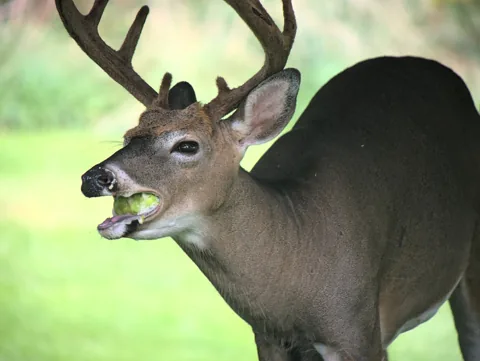 Deer (white-tailed deer shown; mule deer similar)
Odocoileus species (shown: white-tailed deer, O. virginianus; also mule deer, O. hemionus)
White-tailed and mule deer browse gardens, shrubs, young trees and flowers, often at dawn and dusk when no one sees them. Fencing is the most reliable fix, with repellents and plant choice helping in lighter cases.
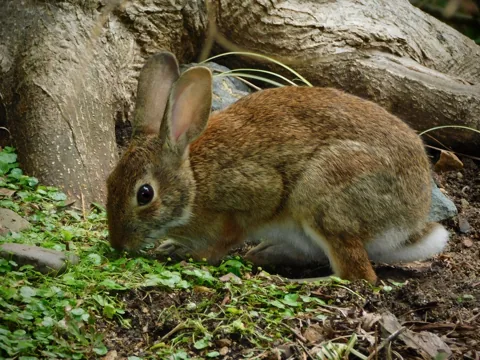 Rabbits (cottontails; eastern cottontail shown)
Sylvilagus species (shown: eastern cottontail, S. floridanus)
Cottontail rabbits are common in yards with brush and dense landscaping. They clip vegetables and flowers in spring and summer and gnaw the bark of young trees and shrubs in fall and winter.
Before you start
Make sure it's deer. Deer have no upper front teeth, so they tear twigs and leaves and leave a rough, shredded end; rabbits and rodents leave a neat cut at a 45-degree angle, lower to the ground. Tracks, droppings and trails also confirm deer.[2][1][4][5]
Deer are creatures of habit. They return to places where they have fed, use the same paths, and are hard to move once the habit is set, so it's easier to stop damage before it starts than after.[2][3][5]
Damage is most common on new growth in spring, and Minnesota Extension says it often climbs in early spring, when deer fat reserves are lowest. Deep snow, drought and high deer numbers all push hungry deer into gardens.[2]
Sources differ on the worst season. Colorado State, like Minnesota, says damage is most often noticed in spring on new, succulent growth. Penn State says that in orchards the most serious damage comes in winter, when natural food is scarce: dwarf, semidwarf and young standard trees suffer most, and browsing of dormant terminal buds can stunt or misshape standard fruit trees under 3 years old.[4][5][2]
Bucks also shred the bark of small trees by rubbing their antlers in the fall rut, which can do more harm than browsing and can happen even where you see no browsing.[2]
UC IPM puts antler rubbing in mid to late summer, when bucks scrape off the shedding velvet, while Minnesota ties it to the fall rut and says guards against rubbing should be in place from August through December. Penn State says rubbing can break limbs and girdle the trunk, killing the tree if enough bark comes off.[1][2][5]
Minnesota Extension says its strategies work best when several are used together, and suggests trying different ones to see what works on your property.[2][5]
Fences: the most reliable protection
Minnesota Extension says deer can jump up to 12 feet high and 30 feet long and can crawl through gaps as small as 7 1/2 inches. UC IPM says deer normally won't jump a 6-foot fence but can clear 8 feet on level ground when chased or threatened, so it recommends 7 or 8 feet, especially where mule deer live.[2][1]
- Height: 7 to 8 feet on level ground; Minnesota says at least 8 feet for larger areas. On sloping ground, UC IPM says you may need 10 or 11 feet to stop deer jumping down the slope.[1][2][4][5]
- Penn State builds the conventional 8-foot woven-wire fence from two widths of 4-foot woven wire on 12-foot posts, with the wire kept close to the ground so deer can't crawl under. Penn State and ICWDM both say a woven-wire fence is expensive to build but long-lasting and needs little maintenance.[5][3]
- Material: for a garden approaching a quarter acre, UC IPM says the best conventional fence material is 4-inch woven wire. Use smaller mesh, or graduated mesh that's smaller at the bottom, if you also need to keep out rabbits.[1]
- The bottom: run an extra strand of wire along the ground, and stake the mesh down in dips between posts or fill the dips with material that won't rot or wash away.[1][5]
- Gates: make them as tall as the fence and keep them closed. A removable section in an uphill corner, or in the corner farthest from human activity, lets you drive out a deer that gets in.[1]
- Saving money: you can raise a 6-foot mesh fence with two or more strands of 9- or 10-gauge smooth wire spaced 4 to 6 inches apart. Barbed wire has no advantage for these top strands. Keep vertical stays on mesh fences no more than 6 to 8 feet apart so the wire stays tight.[1]
- Converting an existing fence: attach uprights vertically or angled away from the area you're protecting, and add mesh or smooth wires above the fence no more than 4 to 6 inches apart. A 3- or 4-foot extension makes most fences deer-proof if the lower part is sound and tight to the ground.[1]
- Slanted fences: an outward-sloping fence doesn't need to be as tall, because deer approaching it end up under the overhang, which discourages them from jumping.[1]
- Colorado State also describes polypropylene mesh barriers, typically 8 feet high with high tensile strength, that blend into the surroundings.[4]
- Small beds: Minnesota Extension reports that micro-exclosures 8 by 16 feet and only 50 inches high have kept deer out.[2]
- Before you build, check local rules; many areas restrict fence height and setbacks. After you build, check the whole fence and gates often, since a fence is only as strong as its weakest point.[2]
Electric, polytape and fishing-line fences
Deer are drawn to a baited electric fence by its look or smell, touch it with their noses, and learn to avoid the fenced area. Temporary electric fences are cheap and easy to build and protect crops while there's no snow.[3][5]
Penn State explains why this works: deer can easily jump an electric fence but usually try to go through or under it instead, so the shock trains them to stay 3 to 4 feet away from the wires.[5]
UC IPM adds a caution: standard livestock electric fences haven't proven very effective for deer in California. A high-voltage, high-tensile fence built specifically for deer may work, but UC IPM says it should be professionally installed and constantly monitored.[1]
Other sources report better results with purpose-built designs. Penn State researchers developed a five-wire high-tensile electric fence that statewide tests showed to be an adequate means of deer control, and Colorado State lists vertical five-, seven- and nine-wire, slanted seven-wire and single-strand configurations.[5][4]
- Peanut-butter fence: ICWDM calls it effective for small gardens, nurseries and orchards up to 5 acres under moderate deer pressure. It's a single strand of 17-gauge smooth wire on insulators about 2 1/2 feet above the ground, carried on fiberglass rods set every 45 feet.[3]
- Colorado State gives a smaller limit for the same baited single-wire fence: small gardens, nurseries and orchards of up to 3 to 4 acres under moderate deer pressure.[4]
- To bait it, attach 3- by 4-inch foil strips to the wire every 3 feet with strips of cloth adhesive tape, coat the tape with a 1-to-1 mix of peanut butter and vegetable oil, and fold the foil over. Minnesota's version simply spreads peanut butter on foil folded over the wire.[3][2][5]
- Polytape and polywire are strong and portable, and both polytape and electric wire deter deer. Tie flags on the wires so deer and people can see them.[3][2][4]
- Put temporary electric fences up at the first sign of damage, before deer settle into feeding there, and inspect and maintain them every week. UC IPM says polytape fences may work best when installed before deer form the habit, for seasonal gardens or new plantings.[3][1][6]
- Two-tier polytape fence: Clemson Extension runs an outer fence of one polytape strand 18 to 24 inches off the ground and an inner fence 4 to 5 feet inside it, with a lower strand at 2 to 4 feet, on fiberglass poles about 15 feet apart. The gap between the two fences makes it hard for deer to judge a jump. ICWDM describes a similar offset or double fence for gardens and nurseries up to about 40 acres under moderate deer pressure.[6][3]
- Where deer have damaged a garden before, Clemson advises putting the fence up before the crop is planted.[6]
- Electric fences cost less to build than woven wire but need more checking: they short out when weeds touch the wire, a wire slips off an insulator, or a fallen branch pushes two wires together.[1][5][6]
- Keep a clear strip outside the fence so deer can see it and weeds don't ground the wires. Penn State says a 6- to 8-foot mowed strip; ICWDM gives 6 to 12 feet of open area for its offset and vertical fences.[5][3]
- Electric fences are prohibited in some areas, so check local regulations first.[2]
- Fishing-line fence: Minnesota Extension describes high-test monofilament (30 pounds or more) strung tightly around a bed 30 to 36 inches above the ground and about 2 feet outside the bed's edge, on strong corner posts. A deer walking in after dark bumps into a line it can't see. It may give short-term protection for some garden beds.[2]
- Minnesota adds that the fishing-line fence doesn't work when deer numbers are high or when deer feed during the day.[2]
- Polypropylene mesh fencing works for limited-term exclusion, such as protecting new trees and shrubs until they grow beyond the deer's reach, usually 5 to 7 feet above the ground.[1]
Cages, tubes and bud caps for single plants
Protecting individual plants can be more practical and cheaper than fencing a whole area. Young fruit or nut trees in a home orchard, for example, can be fenced one by one until their main branches grow above the deer's reach.[1]
- Make a cage by attaching poultry wire, heavier woven wire or strong plastic netting to two stakes in a circle around the tree. Use smaller mesh if rabbits or rodents are also a problem.[1]
- Minnesota Extension says wire cylinders should be at least 6 feet taller than the snow depth to give full protection. ICWDM says 4-foot woven-wire cylinders keep bucks from rubbing tree trunks with their antlers.[2][3]
- ICWDM says 5-foot rigid fencing with 2-inch mesh, fastened to posts, gives excellent protection against browsing, and heavy black plastic fencing can work for single trees or planting beds in urban areas.[3]
- Colorado State calls tubes of plastic netting around seedlings an effective way to cut damage to small trees. Attach them to a support stake; the netting breaks down in sunlight in three to five years.[4]
- Tree tubes and shelters protect seedlings and shrubs, and tall tubes protect the trunks of larger saplings from antler rubbing. If you use tubes, ICWDM advises screening the top so cavity-nesting birds don't get trapped inside.[2][3]
- Sources disagree on whether tubes stop antler rubbing. Minnesota says tall tubes protect the trunks of larger saplings, and ICWDM says 4-foot woven-wire cylinders keep bucks off trunks, but Colorado State warns that trunk tubes may not stop rubbing and that fencing may be needed.[2][3][4]
- Bud caps are small squares of newspaper or cardstock stapled around the terminal (top) buds of trees, mostly conifers in winter. They don't protect the side branches.[2][4]
- Check protectors regularly. They can restrict growth or hold in excess heat or moisture, and they should come off once the tree is big enough to withstand browsing or when the season of risk has passed.[1][2]
Repellents: how to get the most from them
Repellents work by taste or smell. Contact repellents go on the plant and make it taste bad; area repellents give off an unpleasant odor where you don't want deer. Some, like capsaicin, condition deer to avoid a plant after they eat it.[3][2][4][5]
Expect a reduction, not an end, to damage. ICWDM says the best repellents tend to reduce deer damage for 4 to 6 weeks under moderate feeding pressure and that no repellent stops deer under all conditions; UC IPM says most aren't very effective or long lasting.[3][1][5]
Studies suggest repellents containing fermented (putrescent) egg compounds work better than other types. Other active ingredients ICWDM lists include ammonium soaps of higher fatty acids, thiram (a fungicide that acts as a taste repellent on dormant trees and shrubs), capsaicin and dried blood.[1][3]
Research reviews don't all agree with that ranking. A 2020 review of 58 studies worldwide found odor-based repellents, such as those made from meat and blood or from predator urine, hair and feces, reduced deer damage most. In trials on hungry captive mule deer and elk in Colorado in 1989, 1991 and 1992, reported by Colorado State, a whole-egg spray, a putrescent egg product, coyote urine and the strongest hot-sauce mix rated high against deer; thiram and an ammonium soap rated medium, bar soap low to medium, and two denatonium benzoate products failed.[7][4][3]
A 2026 global meta-analysis of non-lethal browsing control in forests found that tree guards, repellents and exclusion fencing all significantly reduced browsing by mammals and kept working for long periods, but results varied widely within each method.[8]
Colorado State describes a homemade spray of 20 percent whole eggs and 80 percent water, reapplied in about 30 days. ICWDM takes the opposite view and says home remedies and other non-regulated products should not be used for deer control.[4][3]
- Start before deer do. Apply repellents before damage occurs, and reapply often, especially after rain, heavy dew or sprinkler irrigation. New growth that appears after you spray isn't protected until you treat it.[1][2][3][5]
- Winter and dormant-season treatments: apply on a dry day when it's above freezing, and treat to about 6 feet above the deepest expected snow. Treat young trees completely; on older trees it's more economical to treat only the top growth.[3][2][4][5]
- Treat from the top down, the way deer browse, and put the repellent at the level of the buds and new growth you want to protect.[2][4]
- Switch repellents from time to time so deer don't meet the same one over and over and get used to it.[2]
- Repellents work best on less-preferred plants in small areas. When food is scarce or deer numbers are high, deer are likely to ignore them.[2][1][3][4][5]
- Read the label. Most repellents aren't allowed on parts of plants people will eat, though some can be used in the dormant season or when no fruit is present. Be sure the product is registered for your plant and season.[1][3][5]
- ICWDM and Penn State both name an ammonium-soap repellent as one registered for use on edible crops. ICWDM says its effect usually lasts 2 to 4 weeks and may need renewing after heavy rain.[3][5]
- Some repellents injure certain trees and shrubs, especially new growth. If in doubt, test the product on a single plant first.[1]
Scare devices, sprinklers and dogs
- Noisemakers, visual objects and other frightening devices usually work for only a few days, if at all. Suburban deer meet changing sights and sounds every day and quickly ignore anything that doesn't hurt them, and even in rural areas propane cannons and electronic alarms work only for short periods.[1][4][3]
- Motion-activated sprinklers, lights or noisemakers have worked better for some home gardeners, but only for a while in some situations.[1][2]
- A dog kept inside the area by an invisible fence or a physical fence can keep deer out of a limited area, but the dog needs care and can cause damage of its own. ICWDM says free-running dogs are not advisable and may be illegal.[3][2][5]
- If you sell fruit, note that Penn State says growers seeking Good Agricultural Practices (GAP) food-safety certification no longer keep dogs in orchards.[5]
Plant choices, and what not to do
- Choose plants deer tend to avoid, using lists from your local extension office or Master Gardeners. Minnesota Extension notes that deer tend to avoid lilacs and red pine, and suggests surrounding palatable plants with less attractive ones.[1][2][4]
- No plant list is foolproof. When food is scarce, deer will eat most plants, including many sold as deer-resistant.[1][2][3][4]
- Don't feed deer in late winter. Minnesota Extension says their digestive systems aren't ready for high-energy food then, so feeding can harm or kill them; it also spreads disease and can push deer numbers higher.[2]
- Home remedies such as human hair, strongly scented soap bars and predator urine or feces may repel deer for a day or a few days, probably because they're new. UC IPM says most, along with many commercial repellents, haven't protected gardens satisfactorily in California, and Minnesota Extension says their effectiveness hasn't been tested.[1][2]
- Colorado State calls home-remedy repellents such as bags of human hair and bars of soap hung in trees questionable at best, and says deer have been reported eating the soap.[4]
- Clearing large areas of woods or brush to remove deer cover isn't recommended. It destroys habitat for other wildlife, and deer forage over such a large area that removing all their food is impractical.[3]
- No toxicants are registered for deer, and poisoning deer for any reason is illegal.[3]
When there are simply too many deer
- Minnesota Extension calls reducing the population during the regulated hunting season one of the most effective ways to prevent damage. If you don't hunt, you can give archery or firearm hunters access to your land.[2][5]
- Land posted against hunting can make things worse: Penn State says closed areas act as refuges during the season and may concentrate deer.[5]
- Deer move across many properties, so neighbors need to cooperate, and special archery hunts in developed areas often need local government support.[3][2]
- Some states issue depredation permits that allow deer causing damage to be removed outside the hunting season. In California, deer are game animals and you need a permit to remove them by lethal means.[3][1][5]
- Talk with your state wildlife agency's local office about permits and managed hunts.[2][3][5]
Common questions
- How tall does a deer fence need to be?
- UC IPM recommends 7 to 8 feet on level ground and possibly 10 or 11 feet on steep slopes; Minnesota Extension says at least 8 feet for larger areas. Very small enclosures can be lower: Minnesota reports 8-by-16-foot micro-exclosures only 50 inches high have kept deer out.[1][2][4][5]
- Which deer repellent works best?
- Studies suggest fermented (putrescent) egg repellents are more effective than others. Even the best tend to reduce damage for 4 to 6 weeks under moderate pressure, so reapply them and switch products from time to time.[1][3][2][4]
- Do bars of soap or human hair keep deer away?
- Only briefly. UC IPM says they may repel deer for a day or a few days, probably because they're new to the deer.[1][4]
- Why are deer eating my deer-resistant plants?
- Deer avoid some plants when better food is available, but when food is scarce they eat most plants, including many listed as deer-resistant.[1][2][4]
- Does predator urine keep deer away?
- The evidence is mixed. UC IPM says predator urine and similar home remedies may work for only a day or a few days, but a 2020 review of 58 studies found predator-odor repellents among the most effective, and Colorado State's captive-deer trials rated coyote urine high.[1][7][4]
- Can I put up an electric fence before deer find my garden?
- Yes, and that is when it works best. Clemson advises setting a fence up before planting where deer have caused damage before, and ICWDM and UC IPM say temporary electric and polytape fences work best when installed before deer settle into feeding there.[6][3][1]
Photo credits
- Deer (white-tailed deer shown; mule deer similar): (c) Blake Ross, some rights reserved (CC BY) — via iNaturalist, CC BY 4.0
- Rabbits (cottontails; eastern cottontail shown): (c) Michael J. Papay, some rights reserved (CC BY) — via iNaturalist, CC BY 4.0
Sources
- University of California Statewide IPM Program, “Pest Notes: Deer.” ipm.ucanr.edu/home-and-landscape/deer/ (accessed 2026-11-10)
- University of Minnesota Extension, “How to manage deer damage on trees and other plants.” extension.umn.edu/planting-and-growing-guides/white-tailed-deer-damage (accessed 2026-11-10)
- Internet Center for Wildlife Damage Management, “Deer Damage Prevention and Control Methods.” icwdm.org/species/mammals/deer/deer-damage-prevention-and-control-methods/ (accessed 2026-11-10)
- Colorado State University Extension, “Preventing Deer Damage (Fact Sheet 6.520).” extension.colostate.edu/topic-areas/natural-resources/preventing-deer-damage-6-520/ (accessed 2026-11-10)
- Penn State Extension, “Orchard Wildlife - Integrated Management of White-Tailed Deer (updated January 2024).” extension.psu.edu/orchard-wildlife-integrated-management-of-white-tailed-deer (accessed 2026-11-10)
- Clemson Cooperative Extension Home & Garden Information Center, “Deer Management for Home Gardeners Using a Two-Tiered Fence System (HGIC 2902, 2019).” hgic.clemson.edu/factsheet/deer/ (accessed 2026-11-10)
- Journal of Environmental Management, via PubMed, “Guerisoli MLM, Pereira JA. Deer damage: A review of repellents to reduce impacts worldwide. J Environ Manage 2020;271:110977.” pubmed.ncbi.nlm.nih.gov/32778276/ (accessed 2026-11-10)
- Biological Reviews, via PubMed, “Grimsdale JBH et al. A global meta-analysis of non-lethal mammal browsing control in forests. Biol Rev Camb Philos Soc 2026;101(6):2901-2919.” pubmed.ncbi.nlm.nih.gov/42633975/ (accessed 2026-11-10)