The short answer
- Put a fence of 1-inch wire mesh (chicken wire works) about 2 feet high around the garden, with the bottom edge buried a few inches or staked tight to the ground so rabbits can't slip or dig under.[2][5][8][1]
- Wrap young trees and shrubs for winter with cylinders of 1/4-inch hardware cloth that stand a little away from the bark and reach above the expected snow depth.[2][5][10]
- Clear brush piles, rock piles, weedy patches and debris, and block off the space under decks and sheds where rabbits hide.[2][5][8][10]
- Repellents can reduce browsing, mainly on ornamentals and trees, but most can't be used on food crops, they wash off and must be reapplied, and they often fail in a vegetable garden.[1][5][6][7]
- Trapping is legal in some places and not others, and moving a trapped rabbit may be illegal. Check your state wildlife agency before you set a trap.[1][6][10]
Rabbit profiles
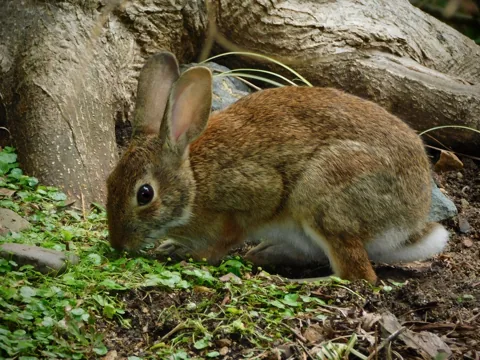 Rabbits (cottontails; eastern cottontail shown)
Sylvilagus species (shown: eastern cottontail, S. floridanus)
Cottontail rabbits are common in yards with brush and dense landscaping. They clip vegetables and flowers in spring and summer and gnaw the bark of young trees and shrubs in fall and winter.
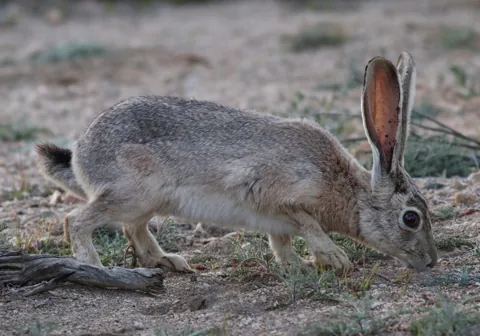 Black-tailed Jackrabbit
Lepus californicus
The black-tailed jackrabbit is a hare, not a true rabbit, common in open country of the western U.S. UC IPM calls it the most destructive rabbit in California gardens and landscapes because of its size and numbers.
Make sure it's rabbits
Rabbits bite off stems and twigs cleanly at a sharp angle, about 45 degrees, as if cut with clippers or a knife. Deer have no upper front teeth, so they leave a ragged, torn edge, and their browsing often sits above the roughly 2 feet a rabbit can reach.[1][5][10]
Other signs are round, pea-sized droppings, tracks left in pairs, and clippings lying on the ground nearby. For a full description of rabbits, their tracks and look-alikes, see the rabbit and jackrabbit profiles linked below.[5][7]
- Plants vanishing overnight, especially young tender shoots, point to a rabbit, according to the Connecticut Agricultural Experiment Station.[10]
- Winter damage: bark gnawed off young trees and shrubs, sometimes all the way around the stem. Deep snow lets rabbits reach higher, and ICWDM says young plants are clipped off up to 2 inches above the height of the snow.[3][4][1]
- Vegetables most often eaten, per Iowa State: snap beans, peas, beets, lettuce and spinach. Tomatoes, potatoes and onions are less likely to be damaged.[9]
- Rabbits often feed at dusk and at night. UC IPM suggests checking the garden after dark with a flashlight, where their eyes shine yellow or red.[1]
Step 1: Fence the garden
UC IPM calls a fence probably the most long-term, effective way to protect plantings, and the Connecticut repellent trial found fencing beat every repellent it tested. A rabbit fence doesn't need to be tall or heavy: ICWDM says 2-foot chicken wire with the bottom tight to the ground or buried a few inches is enough.[1][10][2]
The mesh matters more than the height. Use 1-inch mesh or smaller so young rabbits can't squeeze through. Iowa State notes that 2-inch gaps will hold back adult rabbits in winter but not the young in summer.[2][8][1]
- Height: Missouri and Kansas extension give 18 to 24 inches; ICWDM and Iowa State say 2 feet; the Connecticut station says at least 3 feet. UC IPM says cottontails won't jump a 2-foot fence, but recommends 3 feet above ground where jackrabbits live, and higher where snow piles up.[5][7][2][8][10][1]
- Bottom edge: stake it to the ground or bury it. Sources give different depths: several inches (Missouri, Kansas), about 4 inches (Iowa State natural resources), 1 to 2 inches with U-shaped landscape pins for a vegetable plot (Iowa State Yard and Garden), or at least 6 to 10 inches with a few inches bent outward (UC IPM).[5][7][8][9][1]
- Gates: use tight-fitting gates with sills so rabbits can't dig under the bottom rail, and keep them shut.[1]
- Posts: permanent posts aren't needed. Light stakes, rebar or temporary posts hold chicken wire up.[7][9][6][1]
- Bigger areas: a welded-wire, chain-link or hog-wire fence works if the lower 1½ to 2 feet is covered with 1-inch mesh (ICWDM). Missouri extension says welded wire with mesh no larger than 1 by 2 inches will keep rabbits out of larger areas if it is maintained.[2][5]
- Before you close the last gap, make sure no rabbit is inside. UC IPM warns that a rabbit that gets into a fenced area may not be able to get out.[1]
- Walk the fence now and then and look for digging under the bottom or new damage elsewhere; UC IPM notes that rabbits can switch to new food once they're shut out of the garden.[1][6]
Movable panels, cages and electric netting
If a full fence isn't practical, protect beds or single plants instead. The Connecticut station notes that beans and peas eventually grow above a rabbit's reach and only need cover until then.[10]
- Fence panels: Kansas State describes 18- to 24-inch panels of lumber frames covered with 1-inch poultry netting and wired to light posts at the corners; UC IPM describes 24- to 30-inch wood lath or PVC frames. Both give easy access for gardening, and the panels can be reused or moved.[7][1]
- Domes and cages: secure a dome or cage of chicken wire over a small flower bed while plants get established. Iowa State suggests a wire cover over tulips and other spring flowers until they grow big enough to be less attractive.[2][8]
- Electric netting: UC IPM lists it as suitable for rabbits and easy to move, which makes it handy for seasonal gardens; it suggests consulting a reputable dealer about power sources. The Connecticut station says a two-wire electric fence would deter rabbits.[1][10]
- Drip lines: rabbits chew plastic irrigation tubing. UC IPM suggests hanging it out of reach or running it through 3/4-inch PVC pipe.[1]
Step 2: Guard young trees and shrubs for winter
Rabbits gnaw the smooth, thin bark of young trees. If they strip a ring all the way around the trunk (girdling), the tree or shrub can die because nutrients can no longer move past the wound. Older trees with rough bark are less often gnawed.[1][10][3]
A cylinder of hardware cloth around the trunk is the standard fix. ICWDM says that when rabbits are abundant and food is short, only hardware cloth guarantees protection; paper wraps can be chewed through.[2][5][6]
- Mesh: 1/4-inch hardware cloth, which also stops voles. ICWDM says 1/2- to 3/4-inch mesh can cut cost if the cylinder stands far enough from the trunk that rabbits can't reach the bark through the holes.[2][5][10]
- Height: Missouri extension and the Missouri Department of Conservation give 18 to 24 inches; the Connecticut station says from the ground to 18 inches up; ICWDM says the guard should reach 20 inches higher than the expected depth of snow. MDC warns that guards stop working once snow is deeper than the wire.[5][6][10][2]
- Spacing: set the cylinder 1 to 2 inches from the trunk (ICWDM) or 2 to 4 inches from the bark (Connecticut station). Iowa State says to keep wire with larger holes at least 2 inches away.[2][10][8]
- Anchor it: set the bottom into the ground and stake the cylinder so rabbits can't push it against the trunk. UC IPM buries poultry-netting cylinders 2 to 3 inches and braces them away from the stem.[5][7][1]
- Secure the top of the cylinder so birds don't get trapped inside.[2]
- Multi-stemmed shrubs: circle the whole shrub with hardware cloth or 1-inch wire mesh. Iowa State suggests wire cages around shrubs from November to April.[5][6][8]
- Lighter options: plastic tubes, polypropylene netting and paper, plastic or foil wraps give more temporary protection. Kansas State notes that plastic netting tubes turn brittle in freezing weather, so install them at planting time rather than in a freeze.[5][7][6]
- Keep the ground inside guards clear of leaves and weeds so small rodents don't feed there.[1]
Step 3: Take away cover
Cottontails stay close to thick cover such as brushy fence rows, brush piles and landscaped yards, and they don't dig their own burrows. Missouri extension says they spend most of their lives in 1 to 5 acres of good habitat; Kansas State says 10 acres or less.[5][7][8]
ICWDM says removing cover is especially effective in suburbs, where there is less habitat to fall back on. UC IPM notes it does little against jackrabbits, which travel long distances from cover to feed.[2][1]
- Remove brush piles, rock piles, weed patches, dumps and other debris, especially next to the garden and new plantings.[2][5][6][8]
- Fence or screen off the space under decks, porches and sheds.[8][10]
- Keep the lawn mowed and garden beds weeded; the Connecticut station notes that rabbits like grass and clover.[10]
- Plant daffodils and other resistant spring bulbs in place of tulips, which rabbits favor.[2]
- Clearing cover can also push out other wildlife, such as songbirds and pheasants, so focus on cover next to the garden and new plantings.[1][2][5]
- The Connecticut station suggests a decoy patch of plants rabbits like, planted well away from the main garden, and cautions that lists of plants rabbits don't prefer only go so far, since a hungry rabbit is not a picky eater.[10]
Repellents: what the evidence says
Repellents work by taste or by smell. Taste repellents such as capsaicin (hot pepper) or the fungicide thiram go directly on the plant. Odor repellents based on putrescent egg, garlic, dried blood or ammonium soaps are applied on plants or around the edge of the area.[5][2][7]
In a Connecticut Agricultural Experiment Station trial, eight commercial repellents were tested against a fence and no treatment in six two-week trials on lettuce, Johnny jump-ups and alfalfa, with rabbits kept at an unnaturally high density of 113 rabbits per acre (biologists recommend about one per acre in the wild). The fenced plots did best. A dried-blood powder ranked first among the repellents, not far behind the fence, and the other products varied widely. UC IPM likewise says research shows repellents with dried blood or putrescent whole-egg solids can reduce rabbit browsing.[10][1]
- Food crops: most rabbit repellents are not registered for plants people eat. Read the label before using any repellent near vegetables, herbs or fruit.[1][5][7][2]
- Timing: apply before damage starts, and reapply after rain, heavy dew or sprinklers and as new growth appears.[1][2][6]
- Where they work best: woody plants in winter and young trees before they bear fruit. UC IPM says repellents usually fail in a vegetable garden full of favorite foods, even when labeled for edible crops; Kansas State calls them often unsatisfactory.[1][7][5]
- Making them last: taste repellents usually need a sticker added (thiram's label lists them). Kansas State says one thiram application with a sticker normally lasts the dormant season, and that repellents on trees should be applied 18 to 24 inches above the expected snow depth.[5][7]
- Rabbits can get used to a repellent over time, according to Missouri extension, and the cost of repeated applications adds up.[5]
- Fence first: the Connecticut station's advice is to fence if you can, pick a repellent by performance first and smell second if you can't, and consider using both.[10]
Live-trapping, and what your state allows
Sources disagree on whether homeowners should trap. ICWDM calls cage or box traps the best way to remove rabbits in cities and suburbs, and Kansas State calls wooden cage traps, along with fencing, probably the most practical control in towns. The Connecticut station does not recommend trapping, because rabbits can injure themselves even in a live trap and suffer if traps aren't checked often.[2][7][10]
Trapping also gives only short-term relief. Where habitat is good, rabbits from nearby move in after others are removed, so fencing and guards are still needed.[7][2]
- Season: trapping works best in winter and late winter, when food is scarce. In summer, abundant food and many young make baited traps much less effective.[5][6][2][7]
- Trap size: ICWDM gives 9 by 10 by 24 inches and Kansas State 6 by 6 by 24 inches; Missouri extension says the door should be at least 7 inches tall. Some biologists think wooden box traps catch more than wire cages.[2][7][5]
- Placement: set traps on trails or near cover where rabbits feed or rest, so they don't have to cross open ground. In winter, face the opening away from the wind so snow and leaves don't jam the door.[2][7][1]
- Bait: apples, carrots, cabbage, clover, alfalfa, lettuce or half an ear of dry corn, placed at the back of the trap. Soft baits turn to mush when frozen. Covering a cage trap with dark cloth can help, as long as the cover doesn't block the door.[2][5][7][1]
- Check traps every day, and move a trap that hasn't caught anything in a week.[2][7][1]
- Jackrabbits are very hard to trap because they won't enter a confined space, according to UC IPM.[1]
Rabbit laws: check before you trap or move one
Cottontails are game animals in states such as California, Missouri and Connecticut, so taking them is governed by state wildlife rules, and releasing a trapped rabbit somewhere else can be illegal. A few examples show how much the rules vary; call your state wildlife agency for yours.[5][1][10][6][2]
- California: UC IPM says property owners or tenants can take cottontails and jackrabbits damaging gardens or landscaping at any time without a license, but releasing a rabbit elsewhere requires a written permit, so anyone live-trapping must be prepared to euthanize the rabbit. It is illegal to sell the meat or fur of rabbits taken as pests.[1]
- Missouri: the Missouri Department of Conservation says damage-causing cottontails may be trapped or shot out of season without a permit under its property-protection rule, but black-tailed and white-tailed jackrabbits are species of conservation concern and may not be taken under that rule.[6]
- Kansas: a 1992 Kansas State publication describes cottontails as small game and quotes a state law letting landowners kill animals destroying property, subject to conditions that include making reasonable efforts to solve the problem first.[7]
- Connecticut: the Connecticut station says moving rabbits is regulated by the state Department of Energy and Environmental Protection, and many towns have their own rules on relocating wildlife.[10]
- Shooting is restricted or banned in many towns and suburbs, so check local ordinances first.[1][2][6]
If you find a nest of baby rabbits
Cottontails nest right in lawns and gardens. The nest is a shallow, softball-sized hollow lined with fur and dry grass, and the young leave it at about 2 to 3 weeks old.[11][7][5][3]
Wisconsin's Department of Natural Resources says the mother stays away on purpose so she doesn't lead predators to the nest, and comes back only briefly at dawn and dusk to feed the young. A nest that looks abandoned usually isn't.[11]
- If a pet, a child or a mower disturbs the nest, put the young back and rebuild it in the same spot; the mother won't search for a nest that has been moved.[11]
- To keep a pet away, Wisconsin DNR suggests a laundry basket weighted over the nest during the day, removed before dusk each evening so the mother can get in.[11]
- To check whether she's coming back, lay fine grass stems or twigs in a crisscross over the nest and look the next morning. If they've been moved, she has fed the young. Then stay away, since your scent can draw predators.[11]
- A young cottontail about the size of a softball (4 to 5 inches long), with its eyes open and ears up, can fend for itself and should be left alone. For a rabbit that is truly orphaned or hurt, contact a licensed wildlife rehabilitator.[11]
What doesn't work
Several popular fixes do little or carry their own risks.[2][1][6]
- Scare devices: pinwheels, hanging pie pans, jars of water, noisemakers, flashing lights and ultrasonic units are not effective, per ICWDM, UC IPM and Kansas State. Iowa State and the Connecticut station say fake owls, scarecrows and the like work briefly until rabbits get used to them.[2][1][7][8][10]
- Mothballs: the Missouri Department of Conservation says they don't keep rabbits away, and the naphthalene in them is toxic and its vapor harmful to people.[6]
- Poison: ICWDM says no toxicants are registered for rabbit control; UC IPM says the restricted-use baits sold for serious farm damage aren't practical for homeowners.[2][1][7]
- Removing a few rabbits without fencing: others move in.[7][2]
- Paper tree wraps when rabbits are hungry: they can chew through them.[2]
Handling rabbits safely: tularemia
CDC says people can get tularemia from tick and deer fly bites and from contact with infected animals, especially rodents, rabbits and hares, which often die in large numbers during outbreaks.[12]
CDC's prevention advice for yard work: avoid contact with sick or dead animals, wear gloves when handling animals (especially rabbits), check the area for carcasses before mowing, and don't mow over sick or dead animals.[13][4]
Common questions
- What is the best way to keep rabbits out of a garden?
- A fence of 1-inch wire mesh about 2 feet high with the bottom buried or staked tight to the ground. Extension specialists and a Connecticut field trial rank fencing above repellents.[2][1][10][5]
- How tall does a rabbit fence need to be?
- Cottontails won't jump a 2-foot fence, according to UC IPM, and most extension sources give 18 to 24 inches. The Connecticut station says at least 3 feet, and UC IPM suggests 3 feet where jackrabbits occur.[1][5][7][2][10]
- How do I protect young trees from rabbits in winter?
- Circle the trunk with 1/4-inch hardware cloth set into the ground and standing a little away from the bark, tall enough to stay above the snow. Missouri sources give 18 to 24 inches; ICWDM says 20 inches above the expected snow depth.[5][6][2]
- Do rabbit repellents work?
- Some reduce browsing for a while. In a Connecticut trial a dried-blood powder did best among eight products, but none matched a fence. Most can't be used on food crops and must be reapplied after rain and new growth.[10][1][5]
- Can I trap a rabbit and release it somewhere else?
- Often not legally. California requires a written permit to release one elsewhere, Connecticut regulates moving rabbits, and other states vary. Check your state wildlife agency first.[1][10][6]
- I found baby rabbits in my garden. What should I do?
- Leave them. The mother visits only at dawn and dusk. If the nest was disturbed, rebuild it in the same place; Wisconsin DNR explains how to check that she is still feeding them.[11]
Photo credits
- Rabbits (cottontails; eastern cottontail shown): (c) Michael J. Papay, some rights reserved (CC BY) — via iNaturalist, CC BY 4.0
- Black-tailed Jackrabbit: (c) Jan Ebr & Ivana Ebrová, some rights reserved (CC BY) — via iNaturalist, CC BY 4.0
Sources
- University of California Statewide IPM Program, “Rabbits (Pest Notes, Home and Landscape).” ipm.ucanr.edu/home-and-landscape/rabbits/ (accessed 2026-11-10)
- Internet Center for Wildlife Damage Management, “Rabbit Damage Prevention and Control Methods.” icwdm.org/species/other-mammals/rabbits/rabbit-damage-prevention-and-control-methods/ (accessed 2026-11-10)
- Internet Center for Wildlife Damage Management, “Rabbit Biology.” icwdm.org/species/other-mammals/rabbits/rabbit-biology/ (accessed 2026-11-10)
- Internet Center for Wildlife Damage Management, “Rabbit Damage Identification.” icwdm.org/species/other-mammals/rabbits/rabbit-damage-identification/ (accessed 2026-11-10)
- University of Missouri Extension, “Preventing and Controlling Damage Caused by Cottontail Rabbits (G9441).” extension.missouri.edu/publications/g9441 (accessed 2026-11-10)
- Missouri Department of Conservation, “Cottontail Rabbit Control.” mdc.mo.gov/index%2Ephp/node/97 (accessed 2026-11-10)
- Kansas State University Agricultural Experiment Station and Cooperative Extension Service, “Cottontail Rabbits, Urban Wildlife Damage Control (L-858).” bookstore.ksre.ksu.edu/pubs/l858.pdf (accessed 2026-11-10)
- Iowa State University Extension and Outreach, Natural Resources, “Rabbits: Damage Management.” naturalresources.extension.iastate.edu/encyclopedia/rabbits-damage-management (accessed 2026-11-10)
- Iowa State University Extension and Outreach, Yard and Garden, “How do I prevent rabbits from damaging plants in the vegetable garden?.” yardandgarden.extension.iastate.edu/faq/how-do-i-prevent-rabbits-damaging-plants-vegetable-garden (accessed 2026-11-10)
- The Connecticut Agricultural Experiment Station, “Reducing rabbit damage in Connecticut (fact sheet).” portal.ct.gov/-/media/caes/documents/publications/fact_sheets/forestry_and_horticulture/effectivenessofrabbitrepellentsinctfactsheetmarch2015pdfpdf.pdf (accessed 2026-11-10)
- Wisconsin Department of Natural Resources, “Cottontail Rabbit (Keep Wildlife Wild).” dnr.wisconsin.gov/topic/WildlifeHabitat/orphan/CottontailRabbit (accessed 2026-11-10)
- U.S. Centers for Disease Control and Prevention, “About Tularemia.” www.cdc.gov/tularemia/about/index.html (accessed 2026-11-10)
- U.S. Centers for Disease Control and Prevention, “Preventing Tularemia.” www.cdc.gov/tularemia/prevention/index.html (accessed 2026-11-10)