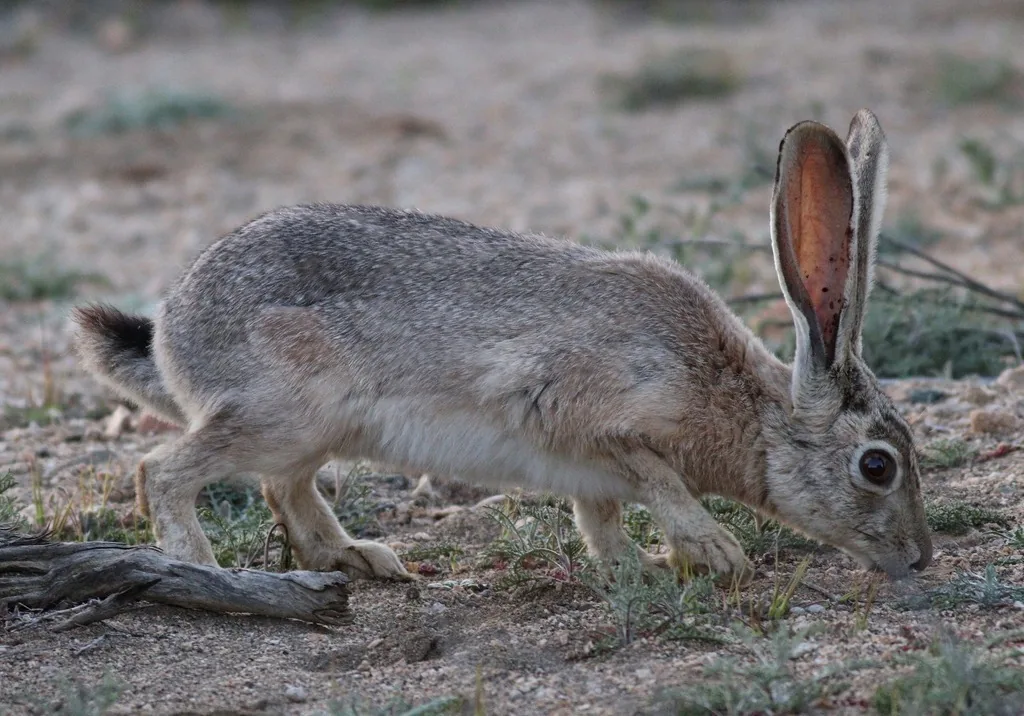
How to identify it
- About the size of a house cat: 3 to 7 pounds and 17 to 21 inches long.[1][2]
- Grayish-brown body with very long, black-tipped ears, long front legs and even longer hind legs.[1][2]
- The top of the tail has a black streak, which gives the black-tailed jackrabbit its name.[1][2]
- Droppings are round pellets up to about 1/2 inch across, roughly twice the size of cottontail pellets.[1]
- Clipped twigs and stems show a clean, angled 45-degree cut, as if made with a knife, usually within about 2 feet of the ground.[1]
Look-alikes
| Look-alike | How to tell them apart |
|---|---|
| Cottontails and brush rabbits | Smaller, with shorter ears: desert cottontails are 12 to 15 inches and under 3 pounds. They stay near dense cover and their young are born nearly furless with closed eyes.[1] |
| White-tailed jackrabbit | A larger hare of the north-central and northwestern U.S., weighing 5 to 10 pounds, with an all-white tail and often a white or pale coat in winter.[2] |
| Deer browsing | Deer lack upper front teeth and leave ragged, torn twig ends, often higher than a rabbit can reach. Jackrabbits leave clean, angled cuts.[1] |
Where it lives
Found mainly in the southwestern U.S. and the southern Great Plains, reaching no farther north than central South Dakota and southern Washington.[2]
Biology and life cycle
Jackrabbits prefer open or semi-open land and adapt well to urban fringes, golf courses, parks, airports and farmland. They rest by day in a shallow scrape, called a form, under a bush.[1]
Breeding runs from late January through August, or year-round where winters are mild. Litters average 2 to 4, with up to 5 or 6 litters a year.[1]
Young are born fully furred with open eyes and can move about quickly within a day.[1][3]
They feed mainly from evening through the night into early morning, eat mostly green grasses and herbaceous plants, and can survive without drinking water.[1]
When food and shelter are apart, jackrabbits travel 1 to 2 miles each way on the same trails daily, and up to 10-mile round trips in dry periods.[1][3]
Damage and signs
- They eat vegetables such as beans, lettuce, carrots and peas, plus fruit, berry and nut crops, herbs, flowers, shrubs and turf.[1]
- Jackrabbits gnaw the smooth bark of young trees and can girdle them, and they chew plastic drip irrigation tubing.[1]
- Unlike cottontails, jackrabbits feed far out into open areas and can eat 1/2 to 1 pound of green vegetation each day.[1][3]
- Damage near rangeland is often worst when wild vegetation dries out. Alfalfa, lettuce, young cotton and young grapevines are favorites, while corn is usually safe past the seedling stage.[4][5]
- When jackrabbits are numerous they can overgraze rangeland; ICWDM estimates eight of them eat as much as one sheep.[4][3]
Health risk
Jackrabbits can carry tularemia (rabbit fever), which people can catch by handling an infected animal bare-handed or eating undercooked meat. Wear gloves, avoid hares that are dead or acting sick, and guard against their ticks and fleas.[1][4]
Control
Keep them out
A fence is the most reliable long-term protection. UC IPM suggests poultry netting with mesh no larger than 1 inch, with the bottom buried 6 to 10 inches.[1][5]
Jackrabbits rarely jump a 2-foot fence unless chased, so UC IPM advises at least 3 feet above ground to discourage jumping.[1]
Electric netting or a multi-strand electric fence can also keep jackrabbits out, and suits seasonal gardens.[1][5]
Protect young trees and vines with cylinders of 1-inch poultry netting, buried 2 to 3 inches and braced away from the trunk so jackrabbits can't chew through.[1][5]
Traps and physical control
Trapping rarely works, since jackrabbits are reluctant to enter a cage or other enclosed space. Removing brush also does little, because they rest far from where they feed.[1][5]
Pesticides
Taste and odor repellents, such as those based on dried blood, egg solids or thiram, help most on woody plants. Apply before damage starts, reapply after rain or new growth, and follow the label.[1][5]
Repellents usually fail in vegetable gardens full of favorite foods, and many cannot be used on plants people eat.[1]
When to call a professional
Toxic baits are restricted-use products for agricultural crop damage and aren't practical for most homeowners. Contact your local Cooperative Extension office for help.[1][5]
Legal status
Jackrabbits are non-game animals in most states, but a few states protect them, so check with your state wildlife agency before using lethal control.[2][5]
In California they are game mammals, but owners or tenants may control jackrabbits damaging crops, landscaping or gardens without a license. Shooting requires nonlead ammunition and must follow local firearm rules.[1]
Some states require permits to shoot from vehicles or with spotlights.[5]
Common questions
- How high does a fence need to be to stop jackrabbits?
- UC IPM recommends about 3 feet above ground with the bottom buried. Jackrabbits rarely clear 2 feet, but a scared or chased one may.[1]
- Is it a jackrabbit or a cottontail eating my garden?
- Jackrabbits are bigger, with very long black-tipped ears and larger droppings up to 1/2 inch. Cottontails are smaller, short-eared and stay near cover.[1]
- Will a live trap catch a jackrabbit?
- Rarely. Both UC IPM and ICWDM note that jackrabbits avoid entering box or cage traps, so fencing and tree guards work better.[1][5]
Sources
- University of California Statewide IPM Program, “Rabbits (Pest Notes, Home and Landscape).” ipm.ucanr.edu/home-and-landscape/rabbits/ (accessed 2026-10-06)
- Internet Center for Wildlife Damage Management, “Hares: Identification.” icwdm.org/species/other-mammals/hares/ (accessed 2026-10-06). Run by university wildlife damage specialists (maintained at the University of Wisconsin-Stevens Point); species modules are based on Prevention and Control of Wildlife Damage (University of Nebraska Cooperative Extension, 1994).
- Internet Center for Wildlife Damage Management, “Hare Biology.” icwdm.org/species/other-mammals/hares/hare-biology/ (accessed 2026-10-06). Run by university wildlife damage specialists (maintained at the University of Wisconsin-Stevens Point); species modules are based on Prevention and Control of Wildlife Damage (University of Nebraska Cooperative Extension, 1994).
- Internet Center for Wildlife Damage Management, “Hare Damage Identification.” icwdm.org/species/other-mammals/hares/hare-damage-identification/ (accessed 2026-10-06). Run by university wildlife damage specialists (maintained at the University of Wisconsin-Stevens Point); species modules are based on Prevention and Control of Wildlife Damage (University of Nebraska Cooperative Extension, 1994).
- Internet Center for Wildlife Damage Management, “Hare Damage Prevention and Control Methods.” icwdm.org/species/other-mammals/hares/hare-damage-prevention-and-control-methods/ (accessed 2026-10-06). Run by university wildlife damage specialists (maintained at the University of Wisconsin-Stevens Point); species modules are based on Prevention and Control of Wildlife Damage (University of Nebraska Cooperative Extension, 1994).
- iNaturalist, “Lepus californicus taxon page (order and family).” www.inaturalist.org/taxa/43130 (accessed 2026-10-06)