How to identify it
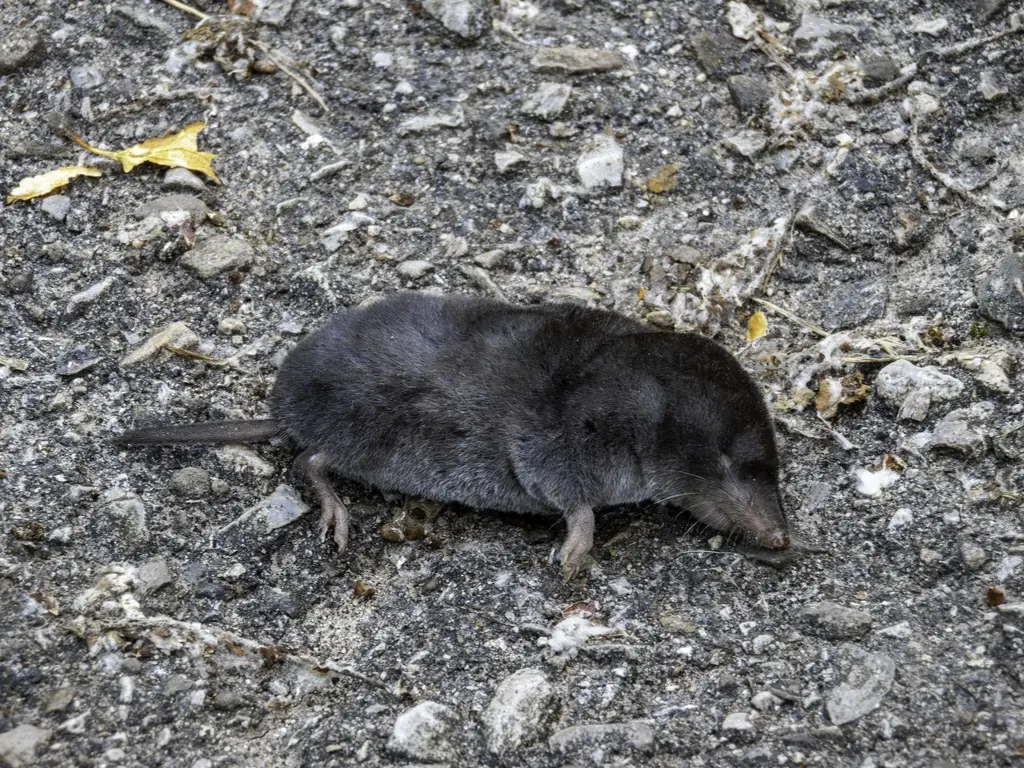
- Shrews have an elongated, pointed snout, dense fur of one uniform color, very small eyes and five clawed toes on each foot.[1]
- Their teeth are small and sharp, and in many species the tips are dark from iron deposits.[1]
- The northern short-tailed shrew averages about 4 1/2 inches long including the tail and weighs about 2/3 ounce, making it a fairly large shrew.[2]
- It is grayish black, sometimes with a silvery or brownish cast, has no visible external ears, and its tail is always less than half the length of the head and body.[2]
Look-alikes
| Look-alike | How to tell them apart |
|---|---|
| House mouse | Mice have four toes on the front feet, larger eyes, two-toned fur and no long pointed snout.[1] |
| Moles | Moles are usually larger than shrews and have greatly enlarged front feet for digging.[1] |
Where it lives
More than 30 shrew species live in North America, in nearly every land habitat; the northern short-tailed shrew favors damp woods and grassy fields with thick leaf litter.[1][2]
Biology and life cycle
Shrews burn energy fast and may need to eat every 3 to 4 hours, sometimes eating up to three times their body weight in a day.[1]
They eat mostly insects plus earthworms, slugs, snails, spiders, centipedes and millipedes, and sometimes small mice, birds or snakes.[1][2]
The northern short-tailed shrew is active day and night all year, digs tunnels in soil or snow, and also uses tunnels made by moles and voles.[2][1]
Its saliva is venomous and helps it subdue prey.[2][1]
It breeds from March to November, with 3 or 4 litters of 6 or 7 young, and lives 1 to 2 years.[2]
Nests of dry leaves, grass and hair are built under logs, stumps, rocks or debris.[2]
Damage and signs
- In and around homes, shrews occasionally fall into window wells, feed on stored food and contaminate it with droppings and urine.[1]
- They may attack pets or birds and chipmunks at feeders.[1]
- Outdoors, northern short-tailed shrews can damage ginseng roots, and other shrews eat tree seeds or raid fish hatcheries and beehives.[1]
Health risk
Shrews may bite if handled carelessly, and the short-tailed shrew's saliva is venomous; disease spread to people is poorly documented. Pick up a dead shrew with a plastic bag turned inside out and seal it.[1][2]
Control
Prevention
Mow regularly around buildings to reduce shrew habitat and food and expose them to predators.[1]
Keep them out
Cover potential entry points with 1/4-inch hardware cloth, and pack small openings with steel wool.[1]
Traps and physical control
Mouse snap traps set across runways, or small box traps baited with peanut butter and rolled oats, can catch shrews.[1]
Because shrews eat insects, live-caught animals can be released in suitable habitat more than 200 yards away, where state rules allow.[1]
Pesticides
No repellents, toxicants or fumigants were registered for shrews when the wildlife damage handbook was written, so trapping and exclusion are the practical tools.[1]
Shrews are not rodents
Shrews belong to the insect-eating mammals, not the rodents; their long, narrow skull lacks the cheekbone arch rodents have.[1][2]
Since they mainly eat insects and other small invertebrates, a shrew in the yard is usually helpful rather than a pest.[1]
Some states have special rules for nongame animals like shrews, so check with your state wildlife agency before trapping or moving them.[1]
Common questions
- Is a shrew a kind of mouse?
- No. Shrews are insect eaters with pointed snouts, tiny eyes and five toes on each front foot; mice are rodents with bigger eyes and four front toes.[1]
- Are shrews poisonous?
- The northern short-tailed shrew has venomous saliva that it uses on prey. Shrews may bite if handled, so don't pick one up bare-handed.[2][1]
- How do I get a shrew out of my house?
- Set mouse snap traps or small box traps along walls, then seal gaps with 1/4-inch hardware cloth or steel wool so others can't get in.[1]
Sources
- University of Nebraska-Lincoln Cooperative Extension, USDA-APHIS Animal Damage Control and Great Plains Agricultural Council, “Shrews, in Prevention and Control of Wildlife Damage (R. H. Schmidt, 1994).” digitalcommons.unl.edu/icwdmhandbook/55 (accessed 2026-10-06). 1994 handbook chapter (the basis of the Internet Center for Wildlife Damage Management's shrew material); used for identification, damage and control. Check current state rules for legal status.
- Virginia Department of Wildlife Resources, “Northern short-tailed shrew (species profile, updated November 29, 2023).” dwr.virginia.gov/wildlife/information/nothern-short-tailed-shrew/ (accessed 2026-10-06)
- iNaturalist, “Blarina brevicauda taxon page (order and family).” www.inaturalist.org/taxa/63113 (accessed 2026-10-06)