The short answer
- Lock down garbage: metal or plastic cans with lids that stay on even if the can tips, held with bungee cords or wire, set in a rack or tied to a post. Storing cans inside a secure building is best.[1][4]
- Bring pet food and water in before dark, pick up fallen fruit and nuts, and keep meat, eggs, fats and oils out of compost. Never feed raccoons, and ask neighbors not to.[1][4]
- Hang bird feeders on a wire between trees or on a baffled pole, and use feeders that catch spilled seed.[4][13]
- Screen the space under decks, porches and sheds with galvanized hardware cloth buried at least 6 inches and bent outward 12 inches, but only after you're sure no raccoons, including young, are inside.[1][4]
- Protect sweet corn, melons and new sod with a low two-wire electric fence run from dusk to dawn, where legal.[1][4]
- Treat raccoon droppings as hazardous: CDC says they can carry roundworm eggs that seriously harm people who swallow them. Remove them promptly with gloves, and cover sandboxes.[12][13]
- Check your state's rules before trapping. California, New York and Missouri limit or advise against releasing trapped raccoons elsewhere, and Pennsylvania lists raccoons as a rabies vector species that should not be relocated.[1][7][6][8]
Related profiles
 Raccoon
Procyon lotor
Raccoons are masked, ring-tailed mammals that adapt very well to towns and suburbs. They raid garbage and gardens, den in attics, chimneys and under decks, and can carry rabies and raccoon roundworm.
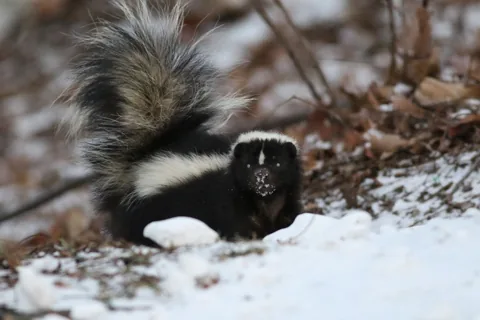 Striped skunk
Mephitis mephitis
The striped skunk is a cat-sized, black and white mammal that often lives under porches, decks and sheds. It digs lawns for grubs, sprays pets that corner it, and is one of the main wildlife carriers of rabies.
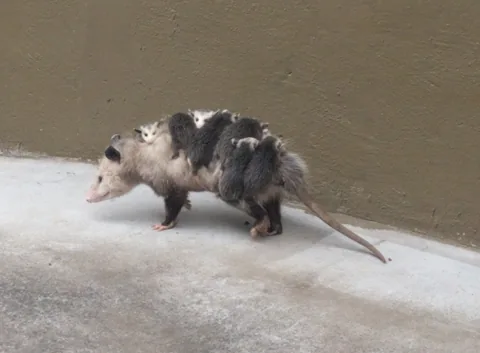 Virginia opossum
Didelphis virginiana
The Virginia opossum is North America's only marsupial, a cat-sized animal with a pointed face and a long, hairless tail. Around homes it raids pet food, garbage and fruit and dens under decks, sheds and houses.
Signs it's a raccoon
Raccoons are active mainly at night, so they're often around for a while before anyone sees one. UC IPM says you may spot them in the garden after dark or peering in a sliding glass door, and that feeding damage, tracks and droppings are the usual clues.[1]
- Looks: a black mask over the eyes and a heavily furred tail with alternating light and dark rings. UC IPM gives adults as about 2 to 3 feet long and 7 to 30 pounds; Missouri Department of Conservation gives 21 1/2 to 38 inches total length and 6 to 25 pounds, with males heavier.[1][5]
- Tracks: they look like small bare hands, and the claws often show. Missouri gives the front track as 2 1/2 to 3 inches long and the hind track as 3 3/4 to 4 inches, like a small human footprint with long toes.[5]
- Tipped or opened garbage: ICWDM says garbage cans and dumps can be a major food source in towns, and UC IPM notes raccoons can unhook simple latches with their handlike front paws.[3][1]
- Rolled-up sod: strips of turf peeled back, sometimes over large areas on successive nights (see the lawn section below).[3][1]
- Sweet corn: many partly eaten ears with the husks pulled back, and stalks broken where the raccoon climbed. Melons get a small hole dug in them and the insides raked out with a paw.[3][1]
- Poultry losses: ICWDM says raccoons usually bite off an adult bird's head and leave it away from the body, may tear the crop and breast, and reach through wire to pull young birds, leaving missing legs or feet. Eggs may be eaten on the spot, with the shell cracked along its long axis.[3]
- Latrines: piles of droppings that raccoons return to. CDC describes the droppings as dark and tubular, with a strong odor (usually worse than dog or cat feces), often holding undigested seeds or other food bits.[13]
Why raccoons pick your yard
UC IPM says raccoons are drawn to gardens and homes because they offer food and den sites, and because urban food and dens are plentiful, city and suburban raccoon populations can become very large.[1]
- They eat almost anything: fruits, berries, nuts, acorns, corn and grain, plus crayfish, fish, frogs, snails, insects, turtles and the eggs and young of ground-nesting birds. In towns they add backyard produce, garbage and compost.[1][2][5]
- Pet food left out overnight ranks high as a food source, UC IPM says, and bird feeders are another dependable one.[1]
- Den sites: hollow trees, brush piles, rock crevices, woodpiles, and spaces under sheds, porches and decks. ICWDM says raccoons prefer crevices and need only a 4-inch gap to get into a space.[1][2][3]
- They range widely. ICWDM gives adult male territories of 3 to 20 square miles and 1 to 6 square miles for females; Missouri gives a home range of 1 to 10 square miles. ICWDM says that because they forage so widely, only local changes to the habitat around your property help.[2][5][4]
- Storm drains, culverts, parks and greenbelts can serve as reservoirs. UC IPM says some neighborhood problems are beyond one homeowner and need a community effort, including enforcing a ban on feeding raccoons.[1]
Step 1: Garbage, pet food, bird feeders and compost
Taking away food comes first in both UC IPM and ICWDM. CDC's roundworm prevention advice starts in the same place: keep raccoons away from food, trash and water so they don't settle in.[1][4][13]
- Garbage cans: use metal (ICWDM's preference) or plastic cans with tight-fitting lids that stay attached even if the can is knocked over. Hold loose lids down with bungee cords, wire, weights or clamps, and keep cans in a rack or tied to a support so they can't be tipped. The best fix is storing cans inside a secure building.[4][1]
- Pet food and water: bring both in before nightfall.[1][4]
- Fruit and nuts: pick up what falls, often.[1]
- Compost: use only plant and vegetable matter, with no meat, eggs, fats or oils, so it doesn't draw raccoons, opossums, skunks and other scavengers. See the compost guide for bins.[4]
- Bird feeders: CDC's roundworm page simply says to remove them. If you keep them, ICWDM suggests hanging feeders on a wire between trees or on a baffled pole, using one type of seed per feeder rather than mixed seed, and using feeders that catch fallen seed.[13][4]
- Outbuildings: close outbuilding and outdoor laundry-room doors at night.[4]
- Feeding: never put food out for raccoons. UC IPM says it only attracts more, and in a 2024 Los Angeles County case report, neighbors regularly fed outdoor cats near a home where raccoons were often seen, which the report notes can attract raccoons.[1][16]
Raccoons tearing up the lawn (grubs)
UC IPM and ICWDM say raccoons roll up turf, especially freshly laid sod, to get at earthworms and grubs. They don't usually dig holes. UC IPM says small cone-shaped holes in a lawn are more likely skunks; see the skunk guide for that problem.[1][3]
- When it happens: ICWDM says sod rolling is most common in mid- to late summer, when young raccoons are learning to forage, and in dry spells when other food is scarce. Raccoons may come back night after night and roll up large areas.[3][4]
- New sod: pin the strips down with long wire pins, wooden stakes or nylon netting until the grass roots in. ICWDM says having sod laid in spring or early summer may avoid the problem.[4]
- Electric fence: UC IPM describes a low two-wire fence, one wire 6 inches above the ground and one at 12 inches, around newly laid sod, taken down once the turf has rooted. ICWDM also recommends electric fencing where damage is extensive and it is legal.[1][4]
- Grub control: ICWDM says grub insecticides only help if the grubs are controlled before the damage starts, and in most cases the problem raccoons have to be removed. The white grub guide explains how to check grub numbers and when to treat.[4]
Protecting sweet corn, melons and other crops
UC IPM says ordinary fences don't stop raccoons; they climb over or dig under, find weak spots, pull off loose boards and enlarge holes in wire. Sweet corn is a favorite, and damage usually happens right before harvest.[1][3]
- Two-wire electric fence: wires at 6 and 12 inches above the ground on evenly spaced wooden posts, run from dusk to dawn, are very effective for sweet corn, melons and other favored crops, per UC IPM. ICWDM says to turn it on before dusk and off after daybreak.[1][4]
- Hot wire on an existing fence: UC IPM says one electrified strand 8 inches above the ground and about 8 inches out from the base of an ordinary fence makes it raccoon-proof. A hot wire at the top of a fence also helps, ICWDM says.[1][4]
- Electric fence safety: UC IPM says such fences must be installed properly, are not right for every situation and should always carry warning signs. Check whether they're legal where you live.[1][4]
- Taping ears: in small gardens, ICWDM says wrapping ripening ears with glass-filament tape, each loop closed over itself, or covering them with plastic bags cuts raccoon damage to sweet corn by 70% to 80%. Tape and fences work better than bags.[4]
- Placement: ICWDM suggests not planting sweet corn near creek bottoms or woods.[4]
- Trees: UC IPM says an electrified wire wrapped around a tree trunk discourages climbing.[1]
Ponds, pools and water
Raccoons fish and drink from backyard water. UC IPM says they sometimes take koi from ponds, and CDC's roundworm prevention list includes removing fish ponds and other water sources, because raccoons eat the fish and drink the water.[1][13]
- Ponds: UC IPM says low electric fences are sometimes used around ponds to protect koi and goldfish.[1]
- Pools: CDC says to keep raccoons out of pools and watch for their droppings, which in pools usually turn up in shallow areas such as the steps. Raccoons tend to use the same spots repeatedly.[15]
- Keeping them out: CDC suggests covering the area of the pool raccoons have visited, keeping the pool fence closed, and finding and discouraging any nearby food sources such as outdoor pet food or loose trash.[15]
- Droppings or a dead raccoon in the pool: CDC says to close the pool to swimmers right away and call local animal control for any local recommendations. If there are none, put on disposable gloves, scoop the feces or carcass out with a net, double-bag it along with the net and gloves, put the bags in a sealed trash can, and wash your hands with soap and water.[15]
- Chlorine doesn't kill roundworm eggs: CDC says pool chlorine kills most germs a raccoon could carry but not Baylisascaris eggs. It suggests either filtering for at least 24 hours, backwashing and replacing the filter material, or backwashing, draining and hosing down the pool, replacing the filter material and refilling. CDC adds that it knows of no human cases linked to pools.[15]
Raccoon latrines and sandboxes
Raccoons use shared toilet sites called latrines. CDC says they are often at the base of trees or in raised forks, and on flat raised surfaces like fallen logs, stumps, large rocks, woodpiles, decks and rooftops, as well as in attics and garages. Raccoons will also use a sandbox, so CDC says to keep sandboxes covered when not in use.[13][14]
- Why it matters: roundworm eggs in the droppings can't be seen without a microscope, and an infected raccoon usually looks healthy, CDC says, so treat every latrine as if it could be contaminated.[13]
- Timing: CDC and the Wisconsin Department of Health Services say fresh eggs take 2 to 4 weeks to become infectious, so removing droppings promptly lowers the risk. CDC says the eggs can survive for years with enough moisture.[12][17][14]
- Gear: disposable gloves; rubber boots you can scrub or disposable shoe covers; and, in a confined space, an N95-rated respirator. Mist the area lightly with water to keep dust down.[13]
- Removal: take up the droppings and any contaminated material and burn it, bury it or send it to a landfill, without getting it on your hands or clothes.[13][17]
- Surfaces: CDC says most chemicals don't kill roundworm eggs but heat kills them instantly, so treat soiled decks and patios with boiling water or a propane torch (ask your local fire department about rules and safety first).[13][17]
- Afterward: wash your hands well with soap and warm running water and launder clothes in hot water with detergent. CDC says local animal control can also help.[13]
- Roof latrines: in one of the 2024 Los Angeles County cases, droppings from a latrine on a sloping roof rolled onto the steps by the back door. The health department recommended removing the latrine, cleaning the area and excluding the raccoons.[16]
Raccoons denning under a deck, porch or shed
UC IPM says spaces under porches, decks, garden and tool sheds are common den sites, and raccoons may damage crawl-space doors trying to get under a house. ICWDM calls exclusion usually the best method, but it has to wait until the animals are out.[1][4]
- Check for young first: most litters are born in April or May, though UC IPM and ICWDM both say some come earlier or later, as late as August. Litters run three to six, averaging about four (UC IPM), or average 3 to 5 (ICWDM).[1][2][5]
- Weaning: ICWDM says young open their eyes at about 3 weeks and are weaned between 2 and 4 months; Missouri says they are usually weaned by August and stay with the mother until the next spring.[2][5]
- Wait if you can: the Pennsylvania Game Commission advises letting young leave a maternity den, and says waiting until fall is a good bet, before blocking access. ICWDM says not to finish any exclusion until you're sure every raccoon has left, and to close the opening right after they're gone.[8][4]
- Mesh: UC IPM specifies 10-gauge 1/4- or 1/3-inch galvanized hardware mesh, with the bottom edge buried at least 6 inches deep, bent outward 12 inches and covered with soil. It says this keeps out skunks, opossums, squirrels and rats too.[1]
- Brush and woodpiles: UC IPM suggests removing woodpiles and other materials raccoons can den in or under and thinning overgrown shrubs.[1]
- Roof access: cut back branches so there's at least 5 feet between trees and the roof, and consider removing trellises and arbors attached to the house. ICWDM notes that capping the chimney or removing the specific raccoon is usually more practical than trying to keep raccoons off the roof entirely.[1][4]
- Attics and chimneys: see the attic guide for chimney caps, attic entry points and chimney litters.[1][4]
Chickens and other poultry
- Shut free-ranging poultry in fenced, predator-proof runs overnight.[4]
- ICWDM says tightly covered doors and windows on coops, or mesh fences with an overhang around the poultry yard, prevent damage, and a hot wire at the top of the fence makes it much more effective because raccoons climb ordinary fences and use overhanging limbs.[4]
- Young birds in wire pens are at risk too: ICWDM says raccoons reach through the wire and try to pull them back through the mesh.[3]
Trapping and what your state allows
UC IPM advises homeowners who aren't experienced with raccoons to hire a professional wildlife control operator, who can tell if a trapped female is nursing young (so babies aren't left to starve) and can legally dispose of the animal. If you trap yourself, read the live-trapping guide first.[1]
- Trap size: at least 10 x 12 x 32 inches, sturdily built (UC IPM and ICWDM). UC IPM says larger 15 x 15 x 36-inch traps are even better.[1][4]
- Bait: canned fish, fish-flavored cat food, sardines or chicken work but can catch cats and dogs. UC IPM suggests marshmallows, grapes, prunes, peanut butter or sweet rolls to avoid cats. Lay small pieces leading up to the trap with a pile behind the treadle.[1][4]
- Set-up: cover the back of the trap with 1/2-inch or smaller mesh so the raccoon can't reach in from outside, and anchor or weight the trap so it can't be flipped. ICWDM warns that a caged raccoon will grab anything within about 12 inches, including siding, shingles and hoses.[1][4]
- Timing: set traps at night and close them in the morning to avoid catching other animals.[1]
- California: raccoons are furbearers; those causing damage may be taken at any time by legal means, but state rules bar relocating them without written permission from the Department of Fish and Wildlife. Some counties run nuisance-animal trapping programs; ask your agricultural commissioner.[1]
- New York: the Department of Environmental Conservation lists a raccoon that digs up your yard or eats your garden as damaging wildlife, which you may take without a DEC permit (out of season it must be buried or cremated immediately). A raccoon that is only a nuisance requires a permit. DEC says it is illegal to move a live-trapped animal off your property.[7]
- Missouri: you or someone acting for you may trap or shoot most damage-causing wildlife out of season without a permit, but the Department of Conservation does not recommend relocation, because it can spread disease and push the problem onto someone else.[6][5]
- Pennsylvania: the Game Commission lists raccoons among rabies vector species that should not be relocated, so a homeowner who traps one has to choose between dispatching it and releasing it. If someone is bitten or scratched, the animal will need rabies testing.[8]
- Shooting: UC IPM and ICWDM say most towns and cities don't allow it. Check state and local rules before using any lethal method.[1][4]
What doesn't work
- Scare devices: UC IPM says motion-activated lights, noisemakers and sprinklers, radios, scarecrows, flags and spinning windmills may work for a few days before raccoons learn there's no threat. ICWDM says none give long-term protection.[1][4]
- Repellents: UC IPM says none of the commercial wildlife repellents have been effective for raccoons, and mothballs, blood meal and other home remedies have failed. ICWDM notes one contact taste repellent is registered for painting on surfaces raccoons chew, but not for use on edible plants or fruit-bearing crops.[1][4]
- Poison: no toxicants are registered for raccoons.[4]
- Ordinary fences: raccoons climb over, dig under or tear through them unless an electric wire is added.[1][4]
- Moving them: UC IPM says released raccoons may come back or become someone else's problem, and that releases are a major way diseases spread to pets, other animals and people.[1][6]
Raccoons and rabies
CDC lists raccoons with bats, skunks and foxes as the animals most often found with rabies in the US, and says more than 90% of reported animal cases are in wildlife. Rabies is deadly once symptoms start but preventable with prompt medical care.[9][10]
- Keep your distance: CDC says never to approach wild animals that look injured, sick or dead, especially animals that are usually active at night, such as raccoons, seen out during the day. Call animal control instead.[10]
- Odd behavior: the New Jersey Department of Health says rabid animals may act strangely, with aggression and signs of nerve damage such as vocalizing, circling and paralysis.[11]
- Bites, scratches or saliva contact: CDC says to wash any wound right away with soap and water for 15 minutes and seek medical care urgently. New Jersey's health department says to notify the local health department where the animal is, which can advise your doctor about treatment and may arrange testing of the animal.[10][11]
- Treatment: CDC says post-exposure prophylaxis (wound care, rabies immune globulin and a series of vaccines given as soon as possible) is nearly 100% effective. Your health department can determine whether you need it.[9][10]
- Pets: keep pets' rabies vaccinations current and keep them away from wildlife as much as possible.[10][1]
Raccoon roundworm: what health agencies say
Raccoon roundworm (Baylisascaris procyonis) lives in raccoons' intestines, usually without making them sick, and its eggs pass in their droppings. CDC says human infections are rare but can be severe if the larvae reach the eyes, organs or brain.[12][13][17][14]
- How common in raccoons: the Wisconsin Department of Health Services says about half of raccoons tested there were infected. A 2025 CDC report says up to 80% of raccoons in the Northeast, Midwest and West Coast regions are affected, and that one raccoon can shed millions of eggs a day.[17][16]
- How people get it: by swallowing infectious eggs, usually by accident from soil, water or objects contaminated with raccoon droppings. CDC says young children and people with developmental disabilities are at highest risk because they're more likely to put fingers, soil or objects in their mouths; hunters, trappers, taxidermists and wildlife handlers may also be at increased risk.[12][14]
- How rare: counts differ by source and date. CDC's spread page says fewer than 25 cases have been documented in the US, with 23 published neurological cases as of 2018, six of them fatal. The 2025 CDC report on two Los Angeles County children says only 35 cases have been reported in the US. West Virginia's health office cites 16 neurological cases as of 2012.[14][16][18]
- Symptoms: CDC lists nausea, tiredness, liver enlargement, loss of coordination, lack of attention to people and surroundings, loss of muscle control, blindness and coma, usually 1 to 4 weeks after exposure.[12][17]
- If a child may have eaten raccoon droppings: CDC says to seek medical attention immediately, since early treatment might reduce serious damage. No drug is completely effective, and there are no widely available tests.[12]
- Dogs: dogs can be infected and pass eggs in their own feces. CDC advises having pets dewormed under a veterinarian's supervision and keeping dogs from eating raccoon droppings.[13][16][14]
- Everyday prevention: wash hands after working or playing outside, cover sandboxes, and don't keep, feed or adopt raccoons.[12][13][17]
When to call a professional or animal control
- A raccoon is acting sick, aggressive or strange, or is out in daylight: call animal control.[10][11]
- A raccoon or its droppings is in the pool, or there's a latrine you can't clean safely.[15][13]
- Young are in a den you need to close, or you've trapped a female that may be nursing. UC IPM says a professional wildlife control operator can tell whether a trapped female has young.[1][8]
- Your state doesn't let you release a trapped raccoon, or you don't want to handle disposal. New York DEC points to licensed nuisance wildlife control operators.[7][1]
- Raccoons are on the roof, in the chimney or in the attic: see the attic guide.[1]
Common questions
- What keeps raccoons out of my yard?
- Removing food does the most: locked garbage cans, no pet food outside at night, no fallen fruit, no meat in compost and no spilled bird seed. Add buried hardware cloth around decks and sheds and a low electric fence around gardens. Scare devices may work for a few days, and no repellent has proven effective.[1][4]
- Why are raccoons rolling up my lawn?
- They're looking for earthworms and grubs, mostly in mid- to late summer and in dry weather. Pin new sod down, use a low two-wire electric fence until it roots, and remember grub insecticides only help if the grubs are controlled before the damage starts.[3][4][1]
- Are raccoon droppings dangerous?
- They can be. CDC says raccoon droppings can carry roundworm eggs that can seriously harm people, especially young children, who swallow them. Remove latrines promptly with gloves, burn, bury or bag the droppings for the landfill, and treat surfaces with boiling water or a propane torch.[12][13]
- Does a raccoon out in the daytime have rabies?
- Not necessarily, but CDC says not to approach animals that are usually active at night, such as raccoons, if they're out during the day or seem sick or injured. Call animal control.[10]
- Can I trap a raccoon and release it somewhere else?
- Often not. California requires written permission, New York makes it illegal to move a trapped animal off your property, Missouri advises against it, and Pennsylvania says raccoons, as rabies vector species, should not be relocated. Check with your state wildlife agency first.[1][7][6][8]
- Does pool chlorine kill raccoon roundworm?
- No. CDC says chlorine kills most germs a raccoon could carry but not Baylisascaris eggs. Close the pool, remove the droppings with gloves and a net, and filter for at least 24 hours or drain the pool, replacing the filter material either way.[15]
Photo credits
- Raccoon: (c) Steven Bodzin, some rights reserved (CC BY) — via iNaturalist, CC BY 4.0
- Striped skunk: (c) Richard Poort, some rights reserved (CC BY) — via iNaturalist, CC BY 4.0
- Virginia opossum: (c) Millie Basden, some rights reserved (CC BY) — via iNaturalist, CC BY 4.0
Sources
- University of California Statewide IPM Program, “Pest Notes: Raccoons.” ipm.ucanr.edu/home-and-landscape/raccoons/ (accessed 2026-11-10)
- Internet Center for Wildlife Damage Management, “Raccoon Biology.” icwdm.org/species/other-mammals/raccoons/raccoon-biology/ (accessed 2026-11-10)
- Internet Center for Wildlife Damage Management, “Raccoon Damage Identification.” icwdm.org/species/other-mammals/raccoons/raccoon-damage-identification/ (accessed 2026-11-10)
- Internet Center for Wildlife Damage Management, “Raccoon Damage Prevention and Control Methods.” icwdm.org/species/other-mammals/raccoons/raccoon-damage-prevention-and-control-methods/ (accessed 2026-11-10)
- Missouri Department of Conservation, “Raccoon (field guide).” mdc.mo.gov/discover-nature/field-guide/raccoon (accessed 2026-11-10)
- Missouri Department of Conservation, “Wildlife Control Guidelines.” mdc.mo.gov/wildlife/nuisance-problem-species/wildlife-control-guidelines (accessed 2026-11-10)
- New York State Department of Environmental Conservation, “Remove or "Take" Nuisance Animals Legally.” dec.ny.gov/nature/animals-fish-plants/nuisance-wildlife-species/remove-take-legally (accessed 2026-11-10)
- Pennsylvania Game Commission, “Nuisance Wildlife.” www.pgc.pa.gov/Wildlife/Pages/NuisanceWildlife.aspx (accessed 2026-11-10)
- Centers for Disease Control and Prevention, “About Rabies.” www.cdc.gov/rabies/about/index.html (accessed 2026-11-10)
- Centers for Disease Control and Prevention, “Rabies Prevention and Control.” www.cdc.gov/rabies/prevention/index.html (accessed 2026-11-10)
- New Jersey Department of Health, Communicable Disease Service, “Rabies.” www.nj.gov/health/cd/topics/rabies.shtml (accessed 2026-11-10)
- Centers for Disease Control and Prevention, “About Raccoon Roundworm.” www.cdc.gov/baylisascaris/about/index.html (accessed 2026-11-10)
- Centers for Disease Control and Prevention, “Preventing Raccoon Roundworm.” www.cdc.gov/baylisascaris/prevention/index.html (accessed 2026-11-10)
- Centers for Disease Control and Prevention, “How Raccoon Roundworm Spreads.” www.cdc.gov/baylisascaris/causes/index.html (accessed 2026-11-10)
- Centers for Disease Control and Prevention, Healthy Swimming, “Responding to Raccoons in and around the Pool.” www.cdc.gov/healthy-swimming/response/responding-to-raccoons-in-and-near-the-pool.html (accessed 2026-11-10)
- Centers for Disease Control and Prevention, MMWR (Los Angeles County Department of Public Health authors), “Baylisascariasis (Raccoon Roundworm Infection) in Two Unrelated Children, Los Angeles County, California, 2024 (MMWR 74(28)).” www.cdc.gov/mmwr/volumes/74/wr/mm7428a1.htm (accessed 2026-11-10)
- Wisconsin Department of Health Services, “Baylisascaris Procyonis.” www.dhs.wisconsin.gov/disease/baylisascaris-procyonis.htm (accessed 2026-11-10)
- West Virginia Office of Epidemiology and Prevention Services, “Baylisascaris.” oeps.wv.gov/baylisascaris (accessed 2026-11-10)