The short answer
- A coyote passing through, even in daylight, is not by itself a problem. New York DEC says a daytime sighting doesn't necessarily mean the animal is sick, and Illinois wildlife specialists say coyotes given their space don't usually threaten people or pets.[6][10]
- Never feed coyotes, and remove the food they find by accident: pet food, garbage, spilled bird seed, fallen fruit and open compost.[1][7][5][8]
- Keep cats indoors, supervise small dogs outside (especially around sunset and at night), and walk dogs on a leash.[7][8][5][1]
- If a coyote lingers near people, haze it: stand tall, yell, wave your arms and throw things toward it until it leaves. Don't run.[7][10][8][1]
- A coyote that doesn't flee from people should be treated as dangerous. Report bold or aggressive coyotes to your local police or animal control and your state wildlife agency, and call 911 if someone is hurt.[7][8][5]
- Anyone bitten or scratched should wash the wound with soap and water right away and get medical care urgently, as CDC advises for any possible rabies exposure.[12]
Related profiles
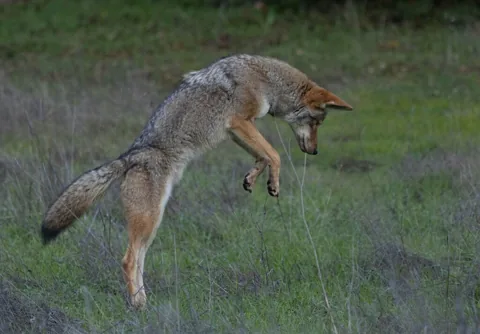 Coyote
Canis latrans
Coyotes are adaptable wild members of the dog family that now live in towns and suburbs as well as open country. Most stay shy, but coyotes that find easy food around homes can lose their fear of people and start taking pets.
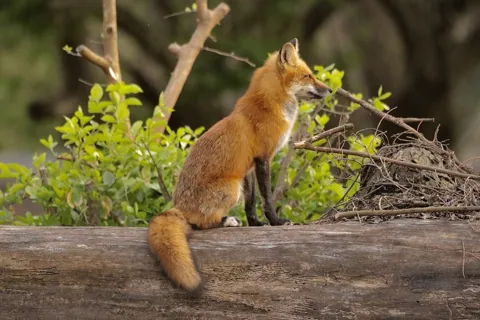 Red Fox
Vulpes vulpes
The red fox is the most common fox in North America and the most widespread wild carnivore in the world. It now breeds in many towns and cities, where most problems involve dens under buildings and raids on poultry or small livestock.
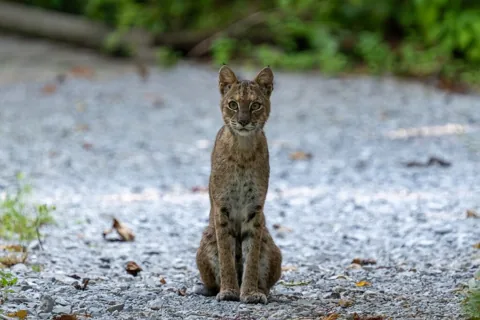 Bobcat
Lynx rufus
Bobcats are medium-sized wild cats, about twice the size of a house cat, that are common but rarely seen. They mostly hunt rabbits and rodents, but an open chicken coop or a small pet left outside can draw one in.
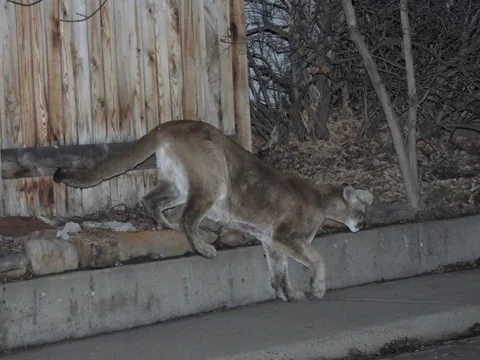 Mountain Lion
Puma concolor
Mountain lions are large, secretive wild cats that usually avoid people. As homes spread into lion country, some lions take pets, poultry and small livestock, especially where deer gather.
Is seeing a coyote normal?
Usually, yes. Illinois wildlife specialists say coyotes live in rural, suburban and highly urban areas across the state, and a coyote resting in or crossing a backyard, golf course, park or field is normal behavior. ICWDM notes high coyote densities near cities such as Los Angeles, Phoenix, Denver, New York City and Chicago.[10][2]
- Daytime sightings: coyotes are not strictly nocturnal. New York DEC says they are more active after sunset and at night but may be seen during the day, and Colorado Parks and Wildlife says they're especially active at dawn and dusk. ICWDM says daytime activity is more likely during the mating and breeding seasons, during periods of low human activity and in cool weather.[6][8][2]
- Seasons: Colorado says coyotes become more visible during their January to March breeding season. UC IPM gives breeding in late January and February with pups born in March and April, while Colorado gives April to mid-May for pups.[8][1]
- Small territories in town: UC IPM says coyote territories can be greater than 15 square miles in dry country with little food but as small as one quarter of a square mile in the suburbs of Los Angeles. Colorado says a coyote that finds food, cover, water and open space in a city won't wander far.[1][9]
- Young coyotes on the move: New York DEC says young coyotes often travel 50 to 100 miles looking for a vacant territory, and ICWDM says pups may disperse 50 miles or more. Fall is when ICWDM says young coyotes leave their home ranges.[6][2]
- Telling it from a dog: coyotes look like a small German shepherd with a longer, narrower snout and a bushy, black-tipped tail usually carried pointing down. Weights differ by region: UC IPM gives 20 to 35 lbs for full-grown males and 18 to 25 lbs for females, Texas Parks and Wildlife gives an average of 25 to 40 pounds, and New York DEC gives 35 to 45 pounds for the larger eastern coyote. See the coyote profile for more on identification.[1][11][6]
When a coyote becomes a problem
UC IPM and ICWDM both describe a pattern researchers have seen before coyote attacks on people: the animals get bolder step by step, and the change speeds up when coyotes get food in residential areas. UC IPM recommends neighborhood-wide action once pets are being attacked or coyotes show up in early morning or late afternoon.[1][3]
- More coyotes on streets and in yards at night.[1][3]
- More coyotes approaching adults or taking pets at night.[1][3]
- Coyotes on streets and in parks and yards in early morning or late afternoon.[1][3]
- Coyotes chasing or taking pets in daytime.[1][3]
- Coyotes attacking pets on a leash or near their owners, or chasing joggers and bicyclists.[1][3]
- Coyotes around play areas, school grounds and parks at midday, and finally acting aggressively toward adults at midday.[1][3]
- New York DEC's rule of thumb is simpler: a coyote that does not flee from people should be considered dangerous. Colorado lists raised hackles, bared teeth and growling as signs of aggression.[7][8]
Take away food, water and cover
Every agency starts here. New York DEC says coyotes in residential areas are drawn to garbage, pet food and other food from people and come to link people with food. UC IPM says coyotes that are fed lose their fear of people quickly and become aggressive, and that anyone who feeds them puts the whole neighborhood's pets and children at risk. Colorado says feeding coyotes is illegal there.[7][1][9]
- Pet food: feed cats and dogs indoors, or empty and pick up dishes right after they eat, and store pet food indoors or in sealed heavy-duty containers.[1][7]
- Garbage and recycling: use cans with tight-fitting lids or other secure bins. Colorado's Pikes Peak wildlife manager says coyotes will tip over garbage cans like bears do.[1][5][9]
- Bird feeders: clean up fallen seed. New York DEC says birds and rodents that gather at feeders can draw coyotes, and UC IPM says spilled seed attracts rodents and rabbits, which coyotes hunt.[5][7][1]
- Fruit: pick fruit before it falls and pick up what drops. UC IPM lists landscape plants whose fruit coyotes favor, including fig, avocado, loquat, guava, date palm and elderberry, and ICWDM notes coyotes eat watermelons, persimmons and berries.[1][2]
- Compost and gardens: fence or contain compost piles so coyotes can't forage in them, and fence vegetable gardens.[1][8]
- Water: UC IPM suggests removing ponds or fountains or fencing them with net wire.[1]
- Cover: remove brush and tall grass, and prune the lower branches of shrubs and small trees up to 2 feet off the ground, so coyotes have fewer places to hide.[7][1]
- Crawl spaces: close off the spaces under porches, decks, sheds and mobile homes, which coyotes use to rest and raise pups.[1]
- Neighbors: UC IPM says to ask neighbors to do the same, and Colorado asks residents to report anyone illegally feeding wildlife.[1][8]
Hazing: teaching coyotes to keep their distance
Hazing means scaring a coyote so it keeps its fear of people. UC IPM says it works best on coyotes that are just starting to come into a neighborhood and still have some wariness, combined with removing what attracts them. ICWDM says hazing only works when it is widespread, consistent and paired with removing food.[1][4]
- How: shout, wave your arms, throw sticks or stones toward the coyote, squirt it with a hose, or blow an air horn or whistle. The aim is to scare it, not injure it.[1][7][10][8]
- Keep at it: ICWDM says to harass or chase the coyote until it is out of sight. Colorado's Pikes Peak wildlife manager urges residents to haze coyotes away from homes and neighborhoods and not let them get comfortable around people.[4][9]
- Carry something: Colorado and New York DEC suggest carrying a walking stick or a flashlight. Colorado also lists an air horn, vinegar in a water gun or a repellent spray as deterrents to have on hand.[8][7]
- Lights and noise devices: here the sources differ. Colorado lists radios, motion lights, strobe lights, sirens, flood lights and ammonia-soaked rags (reapplied after rain) as deterrents near a home. UC IPM says motion-sensitive lights may help, but sound and light devices work only briefly, if at all, because coyotes get used to them when there's no real threat, and strobe-siren units are impractical in suburbs. ICWDM says frightening devices help only for short periods, and that coyotes can often tell when there's no real danger.[8][1][4]
- Near a den: Illinois specialists say coyotes protecting a den or young will vigorously defend the area, and simply walking your dog somewhere else keeps everyone safe.[10]
Protecting cats and dogs
Pets are the most common victims in neighborhoods. New York DEC says coyotes have attacked and killed small dogs left unattended in backyards and that some coyotes appear to specialize in catching cats. UC IPM says groups of coyotes have even attacked large dogs such as Labrador retrievers, sometimes with their owners present. Colorado notes coyotes may see pets as food or as competitors.[7][1][9]
- Cats: keep them indoors, or let them out only under supervision. Colorado says indoors is the best way to guarantee a cat's safety.[7][8]
- Small dogs: don't leave them outside unattended, especially at sunset and at night. Use a fully enclosed kennel if a dog must stay outside, and pick up a small dog when a coyote is in view.[7][8][5][10]
- Large dogs: UC IPM says to bring them inside after dark. New York DEC says owners of medium and large dogs have less to worry about but should still take precautions, because coyotes see other canines as a threat to their territory.[1][7]
- Walks: keep dogs on a short leash, avoid dawn and dusk and thick brush, and stay away from known den sites. UC IPM adds to walk in busy areas and vary your route and timing, since coyotes can learn a routine.[1][8][5]
- Riskiest months: New York DEC says dog-coyote conflicts are most likely in March and April, when coyotes set up dens. UC IPM points to the pup-rearing season more broadly and lists it as March through August, when coyotes' food needs are highest.[7][1]
- Vaccines: keep pets current on rabies vaccine. UC IPM also lists distemper and parvovirus, as your veterinarian recommends.[13][8][1]
- Never let pets play with or approach wildlife.[8][7]
Children and coyotes
Attacks on people are rare, but children are at the greatest risk, according to New York DEC and ICWDM. UC IPM counts more than 160 attacks in California since the 1970s, becoming more frequent particularly in suburban Southern California, with one fatal attack, on a 3-year-old girl in 1981. New York DEC offers perspective: nationwide only a handful of coyote attacks happen each year, while in New York alone dogs put about 650 people in the hospital and kill one each year.[7][3][1]
- Teach kids to recognize a coyote and not to approach it or treat it like a dog. In a 2024 Colorado Springs case, CPW says a 4-year-old was seriously hurt after she and another child walked up to a coyote crouching behind a tree, thinking it was a dog.[1][7][9]
- Teach them what to do: Illinois specialists suggest having children throw their arms up and yell "like a monster" to scare the coyote off, rather than running.[10]
- Watch play areas: New York DEC says to be watchful if a coyote has been seen repeatedly where children spend time.[7]
- Colorado says coyotes most often turn aggressive in spring when protecting a nearby den, or when someone in the area is feeding them.[9]
If a coyote approaches you
- Don't run or turn your back. Illinois specialists point out that the advice is different from what you'd do with an unknown dog.[8][10]
- Make yourself big and loud: stand up, hold your arms out or wave them, open a coat like a cape, shout in a deep, authoritative voice and look the coyote in the eye.[1][7][8]
- Keep small children and pets close to you, or pick them up.[5][8]
- If it stays, throw objects at it, then face it and back away slowly.[8][7][1]
- California's wildlife department says that if a coyote makes contact, fight back, then call animal control or 9-1-1.[5]
Fencing a yard
Fences help but aren't a guarantee: ICWDM says some coyotes learn to dig under or climb over fences of almost any size. Coyotes usually dig under or slip through gaps at gates, and some climb at corners or where cross-braces give a foothold.[4][1]
- Height: UC IPM and ICWDM give at least 5 1/2 feet to discourage jumping. New York DEC's yard advice is lower, a fence taller than 4 feet.[1][4][7]
- Digging: New York DEC says the fence should sit tight to the ground and preferably extend 6 inches below it. UC IPM describes a buried galvanized wire-mesh apron attached to the fence bottom, 4 to 6 inches deep and extending at least 15 inches outward.[7][1]
- Mesh: UC IPM says openings should be no larger than 6 inches between stays.[1]
- Climbing: ICWDM says coyotes don't normally jump 6-foot fences but grab the top and pull themselves over. UC IPM suggests an outward-slanting wire overhang of at least 18 inches or roller devices along the top so they can't get a foothold.[4][1]
- Electric wire: UC IPM says electric fencing can work but needs more upkeep and may be inappropriate or illegal in residential areas, so check local rules first.[1]
A coyote den near your home
Coyotes raise pups in dens under rocks, stumps, brush piles, sheds and even porches. UC IPM says parents usually pick spots with little human activity and may move the litter if disturbed, and recommends harassing coyotes that den near homes so they move the pups somewhere more remote.[8][6][1]
- Timing: pups start coming out of the den at about 3 weeks. ICWDM says they are normally weaned by 6 weeks; New York DEC says 5 to 7 weeks, about when the family leaves the den site.[1][2][6]
- On parkland or open space: Colorado says to notify whoever manages the property.[8]
- On private property: Colorado says landowners can leave the den alone or haze the coyotes away and then destroy the den once they've gone. Its suggestions are bright lights at the opening at night, a loud radio near the entrance, and rags soaked in ammonia or dog droppings placed in the den, applied in the evening and kept up for several days.[8]
- Before filling it in: Colorado says to wet the ground or dust powder outside the opening, and fill the hole only after no tracks go in or out for a day or two. This is Colorado's guidance; elsewhere, ask your state wildlife agency before disturbing a den.[8]
Chickens and other small animals
- Lock poultry and small livestock in secure pens from dusk to dawn, and install electric fencing where you can.[5][1]
- UC IPM also suggests lights over pens and corrals and controlling rodents around the property, and says to be especially watchful during pup-rearing season.[1]
- New York DEC says most livestock problems there involve sheep or free-ranging chickens and ducks, and that good husbandry prevents most of them; preventing losses is much easier than stopping them once they start. See the chicken coop guide for coop pests and predators.[7]
- Keep rabbits and other small pets indoors, or in enclosed kennels if they're outside.[1]
Trapping, relocation and removal rules
Agencies agree that removal is a last step, done by professionals, and that trapped coyotes are not moved elsewhere. This guide doesn't cover trapping methods; contact your state wildlife agency or a licensed wildlife control operator.[1][10][8]
- California: UC IPM says relocating coyotes is illegal without prior approval from the state wildlife department, leghold traps have been banned for coyotes since a 1998 ballot measure except in declared health and safety emergencies or to protect endangered species, and suburban removal is normally done by professionals.[1]
- Colorado: CPW does not allow coyotes to be relocated. Coyotes may be live-trapped on private property but must be killed once caught, and within city limits CPW says to use a licensed wildlife control company.[8]
- Illinois: hire a nuisance wildlife control operator licensed by the Illinois Department of Natural Resources. Removed coyotes are euthanized, not relocated.[10]
- New York: New York DEC refers residents to its regional wildlife offices, USDA Wildlife Services and licensed nuisance wildlife control operators.[7]
- Why relocation fails: Colorado says moved coyotes often travel back, end up in another coyote's territory and can spread disease.[8]
- Removal is temporary: UC IPM, Colorado and Illinois all say other coyotes move into territory left open. UC IPM adds that removing a few problem coyotes can make the rest wary of people again for months or years, and Illinois says to target only the coyotes causing trouble. See the live-trapping guide for general rules on trapping other wildlife.[1][8][10]
What doesn't work
- Repellents: UC IPM says no chemical repellents are registered for coyotes, and ICWDM says none are registered by EPA. Colorado still lists ammonia-soaked rags and other odor deterrents, which have to be reapplied.[1][4][8]
- Poisons: UC IPM says toxicants for coyotes are illegal in California, apart from den fumigants reserved for predator control specialists.[1]
- Wiping out the local population: Illinois specialists call it usually unrealistic and always temporary, and UC IPM says population models show more than three-quarters of coyotes would have to be killed every year.[10][1]
- Running away, or turning your back on a coyote.[8][10]
Rabies and other diseases
ICWDM says coyotes can carry rabies and tularemia, along with distemper, parvovirus and mange. CDC says rabies spreads mainly through bites or scratches from an infected animal and is found in wildlife throughout the country except Hawaii.[3][12]
- If you are bitten or scratched: wash the wound right away with soap and water and seek medical care urgently. CDC says post-exposure care includes wound care, rabies immune globulin and a series of four or five rabies vaccine doses, given as soon as possible.[12][13]
- Avoid sick-looking animals: CDC says never to approach wild animals that appear injured, sick or dead and to call animal control instead.[13]
- Pets: CDC says people can be exposed to rabies through pets that encounter a rabid animal, and that keeping pets up to date on rabies vaccines and away from wildlife lowers the risk.[13]
When and where to report a coyote
- Someone is hurt: call 911.[8][5]
- Bold or aggressive coyotes: New York DEC says to contact your local police department and DEC regional office when coyotes show little or no fear of people. Colorado asks that dangerous behavior toward people be reported to CPW.[7][8]
- California: report coyote incidents through the state wildlife department's online system, and call animal control or 9-1-1 if a coyote makes contact.[5]
- Illinois: alert neighbors and your local police or public safety office as soon as a problem develops.[10]
- Attacks on pets or livestock: UC IPM says to report aggression or attacks to local animal control and the state wildlife agency, and livestock losses to the county agricultural commissioner.[1]
- A coyote resting in or crossing a yard is normal behavior, Illinois specialists say; the reports above are for bold or aggressive animals.[10]
Common questions
- Is it normal to see a coyote during the day?
- Yes. Coyotes are more active at night and at dawn and dusk, but New York DEC and Illinois wildlife specialists say daytime sightings are common and don't by themselves mean the coyote is sick. Watch for boldness instead: a coyote that won't run from people.[6][10][8]
- Will a coyote attack my dog?
- Small dogs are at greatest risk, especially left alone in a yard at night, and coyotes have attacked larger dogs too. Keep dogs on a short leash, supervise them outside, avoid dawn, dusk and den areas, and take extra care in spring.[7][1][8]
- Are coyotes dangerous to children?
- Attacks are rare, but children are at the greatest risk. Teach kids not to approach a coyote and to make themselves big and loud, and report any coyote that hangs around play areas or doesn't run from people.[7][3][10]
- What should I do if a coyote comes toward me?
- Don't run. Stand tall, wave your arms, yell, and throw something toward it. If it stays, back away slowly while facing it. If it makes contact, fight back and call animal control or 911.[8][7][5]
- Can I trap a coyote and move it somewhere else?
- Generally no. Colorado doesn't allow relocation, California requires prior approval, and Illinois says removed coyotes are euthanized, not relocated. Contact your state wildlife agency or a licensed wildlife control operator.[8][1][10]
- Is there a repellent that keeps coyotes away?
- No chemical repellent is registered for coyotes, according to UC IPM and ICWDM. Colorado lists ammonia-soaked rags and noise or light devices as deterrents, but UC IPM says coyotes get used to scare devices quickly.[1][4][8]
Photo credits
- Coyote: (c) Annette Herz, some rights reserved (CC BY) — via iNaturalist, CC BY 4.0
- Red Fox: (c) Rev. Lee A. Payne, Jr., some rights reserved (CC BY) — via iNaturalist, CC BY 4.0
- Bobcat: (c) Brandon Johnson, some rights reserved (CC BY) — via iNaturalist, CC BY 4.0
- Mountain Lion: (c) Jared Shorma, some rights reserved (CC BY) — via iNaturalist, CC BY 4.0
Sources
- University of California Statewide IPM Program, “Pest Notes: Coyote.” ipm.ucanr.edu/home-and-landscape/coyote/ (accessed 2026-11-10)
- Internet Center for Wildlife Damage Management, “Coyote Biology.” icwdm.org/species/carnivores/coyotes/coyote-biology/ (accessed 2026-11-10)
- Internet Center for Wildlife Damage Management, “Coyote Damage Identification.” icwdm.org/species/carnivores/coyotes/coyote-damage-identification/ (accessed 2026-11-10)
- Internet Center for Wildlife Damage Management, “Coyote Damage Prevention and Control Methods.” icwdm.org/species/carnivores/coyotes/coyote-damage-prevention-and-control-methods/ (accessed 2026-11-10)
- California Department of Fish and Wildlife, “Human-Wildlife Conflicts: Coyotes.” wildlife.ca.gov/HWC/Coyotes (accessed 2026-11-10)
- New York State Department of Environmental Conservation, “Eastern Coyote.” dec.ny.gov/nature/animals-fish-plants/eastern-coyote (accessed 2026-11-10)
- New York State Department of Environmental Conservation, “Coyote Conflicts.” dec.ny.gov/nature/animals-fish-plants/nuisance-wildlife-species/coyote-conflicts (accessed 2026-11-10)
- Colorado Parks and Wildlife, “Living with Coyotes.” cpw.state.co.us/living-coyotes (accessed 2026-11-10)
- Colorado Parks and Wildlife, “CPW pursues coyote after child attacked; urges people to protect children, pets from wildlife (news release, Nov. 30, 2024).” cpw.state.co.us/news/11302024/cpw-pursues-coyote-after-child-attacked-urges-people-protect-children-pets-wildlife (accessed 2026-11-10)
- Wildlife Illinois (Illinois Department of Natural Resources and University of Illinois Extension), “A Coyote in My Neighborhood or Yard.” wildlifeillinois.org/?p=2227 (accessed 2026-11-10)
- Texas Parks and Wildlife Department, “Coyote (Canis latrans).” tpwd.texas.gov/huntwild/wild/species/coyote/ (accessed 2026-11-10)
- Centers for Disease Control and Prevention, “About Rabies.” www.cdc.gov/rabies/about/index.html (accessed 2026-11-10)
- Centers for Disease Control and Prevention, “Rabies Prevention and Control.” www.cdc.gov/rabies/prevention/index.html (accessed 2026-11-10)