How to identify it
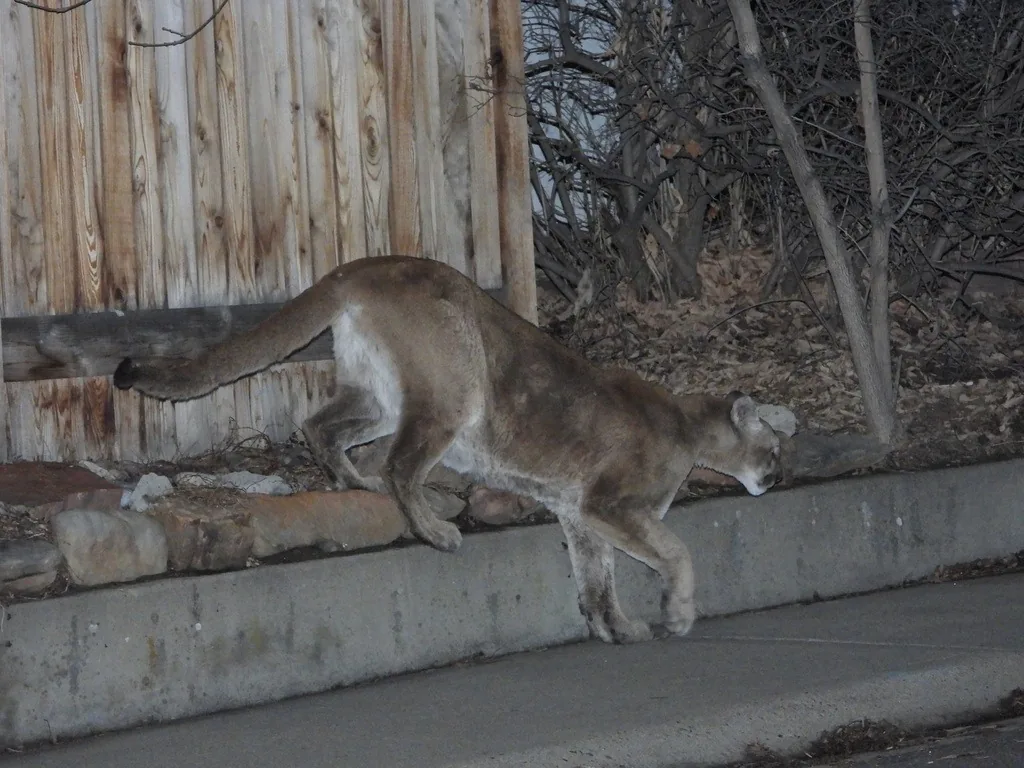
- A large, slender cat with a smallish head and a long tail that can be about one-third of its total length.[5][3]
- Adults are tawny, tan or slightly reddish with a white belly and black tips on the muzzle, ears and tail.[2][4]
- Males can weigh up to about 170 pounds and females up to about 120 pounds; a male can measure 7 to 8 feet long including the tail.[2][5]
- Kittens have brown-black spots that begin to fade at about 3 months of age.[2]
- Tracks are up to about 4 inches wide, roughly baseball-sized, and usually show no claw marks.[2][7]
- There are no confirmed black mountain lions in North America.[5][7]
Look-alikes
| Look-alike | How to tell them apart |
|---|---|
| Bobcat | Bobcats are much smaller, weighing about 15 to 35 pounds, with a short bobbed tail instead of a long one.[2][3] |
| Domestic cat | People sometimes mistake large house cats for lions, but an adult lion stands up to about 30 inches at the shoulder and has a much longer tail.[2] |
| Coyotes and dogs | Cat claws retract when walking, so lion tracks rarely show claw marks; dog and coyote tracks usually do.[7] |
Where it lives
Mountain lions range from Canada to South America. In the U.S. the West is their stronghold. Eastern populations are extinct or endangered, including Florida's small panther population, while lions have resettled parts of the Dakotas and Nebraska.[1][4][5][6]
Biology and life cycle
Lions live alone except for mothers with young; a group seen together is usually a female with kittens, which stay with her for 18 to 24 months.[2]
Females can give birth any time of year after about a 3-month pregnancy, usually to 2 to 4 kittens.[2][4]
Lions are most active from dusk to dawn but also travel and hunt in daylight.[3]
Deer are their main food, and an adult eats about one deer a week; they also take elk, wild pigs, smaller mammals, livestock and pets.[4][3][2]
They stalk and ambush prey, then drag it to a sheltered spot and cover it with dirt, leaves or snow, returning to feed over several days.[3][2]
Home ranges cover roughly 10 to 370 square miles, and males mark boundaries with scrapes, small piles of dirt and twigs.[3]
Damage and signs
- Lions may opportunistically kill poultry, sheep, goats and other small livestock, as well as pets.[2][5]
- Signs of a lion kill include bite marks on the back of the neck or skull, fur plucked cleanly in tufts, drag marks and a carcass buried under dirt or plants.[2]
- Feeding deer or other wildlife near a home can draw lions in, since deer are their main prey.[1][3]
Health risk
Attacks on people are rare: California has verified fewer than 50 since 1890, six of them fatal. Lions that are feeding, or that people have fed, can be dangerous.[1][3]
Control
Prevention
Don't feed deer or other wildlife, and deer-proof your property to avoid attracting a lion's main prey.[1][3]
Secure livestock and outdoor pets in sturdy, covered shelters or fully enclosed kennels at night, and don't feed pets outdoors.[1][3]
Supervise pets outside, especially at dawn and dusk, and keep dogs on a short leash on trails.[3]
Keep them out
California wildlife staff recommend carcass removal, exclusion fencing and livestock guardian animals to protect livestock.[1]
Sanitation
Clear dense brush and tall grass near the home to remove hiding places, and install outdoor lighting so lions can't approach unseen.[1][3]
When to call a professional
Report livestock or pet losses and aggressive lions to your state wildlife agency, which decides whether removal is allowed.[1][3]
If you meet a mountain lion
Never approach a lion, especially one that is feeding or has kittens, and give it a way to escape.[1][3]
Do not run, crouch or turn your back. Stay calm and face the animal.[1][3]
Make yourself look bigger by raising your arms or opening your jacket, and pick up small children and small pets.[3][1]
If the lion acts aggressively, speak firmly, wave your arms and throw objects. Fight back if attacked.[3]
Warning signs include a crouched body, twitching tail, eyes locked on you, ears forward and hind feet pumping as if to jump.[3]
Legal status varies by state
California has protected mountain lions as a specially protected species since 1990. Owners with confirmed livestock or pet losses can request a depredation permit, and the state favors nonlethal steps first.[2][1]
In 2020 California also made lions in the central coast and southern California a candidate species under the state Endangered Species Act.[2]
Colorado manages lions as big game. A lion may not be killed for damaging personal property, including pets, only when necessary to prevent death or injury to people or livestock, or damage to real property or a vehicle.[3][4]
In Colorado, anyone who kills a lion must report it to Colorado Parks and Wildlife within five days.[3]
The Florida panther is federally endangered, and it is illegal to harm or harass one in any way.[6]
Because the rules differ so much, contact your state wildlife agency before taking any action against a lion.[2][3][6]
Common questions
- Will a mountain lion attack my dog or cat?
- It can, especially pets left outside at dawn, dusk or night. Supervise pets, use a fully enclosed kennel, and keep dogs leashed in lion country.[3][1]
- What should I do if a mountain lion killed my livestock?
- Report it to your state wildlife agency. In California a depredation permit may be issued after a confirmed loss, and Colorado reimburses documented livestock losses.[1][2][3]
- Can I shoot a mountain lion that is on my property?
- It depends on your state. Colorado does not allow it over damage to personal property or pets, only when needed to protect people, livestock, real property or vehicles, and Florida panthers are fully protected.[3][6]
Sources
- California Department of Fish and Wildlife, “Human-Wildlife Conflicts: Mountain Lions.” wildlife.ca.gov/HWC/Mountain-Lions (accessed 2026-10-06)
- California Department of Fish and Wildlife, “Mountain Lions in California.” wildlife.ca.gov/Conservation/Mammals/Mountain-Lion (accessed 2026-10-06)
- Colorado Parks and Wildlife, “Living with Mountain Lions.” cpw.state.co.us/living-mountain-lions (accessed 2026-10-06)
- Colorado Parks and Wildlife, “Mountain Lion species profile.” cpw.state.co.us/species/mountain-lion (accessed 2026-10-06)
- Texas Parks and Wildlife Department, “Mountain Lion (Puma concolor).” tpwd.texas.gov/huntwild/wild/species/mlion/ (accessed 2026-10-06)
- Florida Fish and Wildlife Conservation Commission, “Florida Panther Program.” myfwc.com/wildlifehabitats/wildlife/panther/ (accessed 2026-10-06)
- Florida Fish and Wildlife Conservation Commission, “Identifying Florida's Wild Cats.” myfwc.com/media/29024/identifyingflwildcats.pdf (accessed 2026-10-06)
- iNaturalist, “Puma concolor taxon page (order and family).” www.inaturalist.org/taxa/42007 (accessed 2026-10-06)