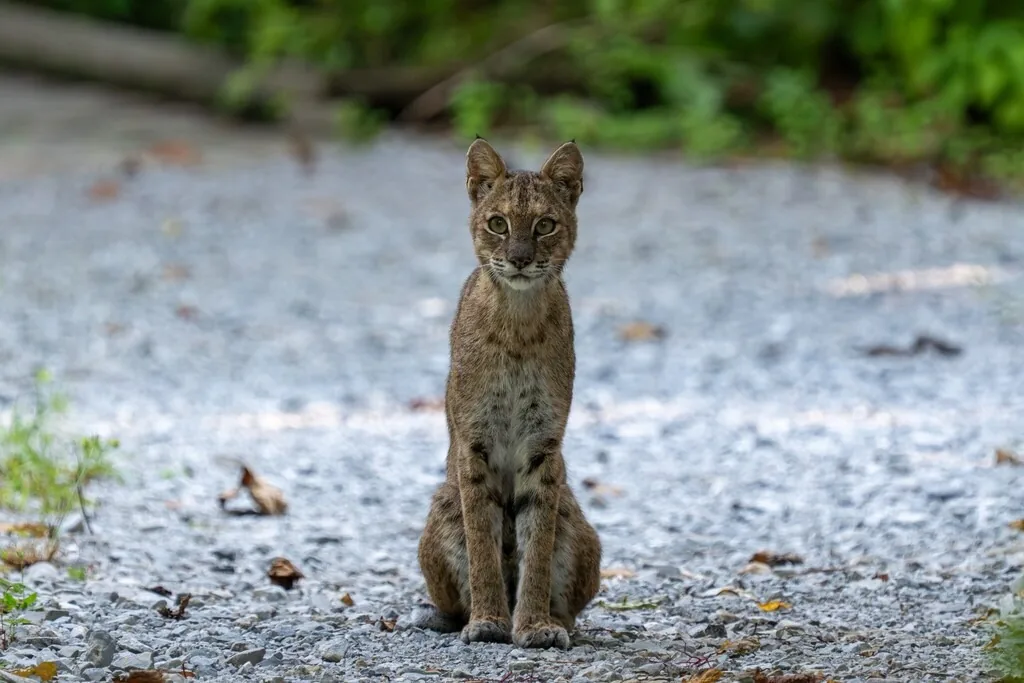
How to identify it
- A short, bobbed tail about 4 to 6 inches long with a black tip, a round face and pointed ears with short black tufts.[1][5]
- The backs of the ears have prominent white spots.[1][7]
- Fur is tan, yellowish brown or reddish brown with dark spots or streaks; the belly is white with black spots and the inner legs have black bars.[1][5]
- Adult males weigh about 14 to 45 pounds and females about 9 to 33 pounds, with males larger than females.[1]
- Tracks are round, about 2 inches across, like a large house cat's, with no claw marks, and the trail zig-zags as the cat hunts.[1][7]
Look-alikes
| Look-alike | How to tell them apart |
|---|---|
| Mountain lion | Mountain lions are several times larger, with a tail about 3 feet long; their tracks are baseball-sized, about three times the size of a bobcat's golf-ball-sized tracks.[7] |
| House cat | A bobcat is about twice the size of a domestic cat and has a short bobbed tail.[5][8] |
| Coyotes and foxes | Cats walk with their claws pulled in, so bobcat tracks rarely show claw marks, while dog and coyote tracks usually do.[7][1] |
Where it lives
Bobcats live from Mexico to northern British Columbia and in all 48 contiguous states, in habitats from subtropical forests and swamps to dry rimrock country; in Florida they have adapted well to neighborhoods.[1][2][6]
Biology and life cycle
Bobcats are solitary and secretive and are most active at dawn, dusk and night, though daytime sightings are not unusual.[2][8][5]
Breeding runs from about January to June depending on the region, and litters of 1 to 4 kittens are born after about 50 to 70 days.[2][5][8]
Kittens may stay with their mother through their first winter.[2]
Dens are in caves, rock crevices, old beaver lodges, thick brush and sometimes human-made structures.[2][5]
Rabbits, squirrels and rodents make up most of the diet, along with birds; they occasionally eat livestock and scavenge.[2][8]
A bobcat keeps the same territory for life and usually travels 1 to 4 miles a day within it, hunting mainly by sight.[2][5]
Damage and signs
- Bobcats are opportunistic and occasionally kill poultry, waterfowl, sheep, goats and calves, as well as house cats and small dogs.[3][5]
- They bite the skull, neck or throat of small prey, leaving canine punctures about 3/4 to 1 inch apart, and leave claw marks on the back and shoulders of larger animals.[3]
- Bobcats do not damage buildings, though they may scratch trees and spray urine to mark territory.[3]
Health risk
Bobcats rarely cause problems for people. Like any mammal they can get rabies, so wash any bite or scratch with soap and water right away and seek medical care.[8][9]
Control
Prevention
Secure pet food and garbage, and don't feed wildlife; even bird feeders can concentrate the rodents and birds bobcats hunt.[6][4]
Don't leave small pets outside or on screened porches unattended, and walk dogs on a leash.[6]
Keep them out
Keep chickens and other small animals in fully enclosed pens at night; bobcats climb posts and jump fences 6 feet or higher, so add a woven-wire top.[6][4][8]
Electric wires about 12 and 18 inches above the ground help stop bobcats from climbing pen fences.[4][8]
Sanitation
Remove brushy ground cover near pens and fix feeders so seed doesn't spill and attract rodents.[4][7]
Traps and physical control
Haze a bobcat seen near homes or livestock by yelling, using an air horn, or throwing rocks toward it but not at it. Bright or flashing lights deter them only briefly.[6][4]
Pesticides
No repellents are available and no toxicants are registered for bobcats.[4]
When to call a professional
Bobcats are protected by state law, and trapping or shooting is regulated. Check state and local rules or contact your state wildlife agency before removing one.[1][4]
Legal status varies by state
Every state in the bobcat's range protects it by law, usually as a game animal or furbearer with licensed hunting and trapping seasons.[1][8]
In Florida, a bobcat can be taken as a nuisance if it damages property, threatens public safety or causes problems in or under a building.[6]
Florida forbids euthanizing a live-captured bobcat; it must be released at the capture site or on a property of 40 acres or more in the same county, with written landowner permission.[6]
Florida also requires an FWC permit for padded steel traps and checking all traps at least once every 24 hours.[6]
Removing one bobcat does not keep others from moving into the same area, so securing attractants matters most.[6]
Common questions
- Will a bobcat attack my cat, dog or chickens?
- It can. Bobcats occasionally kill poultry, house cats and small dogs, so keep small pets supervised and lock chickens in fully enclosed pens.[3][6]
- Is a bobcat in my yard during the day dangerous?
- Not by itself. Bobcats sleep only a few hours at a time, so daytime sightings are not unusual. Haze it away and remove food sources.[5][6]
- Can I trap and relocate a bobcat?
- Only as your state allows. Bobcats are regulated as game or furbearers, and Florida requires live-caught bobcats to be released in the same county.[1][6]
Sources
- Internet Center for Wildlife Damage Management, “Bobcats: Identification.” icwdm.org/species/carnivores/bobcats/ (accessed 2026-10-06). Run by university wildlife damage specialists (maintained at the University of Wisconsin-Stevens Point); species modules are based on Prevention and Control of Wildlife Damage (University of Nebraska Cooperative Extension, 1994).
- Internet Center for Wildlife Damage Management, “Bobcat Biology.” icwdm.org/species/carnivores/bobcats/bobcat-biology/ (accessed 2026-10-06). Run by university wildlife damage specialists (maintained at the University of Wisconsin-Stevens Point); species modules are based on Prevention and Control of Wildlife Damage (University of Nebraska Cooperative Extension, 1994).
- Internet Center for Wildlife Damage Management, “Bobcat Damage Identification.” icwdm.org/species/carnivores/bobcats/bobcat-damage-identification/ (accessed 2026-10-06). Run by university wildlife damage specialists (maintained at the University of Wisconsin-Stevens Point); species modules are based on Prevention and Control of Wildlife Damage (University of Nebraska Cooperative Extension, 1994).
- Internet Center for Wildlife Damage Management, “Bobcat Damage Prevention and Control Methods.” icwdm.org/species/carnivores/bobcats/bobcat-damage-prevention-and-control-methods/ (accessed 2026-10-06). Run by university wildlife damage specialists (maintained at the University of Wisconsin-Stevens Point); species modules are based on Prevention and Control of Wildlife Damage (University of Nebraska Cooperative Extension, 1994).
- Florida Fish and Wildlife Conservation Commission, “Bobcat (Lynx rufus) species profile.” myfwc.com/wildlifehabitats/profiles/mammals/land/bobcat/ (accessed 2026-10-06)
- Florida Fish and Wildlife Conservation Commission, “Living with Bobcats (flyer).” myfwc.com/media/nswnmkqt/living-with-bobcats-flyer.pdf (accessed 2026-10-06)
- Florida Fish and Wildlife Conservation Commission, “Identifying Florida's Wild Cats.” myfwc.com/media/29024/identifyingflwildcats.pdf (accessed 2026-10-06)
- Massachusetts Division of Fisheries and Wildlife (MassWildlife), “Learn about bobcats.” www.mass.gov/info-details/learn-about-bobcats (accessed 2026-10-06)
- Centers for Disease Control and Prevention, “About Rabies.” www.cdc.gov/rabies/about/index.html (accessed 2026-10-06)
- iNaturalist, “Lynx rufus taxon page (order and family).” www.inaturalist.org/taxa/41976 (accessed 2026-10-06)