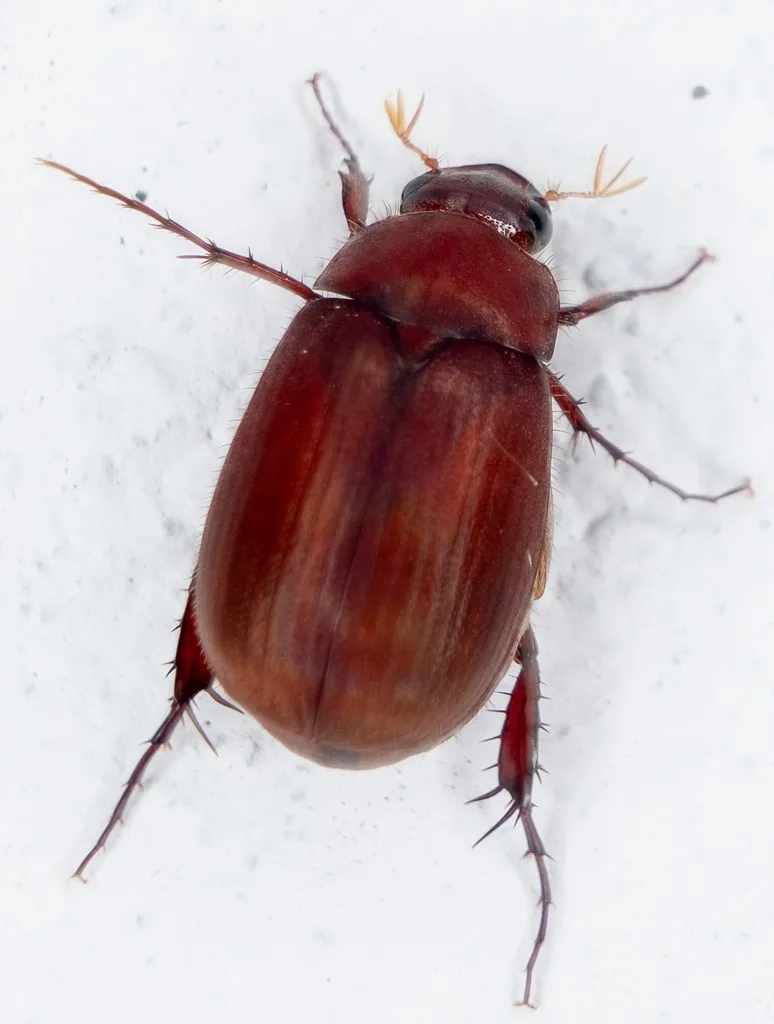
How to identify it
- Adults are about 3/8 inch long, velvety and cinnamon-brown, roughly the size and shape of a coffee bean.[2][3][1]
- The chestnut-brown wing covers are lightly iridescent, and the tip of the abdomen sticks out slightly past them.[1]
- Grubs are C-shaped and white with a brown head and six legs, with a single row of curved spines across the underside of the last segment; telling them from other white grubs requires close inspection.[2][1][3]
Look-alikes
| Look-alike | How to tell them apart |
|---|---|
| Japanese beetle | Similar in shape but slightly larger; Japanese beetles skeletonize leaves, while Asiatic garden beetles leave ragged damage starting at leaf edges.[1] |
| May and June beetles | Much larger; the Asiatic garden beetle is only about 3/8 inch long.[3] |
Where it lives
Native to China and Japan, it was found in New Jersey around 1921-1922 and is now established in the Northeast, including Massachusetts, New Hampshire and Maine; it has also been introduced in parts of Florida.[1][2][3]
Biology and life cycle
There is one generation a year in the Northeast; grubs overwinter 8 to 17 inches deep, deeper than most similar grubs.[1]
Grubs pupate in May and June, and adults emerge at night from late June into July; some remain active into October.[1][3]
Adults hide in the soil or ground litter by day and feed at night, flying between plants when it's above about 70 degrees F and crawling when it's cooler.[1]
Females lay clusters of eggs 1 to 2 inches deep in the soil, up to about 60 eggs over several weeks; eggs hatch in about 10 days to two weeks.[1][2]
Damage and signs
- Adults feed on more than 100 kinds of plants, including vegetables, herbs, fruit, trees, shrubs and flowers such as asters, dahlias, mums and roses.[1][2][3]
- Heavy feeding can strip leaves down to the midribs, especially on favored hosts like butterfly bush, rose, dahlia, aster and chrysanthemum.[1]
- Grubs feed on roots of weeds, grasses, ornamentals, garden plants and blueberries; they are usually minor lawn pests but can cause noticeable damage when numerous.[1][3]
- Because adults are attracted to light, they may become numerous at doors, windows and other brightly lit spots at night.[1][2]
Health risk
Asiatic garden beetles are plant feeders; the beetles at lighted windows and doors are a nuisance rather than a health threat.[1][2]
Control
Keep them out
Spun-bonded fabric row covers can protect garden beds, unless grubs already overwintered in the soil beneath them.[2][1]
Sanitation
Clean up the garden in fall by removing, tilling under or composting weeds, tall grasses and plant debris.[2][1]
Traps and physical control
Handpick beetles at night with a flashlight; they drop when disturbed, so hold a bowl of soapy water under the foliage before touching the plant.[2][1]
A homemade light trap, an outdoor-safe bulb hung about 6 inches above a pan of soapy water on the ground, catches adults; place it away from favored plants.[1][3]
Pesticides
Chemical control is rarely needed for the grubs in lawns; several insecticides are labeled for adults on plant foliage, and systemic products shouldn't go on plants in bloom.[2][1]
Common questions
- What are the small brown beetles on my screen door at night?
- In the Northeast, they may be Asiatic garden beetles, which are strongly attracted to light and can gather in large numbers on windows and screen doors in summer.[2][1]
- Why can't I find what's eating my plants during the day?
- Asiatic garden beetles feed at night and hide in the soil by day; check plants after dark with a flashlight.[1][2]
Sources
- University of Massachusetts Amherst Extension, “Asiatic Garden Beetle (Landscape, Nursery and Urban Forestry fact sheet, updated January 5, 2023).” www.umass.edu/agriculture-food-environment/landscape/fact-sheets/asiatic-garden-beetle (accessed 2026-10-06)
- University of New Hampshire Cooperative Extension, “Asiatic Garden Beetle [fact sheet].” extension.unh.edu/resource/asiatic-garden-beetle-fact-sheet (accessed 2026-10-06)
- University of Maine Cooperative Extension, “Asiatic Garden Beetle (Home and Garden IPM).” extension.umaine.edu/home-and-garden-ipm/fact-sheets/common-name-listing/asiatic-garden-beetle/ (accessed 2026-10-06)
- iNaturalist, “Maladera formosae taxon page (order and family).” www.inaturalist.org/taxa/1260497 (accessed 2026-10-06)