How to identify it
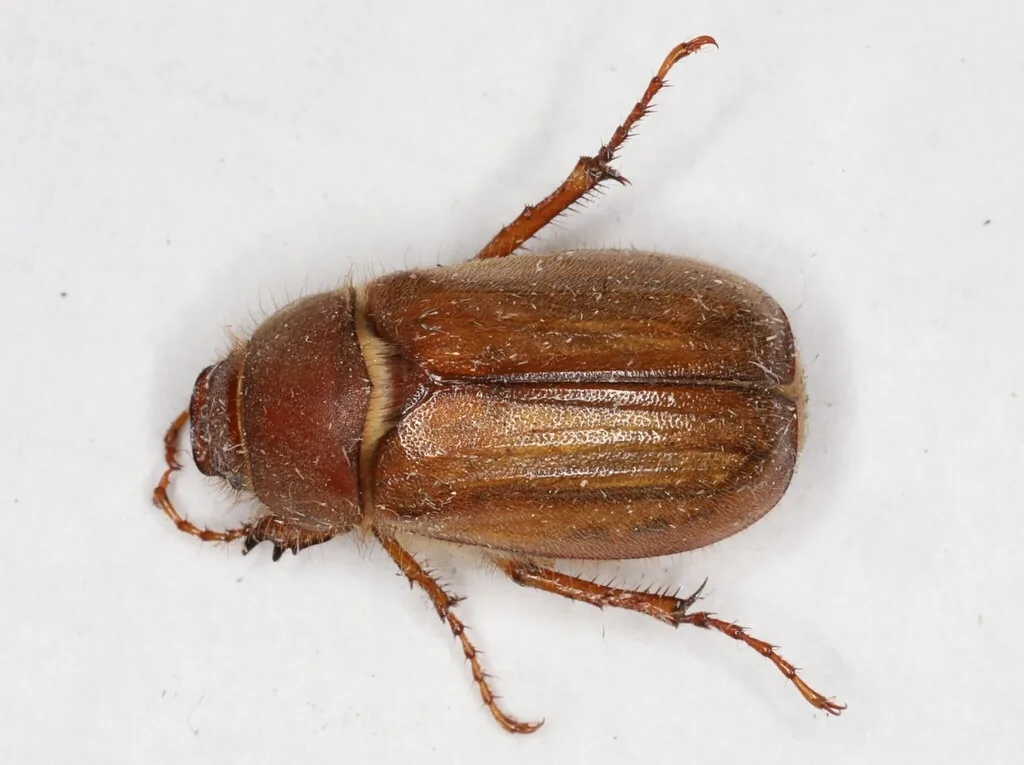
- Adults are oval scarab beetles about 1/2 inch long, tan to reddish brown or brick red.[2][1][3]
- Grubs are grayish white and C-shaped, with a reddish-yellow to brown head and six obvious legs, reaching about 3/4 to nearly 1 inch.[2][3]
- The grub's anal slit is Y-shaped, and the spines on the underside of the last segment form two lines.[3][5]
- Because the grubs look so much like other white grubs, you need a close look at the tip of the abdomen.[2]
Look-alikes
| Look-alike | How to tell them apart |
|---|---|
| Japanese beetle | Japanese beetle adults are shiny metallic green, and their grubs have raster spines that form a V.[3] |
| May and June beetles | The adults look alike, but May and June beetles are usually a little larger and darker.[2] |
| Masked chafers | Masked chafer grubs have raster spines scattered at random with no distinct rows.[6] |
Where it lives
First found in the U.S. in New York in 1940, it now occurs in about 10 states, including parts of Michigan and Wisconsin; it reached Minnesota in 2020 and is spreading in Washington's south Puget Sound region.[2][1]
Biology and life cycle
Adults emerge in June, a couple of weeks before Japanese beetles, and swarm around trees and shrubs at dusk on warm, clear nights to mate.[2][3][1]
Eggs are laid from late June into early August, and the grubs hatch and start feeding on roots within one to two weeks.[1][3]
Dry soil in July and August kills many eggs.[3]
Grubs keep feeding into fall and, in Washington, through winter, then pupate in April and May; there is one generation a year.[1][3]
Damage and signs
- Grubs eat roots and root crowns, causing brown to yellow spots that grow larger over successive years and may die and fill with weeds.[1]
- Badly damaged turf can be rolled back like a rug because the roots are gone.[3]
- Raccoons, skunks and crows often cause the worst visible damage by tearing up turf to eat the grubs.[1][3]
- Stressed lawns suffer most, while well-kept lawns tolerate more grubs before showing damage.[1][3]
Health risk
European chafers don't bite or sting; the adults are not pests, and the harm comes from grubs eating lawn roots.[2][1]
Control
Prevention
Grow healthy turf: water as needed for about an inch a week from late May to early September, fertilize appropriately, and mow regularly.[1]
Before treating, cut three sides of a square of sod next to damaged areas, roll it back, count the grubs, and repeat in several spots.[1][3]
Thresholds vary: Maine Extension uses 5 to 8 grubs per square foot, while WSU says well-kept lawns can tolerate up to 20.[4][1]
Reseed damaged areas in fall or spring to restore the turf.[1]
Biological control
Milky spore disease affects only Japanese beetle grubs, and beneficial nematodes need moist soil and have survived poorly in New Hampshire soils because of wide temperature swings.[3]
Pesticides
Don't treat in fall or winter. WSU advises planning a preventive treatment for July or August of the next season when counts top 25 to 30 grubs per square foot.[1]
WSU lists bifenthrin, chlorantraniliprole, cyfluthrin, permethrin, spinosad and zeta-cypermethrin for those July to August treatments; keep products off flowering plants.[1]
When to call a professional
Some grub insecticide ingredients are limited to licensed applicators, so consider hiring a professional for severe infestations.[1]
Common questions
- Why are crows and raccoons ripping up my lawn in winter?
- In areas with European chafer, they may be digging for grubs, which keep feeding through winter in places like western Washington.[1]
- Does milky spore work on European chafer grubs?
- No. The milky spore agent controls only Japanese beetle grubs.[3]
- When should I treat for European chafer?
- Confirm grub numbers first, then use preventive treatments in July or August after egg laying; WSU advises against fall and winter applications.[1]
Sources
- Washington State University Extension, “Lawn and Turf: European Chafer (HortSense, reviewed 2026).” hortsense.cahnrs.wsu.edu/fact-sheet/lawn-and-turf-european-chafer/ (accessed 2026-10-06)
- University of Minnesota Extension, “European chafer (reviewed 2024).” extension.umn.edu/lawn-insects/european-chafer (accessed 2026-10-06)
- University of New Hampshire Cooperative Extension, “White Grubs (Pest Fact Sheet 23, updated July 2016).” extension.unh.edu/resources/files/Resource002814_Rep4169.pdf (accessed 2026-10-06)
- University of Maine Cooperative Extension, Home and Garden IPM, “European Chafer.” extension.umaine.edu/home-and-garden-ipm/fact-sheets/common-name-listing/european-chafer/ (accessed 2026-10-06)
- Cornell University Department of Entomology, Soil Arthropod Ecology Lab, “Grub ID: Small Grubs, Double Arch, Raster Pattern 1.” grubid.cals.cornell.edu/small-grubs/small-double-arch/small-double-raster-1/ (accessed 2026-10-06)
- Ohio State University Extension, “Masked Chafers (ENT-51).” ohioline.osu.edu/factsheet/ENT-51 (accessed 2026-10-06)
- iNaturalist, “Amphimallon majale taxon page (order and family).” www.inaturalist.org/taxa/360019 (accessed 2026-10-06)