The short answer
- Non-biting midges and mayflies don't bite. Clemson Extension says the midges people mistake for mosquitoes do not bite, and Washington State University adds that they don't carry disease. Missouri Department of Conservation says adult mayflies have only remnant mouthparts and cannot eat or drink.[1][6][3]
- The nuisance is sheer numbers. Both are drawn to lights at night, pile up on walls, windows and pavement, and can make roads and bridges slick. Dense midge swarms have been linked to allergy and asthma flare-ups in some people.[1][6][5][9]
- Spraying does little. Washington State University says killing adult midges with chemicals is impractical because the adults live briefly and fresh ones keep emerging for days, and Mississippi State says lighting changes, exclusion, leaf blowers, vacuums and brooms usually work better than insecticides for mayfly hatches.[6][4]
- If something is biting you, it isn't a non-biting midge or a mayfly. Clemson separates these midges from no-see-ums and biting midges, which belong to a different family; the no-see-um and mosquito guides cover the biters.[1]
Related profiles
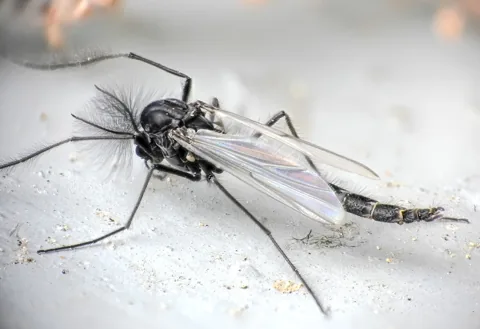 Non-Biting Midges
Family Chironomidae
Non-biting midges (family Chironomidae) are small, delicate flies that grow up in water and emerge in large swarms near ponds, lakes and streams. They are often mistaken for mosquitoes, but they don't bite; the problem is sheer numbers.
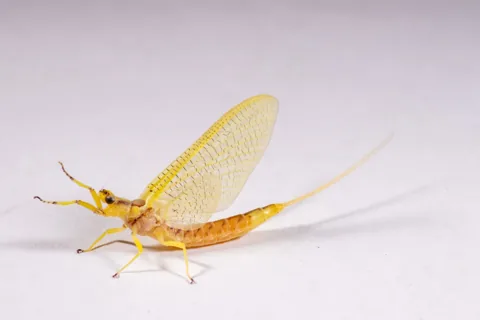 Mayflies
Order Ephemeroptera (e.g., Hexagenia limbata, the giant mayfly)
Mayflies spend most of their lives as aquatic nymphs, then emerge as winged adults that live only a few days at most. Big hatches near lakes and rivers can coat walkways, roads and lit buildings.
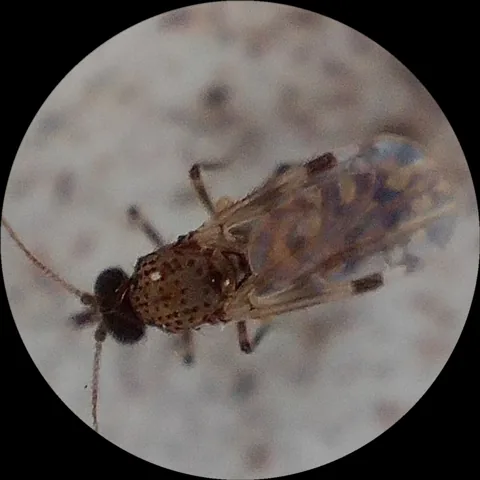 Biting Midges
Culicoides spp.
No-see-ums, also called biting midges, punkies, sand gnats or sand flies, are tiny flies, mostly in the genus Culicoides, whose bites itch intensely; most people feel them without ever seeing them.
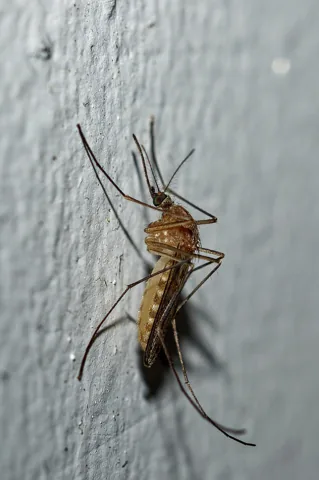 Mosquito
Culicidae (shown: Culex pipiens complex)
Mosquitoes are small, delicate flies whose females feed on blood and can pass on viruses such as West Nile; the control that works best goes after the larvae in standing water.
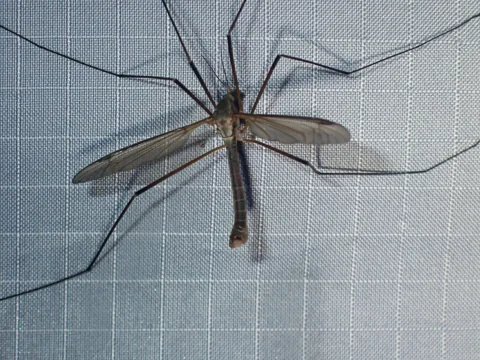 Crane Flies
Family Tipulidae (e.g., Tipula paludosa, the European crane fly)
Adult crane flies are long-legged, mosquito-shaped insects that bump around walls and ceilings in late summer. They don't bite or eat mosquitoes. The concern is the larvae of two invasive European species, called leatherjackets, which feed on lawn roots, crowns and shoots.
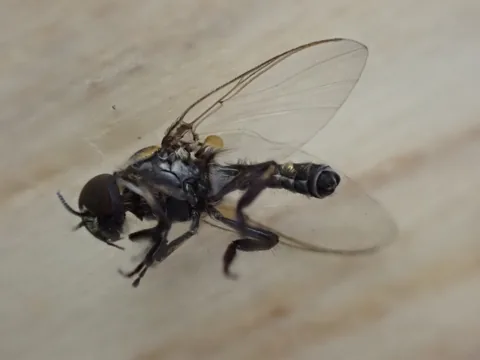 Black Flies
Simulium and related genera (family Simuliidae)
Black flies are tiny, stout, humpbacked biting flies, often called gnats or buffalo gnats. Their larvae live only in running water, and the females swarm around people and animals for blood, mostly in spring and early summer.
Non-biting midge or mosquito?
Midges look a lot like mosquitoes: small, soft-bodied flies with long narrow wings and long thin legs. Missouri Department of Conservation and Clemson Extension point to a few differences you can see on a screen or wall.[2][1]
- Front legs: Missouri Department of Conservation says a resting midge tends to hold its first pair of legs forward and up, where they can pass for antennae at a glance, while many mosquitoes at rest hold their hind legs out and up.[2]
- Mouthparts: Clemson says midges have a much shorter snout (proboscis) than mosquitoes. Missouri Department of Conservation says midges usually have a short proboscis and do not bite people.[1][2]
- Antennae: Clemson describes feathered antennae on females and bushy ones on males; Washington State University says the brush-like or fern-like antennae on males are the one feature all species share.[1][6]
- Wings: Missouri Department of Conservation says midge wings have no scales, while mosquito wings do. You'd need a hand lens to check.[2]
- Size: Clemson gives 1/32 to 1 3/8 inch long; Washington State University gives 2 to 18 millimeters, depending on species. Washington State says color ranges from pale green to almost black.[1][6]
Biting midges, mayflies and other look-alikes
Several families of small flies breed in or near water and look alike at a glance. Missouri Department of Conservation says fine details such as wing veins are needed to identify midges beyond the broadest groups, so for a homeowner the useful question is whether it bites.[2]
- Biting midges: Clemson says non-biting midges should not be confused with no-see-ums, punkies or biting midges, which belong to a separate family, the Ceratopogonidae. Missouri Department of Conservation also lists black flies, phantom midges and dixid midges among the families that look similar.[1][2]
- Crane flies: Missouri Department of Conservation says some people confuse crane flies with mosquitoes and midges.[2]
- Mayflies: Missouri Department of Conservation describes adults as slender and soft-bodied, with four veined wings held upright and together over the back like a butterfly's, the forewings much longer than the hindwings, short antennae, large eyes and two long, threadlike tails.[3]
Why they swarm
A midge cloud hanging over a bush or a porch post is mostly males. Missouri Department of Conservation says male swarms often gather in early evening above a marker such as a bush, a hilltop, water, a dark object or even a person, and that females are rarely found in the swarms. Clemson says most swarms are males listening for the wingbeat of a female.[2][1]
Mayflies come out all at once for a different reason. Mississippi State and Missouri Department of Conservation both compare mass mayfly emergences to periodical cicadas: so many adults appear together that fish, birds and other predators can't eat them all before they mate and lay eggs.[4][3]
Mississippi State says heavy mayfly emergences show up on weather radar like a light to moderate thunderstorm. The National Weather Service office in La Crosse, Wisconsin tracks them on the upper Mississippi River and says radar has picked up mayflies more than 3000 feet above the ground as the wind carries the swarm away from the river.[4][5]
When the hatches happen and how long they last
Midges and mayflies spend most of their lives underwater, so the adults you see are the last short chapter.[2][3]
- Midge season: Washington State University says most adults emerge within one to two weeks, with emergences starting in late spring and finishing in early fall. A University of California report on lakeside housing developments in southern California put the swarm season at March through October.[6][7]
- Midge life cycle: Clemson says eggs hatch in 3 days to a week, larvae grow for 2 to 7 weeks, and pupae rise to the surface 2 to 3 days later to become adults. The University of California report says it takes only a few egg-laying females to build a massive midge population within a few weeks.[1][7]
- How long adult midges live: the sources differ. Washington State University says adults usually live less than a day and a few survive up to a week; Clemson gives 3 to 10 days; the University of California report gives a three-to-five-day adult life; and Missouri Department of Conservation says a few weeks at most.[6][1][7][2]
- Mayfly timing: the National Weather Service says Hexagenia mayflies, one of the largest species, generally emerge in late June to early July along the upper Mississippi River. Its tracking notes describe emergences that begin around sunset and show on radar for about 2 hours on most nights.[5]
- How long a mayfly hatch lasts: Mississippi State says mass emergences are short-lived, usually lasting only a week or so, and that they happen every year with bigger numbers in some years than others.[4]
- Adult mayfly lifespan: Mississippi State says adults live only a day or two; the National Weather Service says a few minutes to a few days depending on species. Missouri Department of Conservation says the nymphs grow for months or years first, and the National Weather Service gives 3 months to 2 years.[4][5][3]
Are they harmful?
Not as biters. Washington State University says chironomid midges don't bite or carry disease, and the University of California report says the same of the lake midges it studied. Missouri Department of Conservation says winged mayflies can't eat or drink at all.[6][7][3]
The real problems come from the numbers.[1][5]
- Breathing problems: Clemson says allergic reactions from breathing in midges have occurred where swarms are thick, and Washington State University says dense numbers have aggravated asthma in the past. In a 1997 study of 123 adults with asthma living around a midge-plagued lake in Japan, 11 tested positive to one local midge species, and the authors called midges an important cause of asthma there alongside mites and silkworm.[1][6][9]
- Roads and bridges: Clemson and Washington State University say swarms can create dangerous driving conditions, and Missouri Department of Conservation says big mayfly swarms cause problems for motorists. The National Weather Service says mayflies make a slippery mess as they pile up and die under lights, and that bridges have had to be cleared with snowplows.[1][6][3][5]
- Stains and mess: Washington State University lists spider webs, stains from egg masses laid on painted surfaces and decaying midges. The University of California report adds that midges deface windows, screens, walls and draperies and sometimes clog car radiators.[6][7]
- A larva in a glass of water: Washington State University says an occasional midge larva turning up in drinking water is unappealing but poses no harm to people. Missouri Department of Conservation says many midge larvae are red, which is why they're called bloodworms.[6][2]
Lights: the change that helps most
Clemson, Washington State University and the National Weather Service all say midges and mayflies are attracted to lights. The National Weather Service says mayflies can fly several miles inland toward them.[1][6][5]
- Wait out the first hour: Clemson says the easiest way to cut down on midge swarms is to leave outdoor lights off for about 45 minutes after sundown, since 90% of the activity happens before then.[1]
- Pull them away from the house: Clemson suggests placing light sources away from the home or gathering area and aiming them back toward it. Washington State University suggests a bright security light between the water and your house, lighting your area with its spill light and using yellow incandescent bulbs near the house, so most midges stop at the security light.[1][6]
- Bulb color: a 2015 study in Los Angeles found that ultraviolet and blue light usually draws the most arthropods, and that LED lamps tuned to cut those wavelengths drew fewer than store-bought LED or compact fluorescent lamps of the same color temperature.[10]
- Shiny pavement: a 2015 study at a lamp-lit bridge over the Danube found that millions of mayflies swarmed near the bridge lights for two weeks and laid eggs on the asphalt, because the road reflected light the way a water surface does.[8]
- Plant a buffer: Washington State University says a windbreak of trees and shrubs between the water and your home can give midges somewhere else to rest.[6]
Cleaning up after a hatch
The University of California report says midges seek cool places during the day and fly out at sunset, and Washington State University says resting swarms settle in shrubs, on patios and on the sides of houses.[7][6]
- Sweep, blow and vacuum: Mississippi State lists leaf blowers, vacuums, brooms and dust pans, along with lighting changes and physical exclusion, as usually more effective than insecticides for mass mayfly emergences.[4]
- Expect spiders: Washington State University says the nuisance is often made worse by large numbers of spiders, and the University of California report says spiders follow the midges and build webs on walls and under eaves, where trapped midges leave gray patches.[6][7]
- Painted surfaces: Washington State University says egg masses that midges lay on paint instead of water leave stains, along with the remains of dead midges.[6]
Why spraying rarely helps, and what pond owners can do
Clemson says complete control of midges is impossible and even partial control can be impractical and undesirable, because chemicals put in the water can harm other aquatic life. Washington State University says few chemical controls are available, midges quickly become resistant to them, and spraying adults is impractical because they live briefly and fresh ones keep emerging for several days.[1][6]
For people who manage their own pond or community lake, the sources offer a few options.[1][6][7]
- Cut the nutrients: Clemson says reducing runoff that feeds midges is more practical than chemicals. The University of California report says lakes surrounded by housing get more organic material from fertilizers, lawn clippings and tree leaves than wild lakes, and that this, plus warm shallow water, makes them ideal for midges.[1][7]
- Fish: the sources differ. Clemson reports some success stocking smaller ponds with bottom-feeding catfish, carp and goldfish at 150 to 500 pounds of fish per acre of water. Washington State University calls the common carp the best biological control in some situations but says fish and game departments seldom permit it, so check with your state wildlife agency before stocking.[1][6]
- Larvicides: in the University of California tests, some larvicides worked in some lakes but not others and held larvae down for only two to three weeks; growth-regulator treatments held back adult emergence for two to four weeks. The report says each lake has to be managed on its own and residents will still have to tolerate some midges.[7]
- Mayflies: Mississippi State says physical controls usually beat insecticides, and the hatch is over in a week or so.[4]
Why a big hatch isn't all bad
Both insects are part of the food web of the lake or river they come from. The Washington State University fact sheet calls chironomid larvae highly beneficial in that food web.[6]
- Fish food: Clemson says midge larvae are a major food for bottom-feeding fish such as catfish and carp, and Washington State University says birds eat the adults. Missouri Department of Conservation says all life stages of mayflies are favorite foods of fish such as trout and bass.[1][6][3]
- Lake cleaners: the University of California report says midge larvae clean up detritus and recycle waste in the water.[7]
- Water quality: the National Weather Service says mayflies are sensitive to gross organic pollution, so their presence means sewage and similar pollution aren't present in large amounts, and Mississippi State calls healthy mayfly populations a sign of a healthy aquatic ecosystem. Midge booms point the other way: Washington State University says midge population explosions occur in new reservoirs, nutrient-rich lakes and systems disrupted by organic pollution or the removal of fish.[5][4][6]
Common questions
- Do lake flies bite?
- No. The non-biting midges and mayflies that swarm off lakes don't bite. Clemson says these midges don't bite, and Missouri Department of Conservation says adult mayflies cannot eat or drink. If you're getting bitten near water, look for no-see-ums (biting midges) or mosquitoes instead.[1][3]
- How long do mayfly swarms last?
- Mississippi State says mass mayfly emergences usually last only a week or so. On the upper Mississippi River, the National Weather Service says Hexagenia mayflies generally emerge in late June to early July, often starting around sunset.[4][5]
- Why are midges all over the outside of my house?
- They fly to lights at night and rest on whatever is nearby. The University of California report says midges seek cool places during the day, and Washington State University says resting swarms settle on shrubs, patios and the sides of houses. Turning lights off for the first 45 minutes after sundown, as Clemson suggests, cuts the numbers.[7][6][1]
- Should I spray for midges or mayflies?
- Usually not. Washington State University says spraying adult midges is impractical because they live briefly and new ones keep emerging, and Mississippi State says lighting changes, exclusion, blowers, vacuums and brooms usually work better than insecticides for mayfly hatches.[6][4]
Photo credits
- Non-Biting Midges: (c) Robert Roach, some rights reserved (CC BY) — via iNaturalist, CC BY 4.0
- Mayflies: (c) DiegoH, some rights reserved (CC BY) — via iNaturalist, CC BY 4.0
- Biting Midges: Sinaloa Silvestre, public domain (CC0), via iNaturalist
- Mosquito: (c) Donald Davesne, some rights reserved (CC BY) — via iNaturalist, CC BY 4.0
- Crane Flies: (c) Louis Imbeau, some rights reserved (CC BY) — via iNaturalist, CC BY 4.0
- Black Flies: Stephen James McWilliam, public domain (CC0), via iNaturalist
Sources
- Clemson Cooperative Extension Home & Garden Information Center, “Midges, HGIC 2433.” hgic.clemson.edu/factsheet/midges/ (accessed 2026-11-10)
- Missouri Department of Conservation, “Midges (Field Guide).” mdc.mo.gov/discover-nature/field-guide/midges (accessed 2026-11-10)
- Missouri Department of Conservation, “Mayflies (Field Guide).” mdc.mo.gov/discover-nature/field-guide/mayflies (accessed 2026-11-10)
- Mississippi State University Extension Service, “Mayfly, Bug's Eye View Vol. 4 No. 11.” extension.msstate.edu/newsletters/bugs-eye-view/2018/mayfly-vol-4-no-11 (accessed 2026-11-10)
- National Weather Service, La Crosse, WI, “Tracking Mayflies.” www.weather.gov/arx/mayfly_tracking (accessed 2026-11-10)
- Washington State University Puyallup Research and Extension Center, “Chironomid Midges, PLS-45 (E. C. Bay, updated 2003).” wpcdn.web.wsu.edu/wp-puyallup/uploads/sites/408/2015/02/PLS-45-Chironomid-Midges.pdf (accessed 2026-11-10)
- University of California Agriculture and Natural Resources, “Boardman (1977), Midges plague lakeside dwellers, California Agriculture 31(4):12-13.” my.ucanr.edu/repository/fileAccessPublic.cfm?fn=ca3104p12-172739.pdf (accessed 2026-11-10)
- PLoS One, via PubMed, “Szaz et al. (2015), Lamp-lit bridges as dual light-traps for the night-swarming mayfly, Ephoron virgo, PLoS One 10(3):e0121194.” pubmed.ncbi.nlm.nih.gov/25815748/ (accessed 2026-11-10)
- Allergy, via PubMed, “Hirabayashi et al. (1997), Studies of bronchial asthma induced by chironomid midges around a hypereutrophic lake in Japan, Allergy 52(2):188-195.” pubmed.ncbi.nlm.nih.gov/9105523/ (accessed 2026-11-10)
- Philosophical Transactions of the Royal Society B, via PubMed, “Longcore et al. (2015), Tuning the white light spectrum of light emitting diode lamps to reduce attraction of nocturnal arthropods, Phil. Trans. R. Soc. B 370:20140125.” pubmed.ncbi.nlm.nih.gov/25780237/ (accessed 2026-11-10)