The short answer
- Black with white or silver markings, biting during the day around the yard: an Aedes container mosquito, most often the Asian tiger mosquito. In the South it may be the yellow fever mosquito.[21][17][22][5]
- Plain brown, biting in the evening and at night, sometimes indoors: a Culex house mosquito, the main West Nile virus carrier.[4][18][8]
- Slender, long-legged, with dark spots on the wings and palps as long as the beak: an Anopheles (malaria) mosquito.[17][18]
- Swarms after heavy rain or flooding, biting at dusk: floodwater mosquitoes such as Aedes vexans, which can fly miles from where they hatched.[19][28][18]
- Very large, with banded legs and a painful bite, after fields flood: Psorophora mosquitoes, including the gallinipper.[17][34]
- Huge, shiny, with a sharply bent beak, and it never bites: the elephant mosquito, whose larvae eat other mosquito larvae.[31]
Mosquito profiles
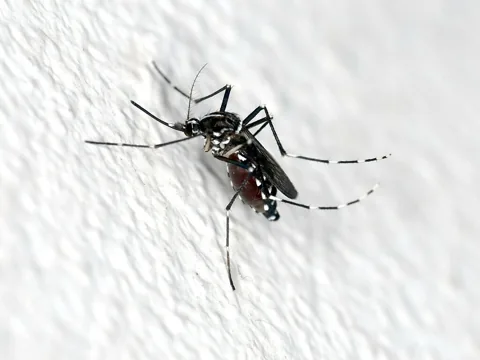 Asian Tiger Mosquito
Aedes albopictus
The Asian tiger mosquito is an invasive, aggressive mosquito that bites during the day and breeds in small water-holding containers around homes. First found at a tire dump near Houston in 1985, it spread rapidly through the southern United States and up the East Coast.
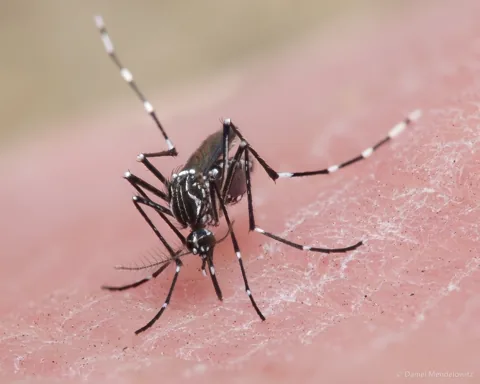 Yellow Fever Mosquito
Aedes aegypti
The yellow fever mosquito, Aedes aegypti, is a container-breeding mosquito that lives close to people and prefers to bite them. It lives indoors and outdoors, and the CDC calls it the main type of mosquito that spreads Zika, dengue and chikungunya viruses.
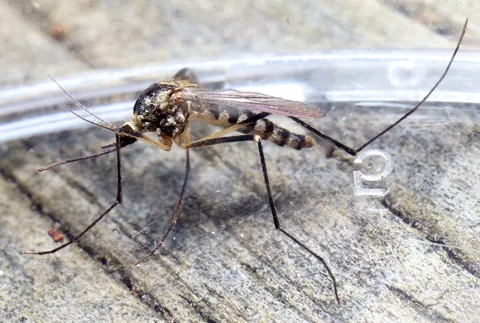 Eastern Treehole Mosquito
Aedes triseriatus
The eastern treehole mosquito is an aggressive daytime biter in and near deciduous woods and the primary vector of La Crosse virus. It lays its eggs in water held in tree holes and in containers, especially discarded tires.
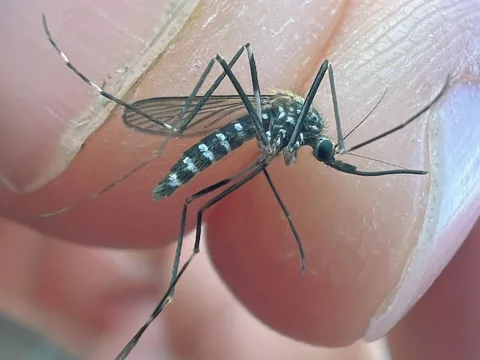 Asian Bush Mosquito
Aedes japonicus
The Asian bush mosquito, also called the Asian rock pool mosquito, is an invasive container-breeding mosquito from East Asia, first detected in New York in 1998. Its cold tolerance keeps it active earlier in spring and later in fall than similar container mosquitoes.
 Northern House Mosquito
Culex pipiens
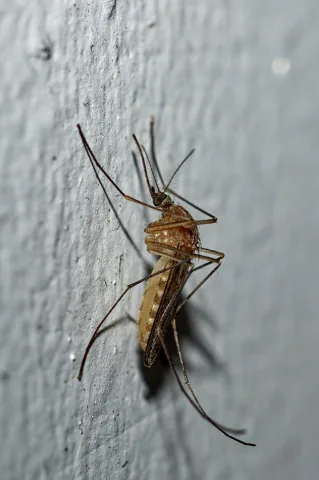
The northern house mosquito, Culex pipiens, is often the most common pest mosquito in cities and suburbs. It bites from dusk to dawn, breeds in stagnant and polluted water, and is a major carrier of West Nile virus in North America.
 Southern House Mosquito
Culex quinquefasciatus
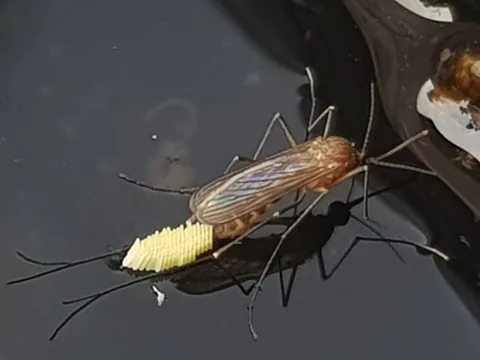
The southern house mosquito bites in the evening, at night and in the early morning, and Texas A&M calls it the most important carrier of West Nile virus and St. Louis encephalitis, especially in the eastern U.S. It prefers birds but will come through unscreened windows and open doors to bite sleeping people.
 Western Encephalitis Mosquito
Culex tarsalis
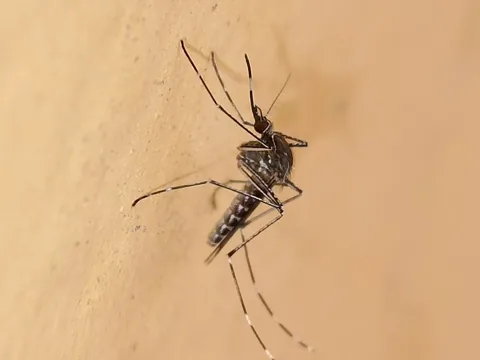
The western encephalitis mosquito, Culex tarsalis, is the main mosquito that carries West Nile virus to people in the western United States. It feeds on birds, where the virus multiplies, and also on people and horses.
 Common Malaria Mosquito
Anopheles quadrimaculatus (a complex of five sibling species)
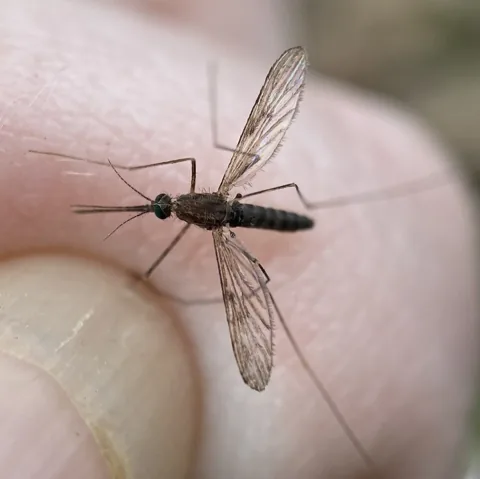
The common malaria mosquito is a large, dark Anopheles mosquito of the eastern United States. It was the most important malaria carrier in the Southeast, still serves as the primary vector in eastern outbreaks, and bites livestock, deer and, to a lesser extent, people.
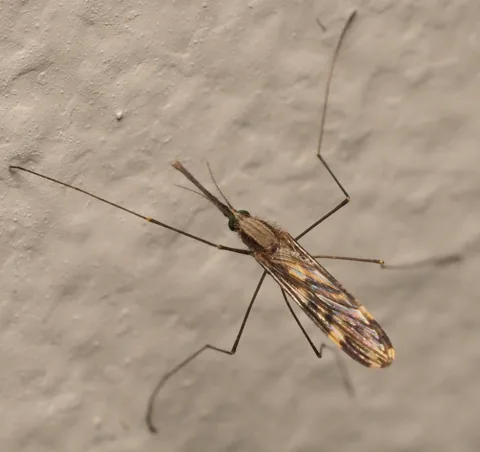 Woodland malaria mosquito
Anopheles punctipennis
The woodland malaria mosquito breeds in ponds, rock pools and the weedy edges of slow streams. Females bite people persistently, especially in the early evening, and they will also bite during the day in shady spots.
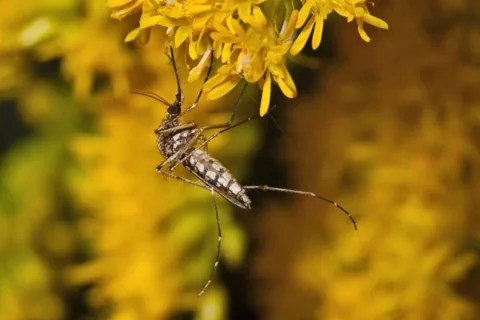 Inland Floodwater Mosquito
Aedes vexans
The inland floodwater mosquito is one of the most widespread pest mosquitoes in the world. Its eggs wait in dry ground for months or years, then hatch in huge numbers when rain or floodwater covers them.
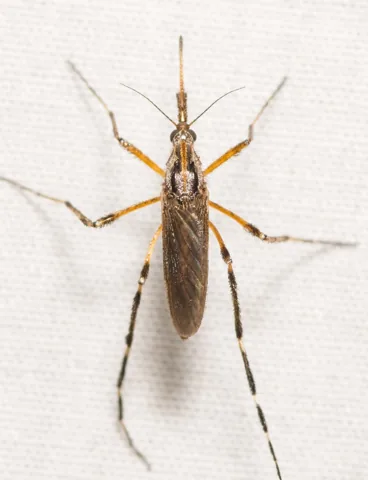 Gallinipper
Psorophora ciliata
The gallinipper is a very large mosquito, about the size of a quarter, with heavily scaled legs banded in yellow and black. It breeds in rain-flooded pools and fields, its larvae eat other mosquito larvae, and the females bite painfully, even in the daytime.
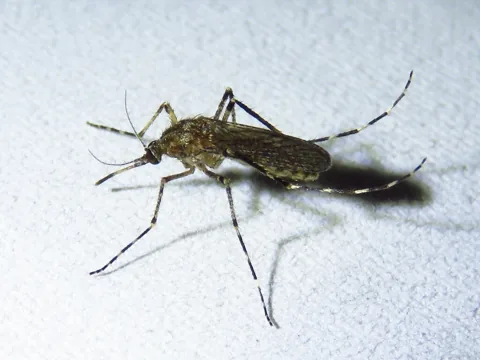 Cattail Mosquito
Coquillettidia perturbans
The cattail mosquito's larvae live attached to the roots and stems of cattails and other emergent plants in permanent wetlands, and adult females readily bite people. CDC lists it as a primary bridge vector that carries eastern equine encephalitis (EEE) virus from birds to people and horses.
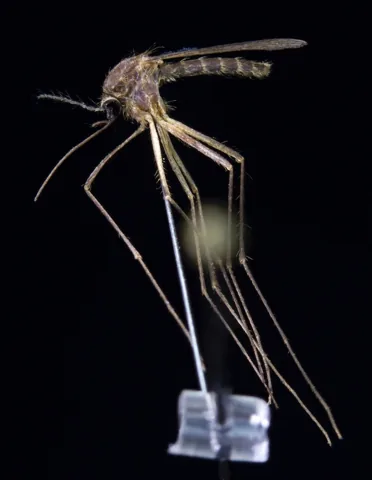 Dark-Tailed Mosquito
Culiseta melanura
The dark-tailed mosquito, Culiseta melanura, is the main mosquito that keeps eastern equine encephalitis (EEE) virus cycling among birds in freshwater hardwood swamps. EEE is rare in people but serious: about 30% of people who develop severe disease die.
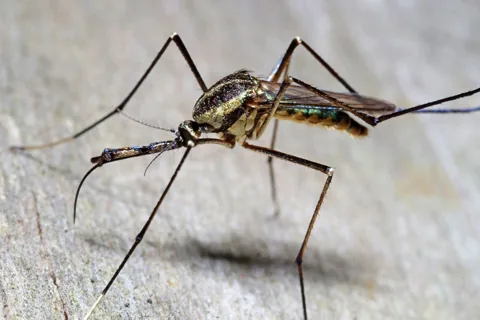 Elephant Mosquito
Toxorhynchites rutilus
The elephant mosquito never takes blood: adults can't take a blood meal and feed only on nectar. Its larvae prey on the larvae of other mosquitoes, including container breeders such as the yellow fever and Asian tiger mosquitoes.
How to tell the main groups apart
Only female mosquitoes bite; they need a blood meal to produce eggs. Males feed on nectar and fruit juices, and their mouthparts aren't strong enough to pierce skin. So any mosquito you catch biting is a female.[1][15]
Oklahoma State University's identification guide separates the common genera with a few features. Aedes have a very pointed tip to the abdomen. Culex have a very blunt one and are usually small to medium-sized. Anopheles are slender with long legs, and their palps (the feelers beside the beak) are as long as the beak itself. Psorophora are the largest, with thick hind legs.[17][18]
Telling species apart takes a closer look at the pattern of pale scales on the top of the thorax, the white bands on the legs and any spots on the wings. Those are the features identification guides such as the Connecticut Agricultural Experiment Station's use, and they are described for each group below.[18][17]
The larvae, or wigglers, differ too. UC IPM notes that Culex and Aedes larvae breathe through an air tube at the rear of the body, which Anopheles larvae lack.[16]
Egg-laying habits sort them by breeding site. Some species lay single eggs on the water surface, some lay rafts of 100 or more eggs, and others lay single eggs just above the waterline in moist soil, tree holes or containers, where they wait for flooding. CDC gives a Culex raft as 100 to 300 eggs; a Rutgers-hosted account of the western encephalitis mosquito gives that species' rafts as averaging about 190.[16][4][26]
Container mosquitoes: Asian tiger, yellow fever and treehole mosquitoes (Aedes)
The Asian tiger mosquito (Aedes albopictus) is covered in shiny black scales with silver-white bands on the legs and palps. Its most striking mark is a single silver-white stripe running down the top of the thorax and head.[23][17][18]
It reached the United States in used tires; Rutgers notes it was first collected at a tire dump near Houston in 1985, and Clemson says it spread into the southern states during the late 1980s. A 1992 account in the same Rutgers collection describes it as established in most states east of the Mississippi River. Clemson calls it the most common daytime biting mosquito in the Carolinas.[24][21][23]
It bites mainly in daylight, with peaks generally in the early morning and late afternoon, and feeds on people, pets, other mammals and birds. Because it is active by day, Clemson notes that nighttime fogging by mosquito control agencies often doesn't control it well.[21][23][17]
The yellow fever mosquito (Aedes aegypti) is a medium-sized blackish mosquito with a silvery-white lyre-shaped (harp-like) pattern on the top of the thorax and broad white rings on the hind legs. Oklahoma State notes it is easily confused with the Asian tiger mosquito, so look carefully at the thorax: one stripe on the tiger, a lyre on the yellow fever mosquito.[22][17]
It lives close to people and prefers to bite them, indoors and out. A Rutgers-hosted account describes it as an early-morning and late-afternoon feeder that will also bite at night under artificial light, often at the ankles, and says adults rest indoors in dark closets and cabinets. CDC describes it as a mosquito of tropical, subtropical and some temperate climates; the Asian tiger tolerates cooler temperatures and a broader range.[5][3][22]
Both breed in containers. CDC says the females lay eggs on the inner walls of water-holding containers just above the waterline, and the eggs hatch when rain or a sprinkler covers them. Buckets, bowls, flowerpots, vases, tires, gutters and bird baths all work. UC IPM notes that even a bottle cap of water can support larvae.[3][6][21][16]
The eggs are hard to get rid of. CDC says they can survive drying out for up to 8 months; a Rutgers-hosted account says yellow fever mosquito eggs resist drying for up to 1 year. CDC says development from egg to adult takes 7 to 10 days, and these mosquitoes fly only a few blocks in their lifetime.[3][22]
CDC says Aedes aegypti is the main mosquito that spreads Zika, dengue and chikungunya viruses, and is more likely to spread them than the Asian tiger mosquito because it lives near and prefers to feed on people. Recent US outbreaks of dengue and chikungunya have been small and local, with local spread reported in parts of Hawaii, Florida and Texas, and in Puerto Rico, the U.S. Virgin Islands and Guam.[5][6][7]
The eastern treehole mosquito (Aedes triseriatus) is dark with unbanded legs; silvery scales on the sides of the thorax are its most telling feature. It breeds in water-filled tree holes and in tires, rain barrels and cans, usually in shade, and stays within a few hundred yards of where it hatched. Females bite mostly at dawn and dusk, and during the day in the woods.[25][18][17]
It is the main carrier of La Crosse virus. CDC says most La Crosse cases occur in the upper Midwest, mid-Atlantic and southeastern states; most infected people have no symptoms, and severe disease occurs most often in children under 16.[17][25][12]
The Asian bush mosquito (Aedes japonicus) is another container breeder, introduced and first detected in Connecticut in 1998. It has a lyre-shaped pattern of golden scales on the thorax and broad white bands on the hind legs, breeds in rock holes, tree holes, catch basins, bird baths and tires, and bites during the day, early evening and after dark.[18]
House mosquitoes: northern, southern and western (Culex)
CDC lists three Culex mosquitoes in the United States: the northern house mosquito (Culex pipiens), the southern house mosquito (Cx. quinquefasciatus) and the western encephalitis mosquito (Cx. tarsalis). The two house mosquitoes are plain: golden-brown to bronze, with pale bands across the abdomen and dark, unbanded legs.[4][18][35]
They breed in standing water, including foul water. CDC lists ponds, swamps, unmaintained swimming pools, wastewater plants, storm drains and ditches. Connecticut's guide adds catch basins, barrels, flowerpots and tires, and notes they are highly tolerant of polluted water; Rutgers lists untended bird baths, clogged gutters, wading pools and septic seepage. Jacksonville's mosquito control program finds the southern house mosquito in septic tanks and catch basins.[4][18][27][35]
CDC says adult Culex are most active from dusk to dawn and rest by day in grass, shrubs and other thick vegetation. Some prefer to feed on birds and bite people when other hosts aren't close by. Connecticut's guide says the northern house mosquito bites people especially in the evening, readily enters houses and spends the winter as adult females in damp, sheltered places such as unheated basements and cellars.[4][18][35][27]
They don't travel far, though sources give different distances. CDC says Culex have been known to fly up to 2 miles; University of Illinois Extension says the northern house mosquito typically travels no more than half a mile.[4][19]
The western encephalitis mosquito (Cx. tarsalis) is the one Culex with obvious markings: a white band around the middle of the beak and white bands on the legs. It is abundant in summer in the mid and far West and relatively rare east of the Mississippi River. It feeds on birds in spring and switches to mammals, including people, by midsummer, and its host-seeking flights can reach 17 miles.[26][17]
Culex are the main West Nile carriers. CDC says West Nile virus is the leading cause of mosquito-borne disease in the contiguous US; it cycles between birds and mosquitoes, especially Culex, and people are dead-end hosts that don't pass it back to mosquitoes. South Dakota State University calls Cx. tarsalis a bridge vector because it bites both birds and people.[8][20]
CDC says Culex mosquitoes in US states can also spread St. Louis encephalitis and eastern equine encephalitis viruses. Most St. Louis encephalitis cases occur in eastern and central states, with sporadic cases and outbreaks in the Southwest. Rutgers calls the northern house mosquito the primary vector of St. Louis encephalitis.[4][13][27]
Malaria mosquitoes (Anopheles)
Anopheles mosquitoes are slender and long-legged, with palps nearly as long as the beak. The common malaria mosquito (Anopheles quadrimaculatus) has four dark spots of scales on each wing. The woodland malaria mosquito (An. punctipennis) has pale cream patches along the front edge of each wing.[17][18][29]
They breed in ponds, marshes, the edges of lakes and slow streams with plenty of emergent plants or floating debris, and in rice fields and reservoirs.[18][17][29]
Connecticut's guide says the common malaria mosquito readily bites people indoors and outdoors, especially in the evening, and the woodland malaria mosquito bites mostly in the early evening and in shade during the day. CDC says the Anopheles mosquitoes that spread malaria bite especially during late evening and at night. The adult females spend the winter in sheltered spots such as barns, abandoned buildings, caves and hollow trees.[18][9][17]
Malaria is not endemic in the United States. CDC says the US reports about 2,000 cases in a typical year, mostly in people infected while traveling, and local spread from an imported case happens only rarely. CDC notes that places where malaria was eliminated, such as the US, mostly still have Anopheles that can spread it, so reintroduction remains a risk. UC IPM notes travelers have occasionally brought the parasite back to California, leading to several small outbreaks.[9][10][16]
The common malaria mosquito was historically the most important malaria carrier in the United States. Oklahoma State and a Rutgers-hosted account note it also carries dog heartworm.[17][29]
Floodwater mosquitoes: the swarms after heavy rain
University of Illinois Extension describes floodwater mosquitoes as species that lay their eggs on low-lying dry ground and hatch when it floods; the eggs can wait more than two years.[19]
The inland floodwater mosquito (Aedes vexans) is the best known. It is small and dark with narrow pale bands on the legs and pale, two-lobed bands across each abdominal segment. Its larvae grow in temporary pools: flooded fields, retention ponds, roadside puddles and woodland pools.[18][17]
It is a fierce biter of people. Females bite in shade during the day but are most active at dusk, with peak activity reported thirty to forty minutes after sunset. It travels far from where it hatched: a Rutgers-hosted account cites flight ranges of five to eight miles in Utah and movements of five, ten and even fifteen miles in New Jersey.[28][18]
Aedes vexans dominates mosquito trap counts in South Dakota. South Dakota State University considers it mainly a nuisance that contributes little to West Nile virus spread, compared with Culex tarsalis.[20]
Big biters and swamp mosquitoes: Psorophora, cattail mosquito and Culiseta
Psorophora are the largest mosquitoes in Oklahoma, recognized by their size and thick hind legs, and are very painful, persistent biters, although Oklahoma State notes they are not commonly hosts of disease. The gallinipper (Psorophora ciliata) is very large with yellow-and-black banded legs; it breeds in flooded fields, its eggs can hatch several years after they are laid, and it prefers to bite mammals.[17][34]
The cattail mosquito (Coquillettidia perturbans) has a broad pale band on the beak and pale bands on the legs. Its larvae live in ponds and marshes with cattails and other emergent plants and get their air by attaching to the roots and stems, so they are hard to find. Connecticut's guide says females bite people in the early morning, at dusk, in the evening and in dense shade during the day. Eastern equine encephalitis virus has been found in it, including after horse deaths in New Jersey in 1983.[18][32]
Culiseta melanura rarely bites people. It breeds in root cavities in acidic red maple and Atlantic white cedar swamps and feeds almost entirely on birds. Rutgers explains that it keeps eastern equine encephalitis virus circulating among birds, while other mosquitoes carry the virus to horses and people.[18][30]
Eastern equine encephalitis is rare but serious. CDC says only a few cases are reported in the United States each year, mostly in eastern or Gulf Coast states with freshwater hardwood swamps, and about 30% of people who develop severe disease die.[11]
The mosquito that doesn't bite: elephant mosquitoes
Elephant mosquitoes (Toxorhynchites) are unusually large, with a wingspan that can exceed 12 mm, and are often covered in shiny, iridescent scales. The beak bends sharply downward at about 90 degrees.[31]
The adults feed on nectar, not blood. Their larvae live in tree holes and containers and eat other mosquito larvae, as many as 400 each during development. Rutgers notes they are clumsy fliers, most often seen resting near tree holes.[31]
What the type tells you to do
Black-and-white daytime biters mean containers close to your house. CDC says to empty and scrub, turn over, cover or throw out anything that holds water once a week, since the eggs stick to container walls; Illinois Extension notes larvae take 5 to 7 days to develop into adults. Illinois Extension recommends replacing bird bath and wading pool water weekly; Jacksonville's mosquito control program says pet dishes and bird baths should be refilled at least every 5 days. Our guide to stopping mosquito breeding covers each kind of container.[14][3][19][36]
Brown evening biters that come indoors point to Culex. Look for standing foul water such as clogged gutters, catch basins, septic tanks with cracked or open lids and neglected pools. CDC says mosquito dunks or other larvicides can treat permanent water like ponds or unmaintained pools, and screens without holes keep them out of the house.[4][35][27]
Floodwater swarms, gallinippers and swamp mosquitoes breed in flooded fields, temporary pools and wetlands. Jacksonville's program says gallinippers and southern house mosquitoes are hard for homeowners to control and that it monitors and treats the wetlands where they breed. CDC suggests contacting your local mosquito control district or program about larger areas of standing water on or near your property.[34][35][4][18]
Match protection to when each type bites. UC IPM notes some species are active at dawn and dusk and others throughout the day, and CDC says mosquitoes as a whole bite day and night. Our yard and in-the-house mosquito guides cover repellents, screens, fans and what doesn't work.[16][2]
Common questions
- How many types of mosquitoes are there?
- CDC says more than 3,700 kinds live worldwide. A single state has dozens: Rutgers lists 63 species sampled in New Jersey, and South Dakota State University reports more than 20 in South Dakota, where just two dominate trap counts.[1][33][20]
- Which mosquitoes bite during the day?
- Mainly the Asian tiger and yellow fever mosquitoes. Floodwater mosquitoes and some woodland species will also bite in shade during the day.[21][22][28][18]
- Do all mosquitoes spread disease?
- No. CDC says some mosquitoes are vectors that spread germs, while nuisance mosquitoes bite but don't spread germs. A mosquito that can carry a virus is only a risk if it has picked the virus up from an infected bird, animal or person.[1][8][6]
- Can you tell by looking whether a mosquito carries West Nile virus?
- No. Health agencies find it by testing batches of trapped mosquitoes. South Dakota tests pools of 1 to 50 trapped mosquitoes for the virus.[20]
- Do male mosquitoes bite?
- No. Only females bite, because they need blood to produce eggs. Males feed on nectar and fruit juices.[1][15]
- What is the huge mosquito that doesn't bite?
- Likely an elephant mosquito (Toxorhynchites). The adults drink nectar, and their larvae eat other mosquito larvae.[31]
Photo credits
- Asian Tiger Mosquito: (c) Rafael Carbonell Font, some rights reserved (CC BY) — via iNaturalist, CC BY 4.0
- Yellow Fever Mosquito: (c) Dan Mendelowitz, some rights reserved (CC BY) — via iNaturalist, CC BY 4.0
- Eastern Treehole Mosquito: (c) Chris Baer, some rights reserved (CC BY) — via iNaturalist, CC BY 4.0
- Asian Bush Mosquito: (c) Ray Fisher, some rights reserved (CC BY) — via iNaturalist, CC BY 4.0
- Northern House Mosquito: (c) Donald Davesne, some rights reserved (CC BY) — via iNaturalist, CC BY 4.0
- Southern House Mosquito: (c) Lek Khauv, some rights reserved (CC BY) — via iNaturalist, CC BY 4.0
- Western Encephalitis Mosquito: (c) Diego López, some rights reserved (CC BY) — via iNaturalist, CC BY 4.0
- Common Malaria Mosquito: (c) fuzzyspider, some rights reserved (CC BY) — via iNaturalist, CC BY 4.0
- Woodland malaria mosquito: Adam Kranz, public domain (CC0), via iNaturalist
- Inland Floodwater Mosquito: Dennis White, public domain (CC0), via iNaturalist
- Gallinipper: (c) Justin Williams, some rights reserved (CC BY) — via iNaturalist, CC BY 4.0
- Cattail Mosquito: (c) Annika Lindqvist, some rights reserved (CC BY) — via iNaturalist, CC BY 4.0
- Dark-Tailed Mosquito: (c) Kyle Rossner, some rights reserved (CC BY) — via iNaturalist, CC BY 4.0
- Elephant Mosquito: (c) Chris Baer, some rights reserved (CC BY) — via iNaturalist, CC BY 4.0
Sources
- U.S. Centers for Disease Control and Prevention, “About Mosquitoes.” www.cdc.gov/mosquitoes/about/index.html (accessed 2026-11-10)
- U.S. Centers for Disease Control and Prevention, “Preventing Mosquito Bites.” www.cdc.gov/mosquitoes/prevention/index.html (accessed 2026-11-10)
- U.S. Centers for Disease Control and Prevention, “Life Cycle of Aedes Mosquitoes.” www.cdc.gov/mosquitoes/about/life-cycle-of-aedes-mosquitoes.html (accessed 2026-11-10)
- U.S. Centers for Disease Control and Prevention, “About Culex Mosquitoes.” www.cdc.gov/mosquitoes/about/life-cycle-of-culex-mosquitoes.html (accessed 2026-11-10)
- U.S. Centers for Disease Control and Prevention, “Potential Range of Aedes Mosquitoes.” www.cdc.gov/mosquitoes/php/toolkit/potential-range-of-aedes.html (accessed 2026-11-10)
- U.S. Centers for Disease Control and Prevention, “How Dengue Spreads.” www.cdc.gov/dengue/transmission/index.html (accessed 2026-11-10)
- U.S. Centers for Disease Control and Prevention, “How Zika Spreads.” www.cdc.gov/zika/causes/index.html (accessed 2026-11-10)
- U.S. Centers for Disease Control and Prevention, “West Nile: Causes and How It Spreads.” www.cdc.gov/west-nile-virus/causes/index.html (accessed 2026-11-10)
- U.S. Centers for Disease Control and Prevention, “About Malaria.” www.cdc.gov/malaria/about/index.html (accessed 2026-11-10)
- U.S. Centers for Disease Control and Prevention, “Where Malaria Occurs.” www.cdc.gov/malaria/data-research/index.html (accessed 2026-11-10)
- U.S. Centers for Disease Control and Prevention, “About Eastern Equine Encephalitis Virus.” www.cdc.gov/eastern-equine-encephalitis/about/index.html (accessed 2026-11-10)
- U.S. Centers for Disease Control and Prevention, “About La Crosse Virus.” www.cdc.gov/la-crosse-encephalitis/about/index.html (accessed 2026-11-10)
- U.S. Centers for Disease Control and Prevention, “About St. Louis Encephalitis Virus.” www.cdc.gov/sle/about/index.html (accessed 2026-11-10)
- U.S. Centers for Disease Control and Prevention, “Mosquito Control at Home.” www.cdc.gov/mosquitoes/mosquito-control/mosquito-control-at-home.html (accessed 2026-11-10)
- U.S. Environmental Protection Agency, “Mosquito Life Cycle.” www.epa.gov/mosquitocontrol/mosquito-life-cycle (accessed 2026-11-10)
- University of California Statewide IPM Program, “Pest Notes: Mosquitoes (Publication 7451).” ipm.ucanr.edu/home-and-landscape/mosquitoes/ (accessed 2026-11-10)
- Oklahoma Cooperative Extension Service (Oklahoma State University), “Guide to the Twelve Most-Important Oklahoma Mosquitoes of Concern for Pest Control Specialists, EPP-7335.” pods.okstate.edu/fact-sheets/EPP-7335pod.pdf (accessed 2026-11-10)
- Connecticut Agricultural Experiment Station, “Identification Guide to the Mosquitoes of Connecticut, Bulletin No. 966 (Andreadis, Thomas and Shepard, 2005).” portal.ct.gov/-/media/caes/documents/publications/bulletins/b966b996pdf.pdf (accessed 2026-11-10)
- University of Illinois Extension, “Mosquitos.” extension.illinois.edu/insects/mosquitos (accessed 2026-11-10)
- South Dakota State University Extension, “Know Your Mosquitoes to Protect Yourself.” extension.sdstate.edu/know-your-mosquitoes-protect-yourself (accessed 2026-11-10)
- Clemson Cooperative Extension, Home & Garden Information Center, “Asian Tiger Mosquito (HGIC 2471).” hgic.clemson.edu/factsheet/asian-tiger-mosquito/ (accessed 2026-11-10)
- Rutgers Center for Vector Biology, “The yellow fever mosquito, Aedes aegypti (Womack 1993, Wing Beats).” vectorbio.rutgers.edu/outreach/species/sp5.htm (accessed 2026-11-10)
- Rutgers Center for Vector Biology, “The Asian tiger mosquito, Aedes albopictus (Novak 1992, Wing Beats).” vectorbio.rutgers.edu/outreach/species/sp8.htm (accessed 2026-11-10)
- Rutgers Center for Vector Biology, “Aedes albopictus (Skuse) (species account by W.J. Crans).” vectorbio.rutgers.edu/outreach/species/albo.htm (accessed 2026-11-10)
- Rutgers Center for Vector Biology, “The eastern treehole mosquito, Aedes triseriatus (Walker 1992, Wing Beats).” vectorbio.rutgers.edu/outreach/species/sp9.htm (accessed 2026-11-10)
- Rutgers Center for Vector Biology, “The western encephalitis mosquito, Culex tarsalis (Reisen 1993, Wing Beats).” vectorbio.rutgers.edu/outreach/species/sp6.htm (accessed 2026-11-10)
- Rutgers Center for Vector Biology, “Culex pipiens: The Northern House Mosquito.” vectorbio.rutgers.edu/outreach/species/cxpip.htm (accessed 2026-11-10)
- Rutgers Center for Vector Biology, “Aedes vexans (Meigen) (Proceedings of the New Jersey Mosquito Control Association).” vectorbio.rutgers.edu/outreach/species/sp13.htm (accessed 2026-11-10)
- Rutgers Center for Vector Biology, “The 'Quads,' Anopheles quadrimaculatus (Kaiser 1994, Wing Beats).” vectorbio.rutgers.edu/outreach/species/sp3.htm (accessed 2026-11-10)
- Rutgers Center for Vector Biology, “Culiseta melanura (Coquillett) (species account by W.J. Crans).” vectorbio.rutgers.edu/outreach/species/sp25.htm (accessed 2026-11-10)
- Rutgers Center for Vector Biology, “The carnivores, Toxorhynchites (Jones and Schreiber 1994, Wing Beats).” vectorbio.rutgers.edu/outreach/species/sp2.htm (accessed 2026-11-10)
- Rutgers Center for Vector Biology, “Identification and surveillance of Coquillettidia perturbans breeding habitat (Romanowski and Candeletti 1984).” vectorbio.rutgers.edu/outreach/species/sp16.htm (accessed 2026-11-10)
- Rutgers Center for Vector Biology, “New Jersey's 63 Mosquito Species.” vectorbio.rutgers.edu/outreach/species/njspp.php (accessed 2026-11-10)
- City of Jacksonville Mosquito Control (Florida), “Psorophora ciliata.” www.jacksonville.gov/departments/neighborhoods/mosquito-control/psorophora-ciliata (accessed 2026-11-10)
- City of Jacksonville Mosquito Control (Florida), “Southern House Mosquito (Culex pipiens quinquefasciatus).” www.jacksonville.gov/Departments/Neighborhoods/Mosquito-Control/Culex-pipiens-quinquefasciatus (accessed 2026-11-10)
- City of Jacksonville Mosquito Control (Florida), “Avoiding Mosquitoes.” www.jacksonville.gov/departments/neighborhoods/mosquito-control/avoiding-mosquitoes (accessed 2026-11-10)