On this page
How to identify it
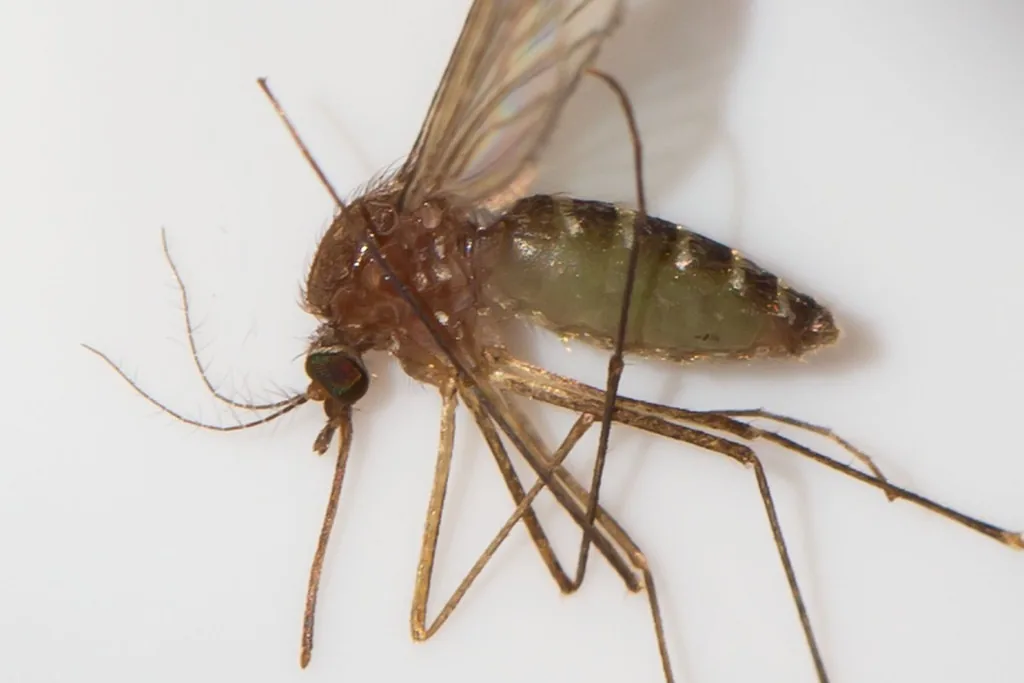
- The top of the thorax is golden-brown and usually shows a distinct pair of pale spots in the middle, the white dots of its name. The spots are often missing on rubbed specimens.[2]
- The dark brown abdomen has broad whitish bands at the front of each segment. The rear edge of each band runs straight across and does not narrow at the sides.[2]
- The legs are entirely dark, the wing veins carry only narrow dark scales, and the proboscis is mostly brown, getting darker toward the tip.[2]
- A large share of females lack the white spots that most keys use to separate this species from the northern house mosquito. Rutgers notes that a certain identification can mean holding a blood-fed female until she lays eggs, then hatching the eggs and examining the larvae.[1]
Look-alikes
| Look-alike | How to tell them apart |
|---|---|
| Northern house mosquito | So similar that Suffolk County, New York, lumps the two together as "Culex spp." The northern house mosquito has no pair of pale spots on the thorax, and its abdominal bands curve inward along the rear edge and pinch in at the sides.[3][2] |
| Unbanded saltmarsh mosquito | Its abdominal bands are faint, variable or missing, the last abdominal segments are mostly dull yellow, and the thorax has no pale spots. It readily attacks people and often comes indoors.[2] |
Where it lives
Culex restuans ranges from central Canada south into Mexico and is very common in the eastern and central United States. Records reach west into California, but west of the Continental Divide it turns up only in scattered places. It is found in every county of New Jersey and Connecticut.[1][2]
Biology and life cycle
Mated females spend the winter inactive in basements, spring houses, outbuildings, caves, animal burrows and other sheltered spots. They gather near moisture and move around during the winter to stay in humid air.[1][2]
Females that survive the winter start laying rafts of eggs in April in southern New Jersey and in May farther north. Numbers usually peak by July, and a second peak in fall produces the females that will overwinter. Larvae can still be found into October.[1]
Larvae use an unusually wide range of water, from nearly clear to grossly polluted: temporary ground pools, grassy swamp edges, sphagnum bogs, roadside ditches, tire ruts, hoof prints, buckets, discarded tires, catch basins, sewage effluent and septic seepage.[1][2]
It is often the first mosquito to colonize water that collects in a discarded tire, even clear water with no leaf litter, and it moves into ground pools after floodwater Aedes broods have emerged from them.[1]
In water rich in organic matter it can go from egg to adult in about 10 days. With little organic matter, development can take three times as long, and the adults may be only half the usual size.[1]
It has several generations a year. In Connecticut, larvae are found from May to October and adults in every month, while Brunswick County, North Carolina, sees it in the greatest numbers in spring, fall and winter.[2][4]
Damage and signs
- Its pest status is disputed. Most authors describe it as a bird feeder that rarely, if ever, bites people, while others report an annoying bite. Rutgers suggests that misidentified adults explain some of the confusion and concludes that it can act as a pest under certain circumstances but in most cases is not attracted to people.[1]
- The Connecticut station reports that it bites people when abundant and when emerging from hibernation in spring. Brunswick County's mosquito control staff think it rarely bites people and rate it of low importance to residents there.[2][4]
Health risk
Connecticut has isolated West Nile, eastern equine encephalitis, Jamestown Canyon, Highlands J and Flanders viruses from it. Suffolk County, New York, counts it and the northern house mosquito together as the group thought to be the main West Nile virus vector there, and possibly an eastern equine encephalitis vector. In New Jersey, eastern equine encephalitis virus is occasionally isolated from it, and Rutgers suggests it may play a minor role in speeding the virus's spread among birds.[2][3][1]
Control
Prevention
Spend less time outdoors in early morning and evening, when host-seeking Culex are most active. Outside at those times, wear long sleeves, long pants, shoes and socks, and use an EPA-registered repellent such as DEET, picaridin, IR3535 or oil of lemon eucalyptus according to its label.[5][6]
Sanitation
Suffolk County notes that its backyard Culex breed close to home and don't travel far, so the best control is removing the water they breed in. Larvicides can help where a breeding site can be found but not removed, though such sites are often too numerous to treat them all.[3]
Get rid of discarded tires, buckets and similar containers that hold water, since this species readily moves into them, and change the water in bird baths at least once a week.[1][5]
Common questions
- What are the white dots on this mosquito?
- Most white-dotted mosquitoes have a pair of pale spots in the middle of the golden-brown thorax. The spots rub off easily, and many females lack them, which is why the species is so easily mistaken for the northern house mosquito.[2][1]
- Does the white-dotted mosquito carry West Nile virus?
- West Nile virus has been isolated from it in Connecticut, and Suffolk County, New York, counts it together with the northern house mosquito as the group thought to be the main West Nile vector in that county.[2][3]
- Where do these mosquitoes spend the winter?
- Mated females shelter in basements, outbuildings, spring houses, caves and animal burrows, then come out to lay eggs in spring: in April in southern New Jersey and in May farther north.[1][2]
Sources
- Rutgers Center for Vector Biology (New Jersey Agricultural Experiment Station), “Culex restuans Theobald (species account by W.J. Crans).” vectorbio.rutgers.edu/outreach/species/rest.htm (accessed 2026-11-08)
- Connecticut Agricultural Experiment Station, “Identification Guide to the Mosquitoes of Connecticut, Bulletin No. 966 (Andreadis, Thomas and Shepard, 2005).” portal.ct.gov/-/media/caes/documents/publications/bulletins/b966b996pdf.pdf (accessed 2026-11-08)
- Suffolk County Department of Health Services (New York), “Suffolk County Mosquito Control Plan: Mosquito Species.” health.suffolkcountyny.gov/suffolkvectorplan/species_suffolk.htm (accessed 2026-11-08)
- Brunswick County Mosquito Control (North Carolina), “Culex restuans Biology (R. Hickman and J. Brown).” www.brunswickcountync.gov/DocumentCenter/View/1359/Culex-Restuans-Biology-PDF (accessed 2026-11-08)
- University of California Statewide IPM Program, “Pest Notes: Mosquitoes, Publication 7451 (revised April 2020).” ipm.ucanr.edu/legacy_assets/PDF/PESTNOTES/pnmosquitoes.pdf (accessed 2026-11-08)
- City of Jacksonville Mosquito Control (Florida), “Avoiding Mosquitoes.” www.jacksonville.gov/departments/neighborhoods/mosquito-control/avoiding-mosquitoes (accessed 2026-11-08)
- iNaturalist, “Culex restuans taxon page (order and family).” www.inaturalist.org/taxa/217908 (accessed 2026-11-08)