The short answer
- Fix the way in first. Install or repair window and door screens, keep doors (garage doors too) closed rather than propped open, and run air conditioning if you have it.[1][2][6]
- Once a week, empty and scrub vases, flowerpot saucers and anything else indoors that holds water. Mosquitoes that get inside can lay eggs there.[1][3]
- Mosquitoes rest in cool, dark, humid spots: under sinks, in showers, closets and the laundry room, and behind or under furniture. That's where to look for them and, if you need it, where an indoor surface spray goes.[1][3]
- An indoor spray kills the mosquitoes that are there, but CDC says spraying alone won't keep a home free of mosquitoes. Bug zappers and plug-in electronic repellers don't stop bites.[3][1][6][18]
- Mosquitoes in the house mostly come from water outdoors. Working on the yard is the other half of the job; see our yard and breeding guides.[1][2]
Mosquitoes that come indoors
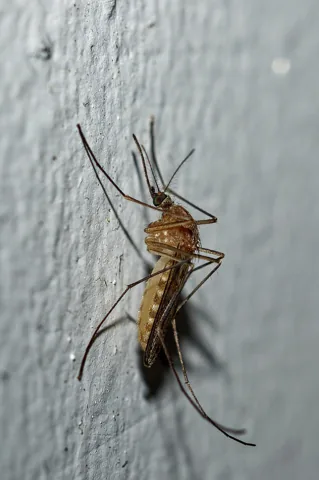 Mosquito
Culicidae (shown: Culex pipiens complex)
Mosquitoes are small, delicate flies whose females feed on blood and can pass on viruses such as West Nile; the control that works best goes after the larvae in standing water.
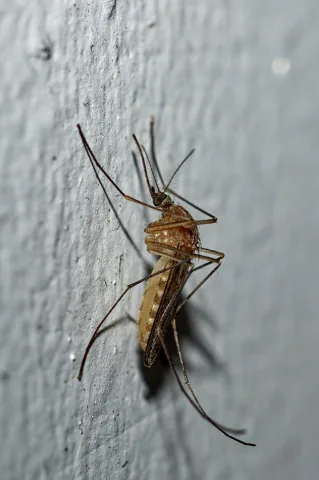 Northern House Mosquito
Culex pipiens
The northern house mosquito, Culex pipiens, is often the most common pest mosquito in cities and suburbs. It bites from dusk to dawn, breeds in stagnant and polluted water, and is a major carrier of West Nile virus in North America.
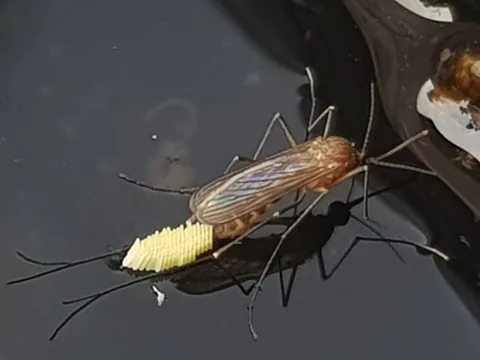 Southern House Mosquito
Culex quinquefasciatus
The southern house mosquito bites in the evening, at night and in the early morning, and Texas A&M calls it the most important carrier of West Nile virus and St. Louis encephalitis, especially in the eastern U.S. It prefers birds but will come through unscreened windows and open doors to bite sleeping people.
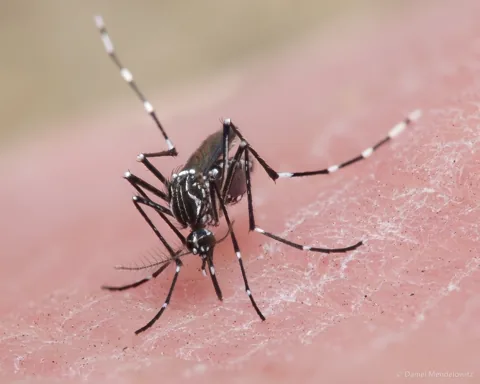 Yellow Fever Mosquito
Aedes aegypti
The yellow fever mosquito, Aedes aegypti, is a container-breeding mosquito that lives close to people and prefers to bite them. It lives indoors and outdoors, and the CDC calls it the main type of mosquito that spreads Zika, dengue and chikungunya viruses.
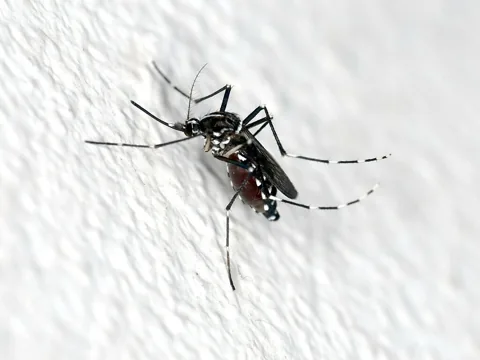 Asian Tiger Mosquito
Aedes albopictus
The Asian tiger mosquito is an invasive, aggressive mosquito that bites during the day and breeds in small water-holding containers around homes. First found at a tire dump near Houston in 1985, it spread rapidly through the southern United States and up the East Coast.
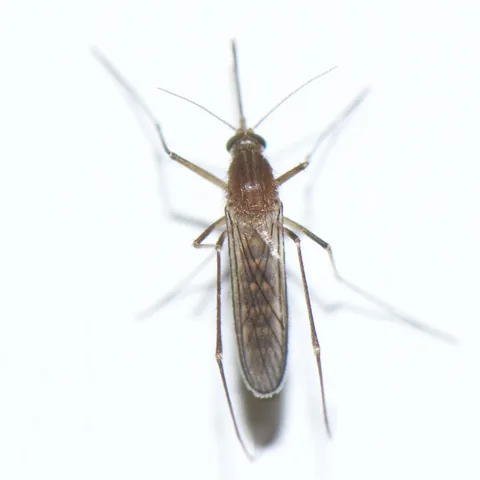 Unbanded saltmarsh mosquito
Culex salinarius
The unbanded saltmarsh mosquito breeds in fresh and brackish water thick with decaying plants, especially coastal impoundments, where it can reach enormous numbers. It bites mainly at twilight and after dark, readily comes indoors, and keeps looking for blood well into the fall.
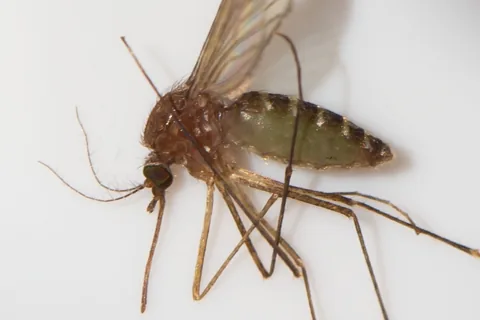 White-dotted mosquito
Culex restuans
The white-dotted mosquito (Culex restuans) is very common in the eastern and central United States. Its larvae live in an unusually wide range of standing water, from clear water in an old tire to sewage seepage, and the adults feed mostly on birds, although they are reported to bite people when they are abundant and when they first leave their winter shelters in spring.
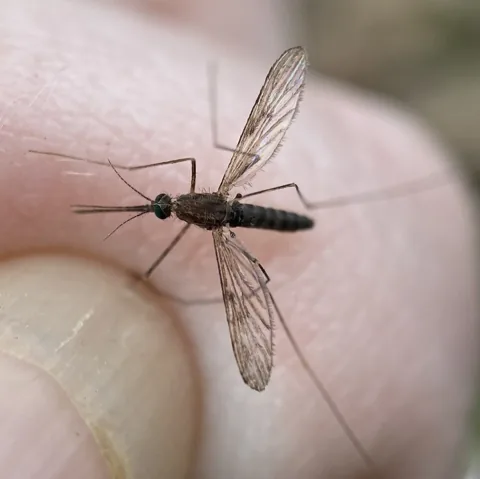 Common Malaria Mosquito
Anopheles quadrimaculatus (a complex of five sibling species)
The common malaria mosquito is a large, dark Anopheles mosquito of the eastern United States. It was the most important malaria carrier in the Southeast, still serves as the primary vector in eastern outbreaks, and bites livestock, deer and, to a lesser extent, people.
Which mosquitoes come indoors, and when they bite
Knowing when you get bitten helps narrow down which mosquito it is and what will help. CDC says mosquitoes bite day and night, and they can live inside your home if windows and doors aren't screened.[3][2]
- Daytime biters indoors: CDC says the yellow fever mosquito (Aedes aegypti) prefers to live near and bite people and lives indoors and outdoors, while the Asian tiger mosquito lives outdoors. In a 2018 survey of houses in southern Mexico, Aedes aegypti was the most common mosquito resting inside houses (56.7%), while Asian tiger and southern house mosquitoes were mostly found resting outside.[4][17]
- Night biters in the bedroom: house mosquitoes (Culex) are most active from dusk to dawn, according to CDC. The Connecticut Agricultural Experiment Station describes the northern house mosquito as mainly a bird feeder that will bite people, especially in the evening, and readily enters houses; it describes the unbanded saltmarsh mosquito (Culex salinarius) as often entering houses and feeding from dusk to dawn.[5][11]
- Some Anopheles bite indoors too. The same Connecticut guide says females of the common malaria mosquito readily bite people indoors and outdoors, especially during evenings.[11]
- Most of these mosquitoes don't travel far. CDC says Aedes aegypti and the Asian tiger mosquito fly only a few blocks in their lifetime, and that Culex don't fly long distances but have been known to fly up to 2 miles. The water they came from is usually close by.[4][5]
How mosquitoes get into the house
Female mosquitoes come indoors looking for blood, which they need to produce eggs.[4][12]
- Open or propped doors, including the door from the garage. CDC lists closing doors, garage doors included, as one of the main ways to keep mosquitoes out.[1]
- Torn, loose or missing screens. A 1914 U.S. Public Health Service guide to mosquito-proofing homes called windows probably the most common place of entrance, and said mosquitoes get in through coarse or torn screens, the sides of poorly fitting screen doors and window screens, chimneys, drain holes and any other opening big enough.[12][1]
- Gaps around doors that have warped or shrunk. The same guide pointed out that a door planed to close in damp weather can leave a crack of half an inch or more when the wood shrinks in warm weather.[12]
- Fireplaces and chimneys. The 1914 guide said people who had screened a house and still had mosquitoes had often left the fireplace open, not knowing mosquitoes will enter through the chimney.[12]
- Light. The same report noted that night-flying Anopheles are attracted to houses by light, and other mosquitoes frequently are too.[12]
Fix screens and doors
Screens are the main defense CDC and UC IPM recommend: install screens on windows and doors, repair any holes, and keep them in good repair. UC IPM specifies fine mesh screens.[1][2][6]
There is good field evidence that screening works. In a 2019 randomized trial in Mérida, Mexico, houses fitted with permanently fixed fiberglass screens on all windows and doors had about half the indoor Aedes aegypti of unscreened houses (rate ratio 0.50), and the researchers estimated 71% efficacy in reducing mosquitoes infected with dengue or Zika viruses. They called screening an effective pesticide-free method.[13]
- Mesh size: the 1914 Public Health Service guide said 18 mesh (18 wires to the inch) was the best size, 16 mesh was quite efficient, and it advised against the coarser 12 and 14 mesh for keeping out mosquitoes.[12]
- Cover the whole opening. The same guide found adjustable sliding screens let mosquitoes work their way in between the lapping ends, and said screening the entire window with a well-fitting frame was the most efficient approach.[12]
- Screen doors should fit, close on their own with a spring, and have any gaps around the edges sealed.[12]
- Close off fireplaces when not in use, and screen other openings into the house. CDC also advises covering open vent and plumbing pipes outdoors with wire mesh that has holes smaller than an adult mosquito.[12][1]
- Keep doors closed, garage doors included, and don't prop them open.[1]
Use air conditioning when you can
CDC recommends using air conditioning when it's available, along with screens and closed doors.[1][2][3]
A study led by CDC researchers of a 1999 dengue outbreak on the Texas-Mexico border found that dengue infections were more common in Nuevo Laredo, Mexico, even though the mosquito that carries it was more abundant in Laredo, Texas. The researchers concluded that air conditioning and how people lived, which limited contact with mosquitoes, appeared to account for the difference.[14]
Empty and scrub indoor water every week
CDC says mosquitoes that enter from outdoors can start laying eggs indoors. Once a week, empty and scrub, turn over, cover or throw out anything inside that holds water, such as vases and flowerpot saucers. Check indoors and outdoors.[1][3]
Scrubbing matters for container mosquitoes. CDC says Aedes females lay eggs on the inner walls of containers just above the waterline, where they stick like glue and can survive drying out for up to 8 months; they hatch when water covers them again. That's why CDC says to scrub containers, not just dump them.[4]
A weekly check works because CDC says a Culex egg takes 7 to 10 days to develop into an adult mosquito, and mosquitoes need only a small amount of water to lay eggs.[5][4]
Find where they rest, and when an indoor spray makes sense
Mosquitoes rest in dark, humid places: CDC lists under sinks, in showers, in closets, under or behind furniture and in the laundry room. Penn State Extension adds crawlspaces and basements to the places adult mosquitoes shelter from sun, heat, wind and drying out.[1][3][8]
CDC suggests an indoor insecticide if you still have mosquitoes after fixing screens and emptying and scrubbing containers. Its indoor spraying fact sheet says to use indoor sprays if you don't have window and door screens, and to pick a product whose label says it kills adult mosquitoes.[1][3]
- Surface sprays go on the cool, dark, humid spots where mosquitoes rest; mosquitoes die when they touch the treated surface. CDC says it's safe for you and your pets to stay inside when these sprays are applied.[3]
- Foggers and aerosols kill mosquitoes in the air. CDC says you and your pets must leave the home while foggers or aerosols are used and cover fish tanks; you can come back after the spray has dried.[3]
- These products work immediately, but some need reapplying. Don't apply more product, or reapply more often, than the label allows.[3][1]
- Spraying alone won't keep the house free of mosquitoes. CDC pairs it with screens, air conditioning and removing water.[3][1]
- Questions about an insecticide and health can go to the National Pesticide Information Center at 1-800-858-7378.[3][1]
Indoor traps and gadgets: what the evidence says
Traps can catch mosquitoes without doing much about bites. Texas A&M AgriLife says a mosquito trap has to be at least as attractive as a person and run continuously while mosquitoes are active to work, and results vary with wind and airflow.[9]
- Household mass trapping has mixed results. In a randomized trial in Manaus, Brazil, one mosquito trap per participating home significantly reduced adult female Aedes aegypti during the first five rainy months, but showed no effect in the following dry season, and the drop in recent dengue infections was not statistically significant. A second trial there, using three sticky traps per household for 17 months, found no reduction in adult Aedes aegypti.[15][16]
- Bug zappers: UC IPM calls them counterproductive because many of the insects they kill prey on mosquitoes, and Texas A&M AgriLife says they don't control the females of biting species.[6][9]
- Plug-in and ultrasonic repellers: a 2007 Cochrane review found 10 field studies, and all 10 found no difference in mosquitoes biting people with or without the device. See our guide to bug zappers and electronic repellers.[18]
- A fan can help where you sit. UW-Madison Extension says mosquitoes, with their small body mass, have a hard time flying in a breeze.[7]
Mosquitoes in the house in late fall or winter
A mosquito in the basement in cold weather is usually an overwintering house mosquito. Rutgers says mated northern house mosquito females spend the winter in culverts, basements and other protected places that stay above freezing, in a slowed-down state; those that survive feed on blood in spring and lay the eggs for the summer population.[10]
The Connecticut mosquito guide agrees, listing damp, well-protected structures, especially unheated basements and cellars, as overwintering sites for the northern house mosquito, and basements among the winter shelters of the white-dotted mosquito (Culex restuans), which may bite people as it comes out of hibernation in spring.[11]
Protecting yourself and children indoors
While you're fixing the gaps, protect the people being bitten. CDC recommends EPA-registered repellents (DEET, picaridin, IR3535, oil of lemon eucalyptus, para-menthane-diol or 2-undecanone) used as the label directs, loose long-sleeved shirts and pants, and clothing treated with permethrin, which is never applied to skin.[2]
- Babies: CDC advises covering strollers and baby carriers with mosquito netting and dressing children in clothing that covers arms and legs.[2]
- Don't use oil of lemon eucalyptus or para-menthane-diol products on children under 3, and don't put repellent on a child's hands, eyes, mouth or irritated skin.[2]
- Our repellent guide compares the active ingredients.[2]
Then deal with the yard
Indoor steps only go so far while mosquitoes keep breeding outside. CDC's home checklist starts outdoors: once a week empty and scrub, turn over, cover or throw out tires, buckets, planters, toys, pools, birdbaths, flowerpot saucers and trash containers, cover water storage, and fill tree holes. UC IPM says the most effective control methods target the larval stage.[1][6]
Our yard guide covers dumping and draining, Bti for water you can't drain, barrier sprays and working with your local mosquito control district.[1][6]
Common questions
- Why do I keep getting bitten at night in my bedroom?
- House mosquitoes (Culex) are most active from dusk to dawn, and some readily enter houses. Look for a torn or missing screen, a door left open, or water standing in a vase or plant saucer, and close the gap.[5][11][1]
- Can mosquitoes breed inside the house?
- Yes. CDC says mosquitoes that get in can lay eggs indoors in vases, flowerpot saucers and other containers. Emptying and scrubbing them weekly stops it.[1][3]
- Where do mosquitoes hide in a house?
- In cool, dark, humid places: under sinks, in showers, closets and the laundry room, and behind or under furniture.[1][3]
- Is it safe to stay home when I spray for mosquitoes?
- It depends on the product. CDC says you and your pets can stay inside when surface sprays are applied, but must leave while foggers or aerosols are used, cover fish tanks, and return after the spray has dried. Follow the label.[3]
- Do plug-in mosquito repellers work indoors?
- No. A Cochrane review of 10 field studies found electronic repellers made no difference to the number of mosquitoes biting people.[18]
- Why are there mosquitoes in my basement in winter?
- Mated northern house mosquito females spend the winter in basements and other protected places that stay above freezing, then feed and lay eggs in spring.[10][11]
Photo credits
- Mosquito: (c) Donald Davesne, some rights reserved (CC BY) — via iNaturalist, CC BY 4.0
- Northern House Mosquito: (c) Donald Davesne, some rights reserved (CC BY) — via iNaturalist, CC BY 4.0
- Southern House Mosquito: (c) Lek Khauv, some rights reserved (CC BY) — via iNaturalist, CC BY 4.0
- Yellow Fever Mosquito: (c) Dan Mendelowitz, some rights reserved (CC BY) — via iNaturalist, CC BY 4.0
- Asian Tiger Mosquito: (c) Rafael Carbonell Font, some rights reserved (CC BY) — via iNaturalist, CC BY 4.0
- Unbanded saltmarsh mosquito: (c) Shannon Stoner, some rights reserved (CC BY) — via iNaturalist, CC BY 4.0
- White-dotted mosquito: (c) Bill Keim, some rights reserved (CC BY) — via iNaturalist, CC BY 4.0
- Common Malaria Mosquito: (c) fuzzyspider, some rights reserved (CC BY) — via iNaturalist, CC BY 4.0
Sources
- U.S. Centers for Disease Control and Prevention, “Mosquito Control at Home (reviewed April 16, 2024).” www.cdc.gov/mosquitoes/mosquito-control/mosquito-control-at-home.html (accessed 2026-11-10)
- U.S. Centers for Disease Control and Prevention, “Preventing Mosquito Bites (August 28, 2024).” www.cdc.gov/mosquitoes/prevention/index.html (accessed 2026-11-10)
- U.S. Centers for Disease Control and Prevention (CDC Stacks), “Mosquito Control: What You Need to Know About Indoor Spraying (CS315050-B, April 2, 2020).” stacks.cdc.gov/view/cdc/130786 (accessed 2026-11-10)
- U.S. Centers for Disease Control and Prevention, “Life Cycle of Aedes Mosquitoes (reviewed April 16, 2024).” www.cdc.gov/mosquitoes/about/life-cycle-of-aedes-mosquitoes.html (accessed 2026-11-10)
- U.S. Centers for Disease Control and Prevention, “Life Cycle of Culex Mosquitoes.” www.cdc.gov/mosquitoes/about/life-cycle-of-culex-mosquitoes.html (accessed 2026-11-10)
- University of California Statewide IPM Program, “Pest Notes: Mosquitoes, Publication 7451 (revised April 2020).” ipm.ucanr.edu/legacy_assets/PDF/PESTNOTES/pnmosquitoes.pdf (accessed 2026-11-10)
- University of Wisconsin-Madison Extension, Wisconsin Horticulture, “Making Informed Mosquito Control Decisions (published August 6, 2026).” hort.extension.wisc.edu/articles/making-informed-mosquito-control-decisions/ (accessed 2026-11-10)
- Penn State Extension, “Watershed Friendly Mosquito Control (updated June 15, 2026).” extension.psu.edu/watershed-friendly-mosquito-control (accessed 2026-11-10)
- Texas A&M AgriLife Extension, “ENTO-054: Do-It-Yourself Backyard Mosquito Control (June 2016).” agrilifeextension.tamu.edu/wp-content/uploads/2025/07/Mosquitoes-Backyard-Mosquito-Control-1.pdf (accessed 2026-11-10)
- Rutgers University, Center for Vector Biology (Mosquito Research and Control), “Culex pipiens: The Northern House Mosquito.” vectorbio.rutgers.edu/outreach/species/cxpip.htm (accessed 2026-11-10)
- Connecticut Agricultural Experiment Station, “Identification Guide to the Mosquitoes of Connecticut, Bulletin No. 966 (Andreadis, Thomas and Shepard, 2005).” portal.ct.gov/-/media/caes/documents/publications/bulletins/b966b996pdf.pdf (accessed 2026-11-10)
- U.S. Public Health Service (CDC Stacks), “von Ezdorf RH. Prevention of malaria: suggestions on how to screen the home to keep out effectively the mosquitoes which spread the disease. Public Health Reports 1914;29(9):503-508.” stacks.cdc.gov/view/cdc/67552 (accessed 2026-11-10). Historical guidance; mesh grades and entry points still match current CDC advice to screen and repair openings.
- Tropical Medicine & International Health (PubMed 34587328), “Manrique-Saide P et al. Protective effect of house screening against indoor Aedes aegypti in Mérida, Mexico: a cluster randomised controlled trial. Trop Med Int Health 2021;26(12):1677-1688.” pubmed.ncbi.nlm.nih.gov/34587328/ (accessed 2026-11-10)
- Emerging Infectious Diseases (PubMed 12533286), “Reiter P et al. Texas lifestyle limits transmission of dengue virus. Emerg Infect Dis 2003;9(1):86-89.” pubmed.ncbi.nlm.nih.gov/12533286/ (accessed 2026-11-10)
- Journal of Medical Entomology (PubMed 24724291), “Degener CM et al. Evaluation of the effectiveness of mass trapping with BG-sentinel traps for dengue vector control: a cluster randomized controlled trial in Manaus, Brazil. J Med Entomol 2014;51(2):408-420.” pubmed.ncbi.nlm.nih.gov/24724291/ (accessed 2026-11-10)
- Memórias do Instituto Oswaldo Cruz (PubMed 25946154), “Degener CM et al. Mass trapping with MosquiTRAPs does not reduce Aedes aegypti abundance. Mem Inst Oswaldo Cruz 2015;110(4):517-527.” pubmed.ncbi.nlm.nih.gov/25946154/ (accessed 2026-11-10)
- Insects (PubMed 37367381), “Lopez-Solis AD et al. Aedes aegypti, Ae. albopictus and Culex quinquefasciatus adults found coexisting in urban and semiurban dwellings of southern Chiapas, Mexico. Insects 2023;14(6):565.” pubmed.ncbi.nlm.nih.gov/37367381/ (accessed 2026-11-10)
- Cochrane Database of Systematic Reviews, via PubMed, “Enayati, Hemingway and Garner (2007), Electronic mosquito repellents for preventing mosquito bites and malaria infection, Cochrane Database of Systematic Reviews CD005434.” pubmed.ncbi.nlm.nih.gov/17443590/ (accessed 2026-11-10)