On this page
How to identify it
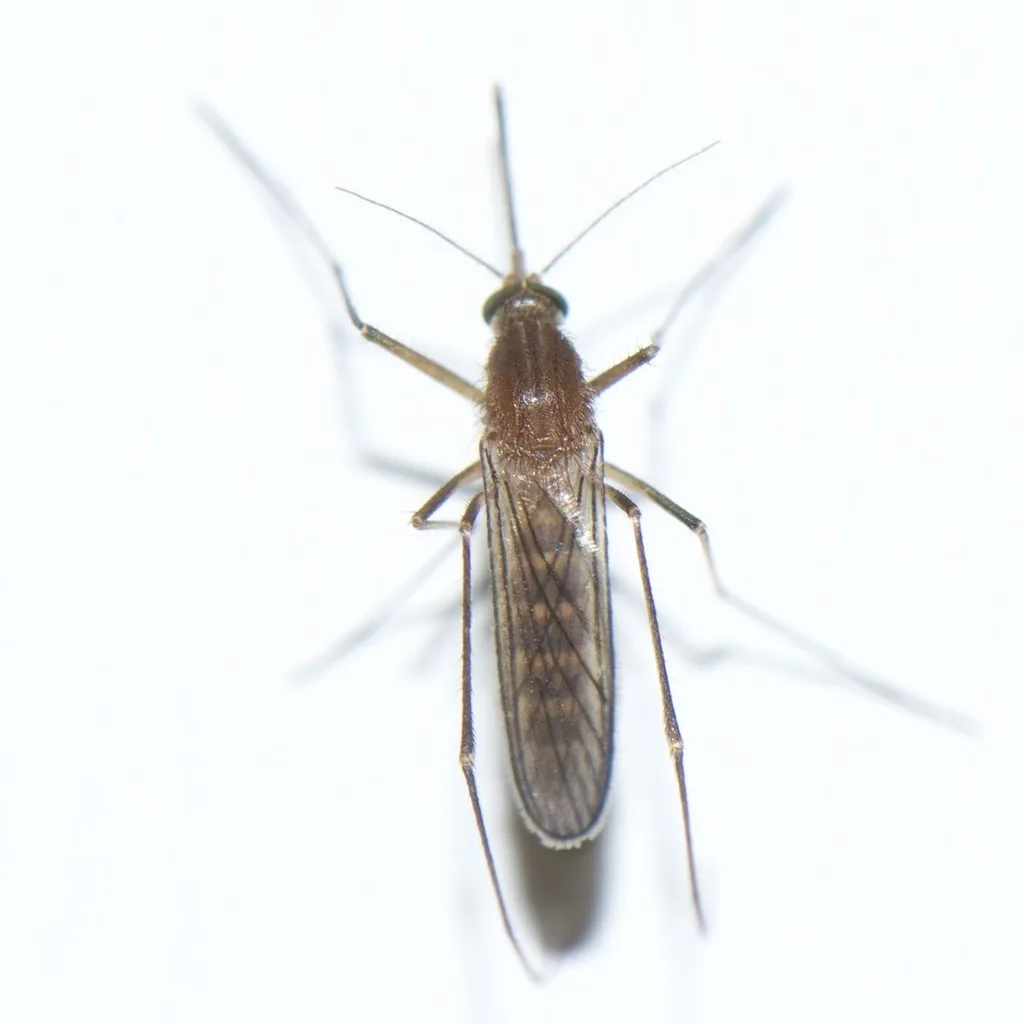
- The proboscis and legs are entirely dark-scaled, with no pale bands, and the top of the thorax is a single color, covered with golden-brown scales.[5]
- The bands on the abdomen vary: some individuals have narrow, dingy yellow bands at the front of each segment, while in others the bands are faint or missing. The sides carry dingy yellow to copper patches, the last two segments are mostly dingy yellow, and, as in other Culex, the abdomen ends bluntly rather than in a point.[5][6]
- It rarely bites in daylight, unlike the salt marsh Aedes mosquitoes. Females look for hosts mostly in the first 2 or 3 hours after sunset, and huge swarms have been reported at twilight near brackish water as adults leave their daytime resting spots in cattails and Phragmites.[1][2]
- By day adults also rest in outbuildings and similar shelters.[4]
- The larvae are fairly easy to recognize by their exceptionally long, thin air tube (siphon), which carries scattered tufts of hairs.[1]
Look-alikes
| Look-alike | How to tell them apart |
|---|---|
| Northern house mosquito | A close relative with a similar life cycle; the larvae look so alike that measuring the air tube is the best way to separate them. Northern house mosquitoes gather in buildings for the winter, which the unbanded saltmarsh mosquito does not.[1] |
| Dark-tailed mosquito | Its larvae look superficially similar but usually live in very different habitat, and under a microscope the comb scales differ: a patch of scales in the unbanded saltmarsh mosquito, bar-shaped scales in the dark-tailed mosquito.[1] |
| Eastern saltmarsh mosquito | Shares coastal marshes, but the eastern saltmarsh mosquito is a day-active biter, while this species rarely bothers people in daylight.[1] |
Where it lives
Most of the eastern United States, from Maine to southern Florida, west to central Texas and north to the lower Great Lakes, with relict populations reported in New Mexico, Wyoming and Idaho. It is most abundant along the Atlantic and Gulf coasts. Severe winters often kill it off at the northern edge of its range, and it is thought to recolonize those areas by migration.[1][2]
Biology and life cycle
Larvae develop in fresh or brackish water with plenty of emergent and decaying vegetation. They are especially abundant in freshwater impoundments, including salt marsh that has been diked and flooded, and numbers peak right after flooding because rotting marsh plants attract egg-laying females.[2][1]
Despite its reputation as the salt marsh Culex, its larvae rarely occur in numbers on the open salt marsh, only along the brackish upper edges. Flooded Phragmites, roadside ditches, polluted groundwater and artificial containers also produce them, and Brunswick County has found larvae in grassy pools, ponds, rain barrels, boat bilges, cattle tracks and stump holes.[1][4]
There are several generations a year. Numbers build gradually from spring through summer to a late-season peak in fall that lasts until cold weather sends adults into hibernation.[1]
Mated females spend the winter in natural shelters, such as muskrat huts and animal burrows, rather than in buildings. Unlike most Culex they keep seeking blood through the fall, pestering duck hunters in November, and they can become active on mild winter days; light traps in Ocean County, New Jersey, caught at least one female every winter month.[1][2]
Females feed on birds and mammals, and also on reptiles and amphibians, mostly from dusk to dawn. Brunswick County's mosquito control staff think they prefer dogs, horses and other furry mammals, and the females readily attack people, often coming into houses.[1][2][4][5]
Damage and signs
- It can be a severe biting pest and readily enters houses for a blood meal. Numbers can be extremely high in coastal areas with good habitat, and Suffolk County calls it a serious pest in much of the Northeast.[1][3]
- Over much of its range it is overshadowed by the day-biting salt marsh Aedes mosquitoes, even though it is often more abundant.[2]
Health risk
The Connecticut Agricultural Experiment Station has isolated eastern equine encephalitis, West Nile, Flanders and Highlands J viruses from it, and West Nile virus has been isolated from this mosquito with some frequency in the Northeast, and Suffolk County notes it is thought to be the main bridge vector of the virus to people in New York City. Rutgers' species account calls it a potential bridge vector of encephalitis viruses because it feeds on birds as well as mammals, but notes that lab studies suggest it is hard to infect and probably acts as a secondary vector during outbreaks; a 1990 paper called it an efficient vector of St. Louis encephalitis.[5][3][1][2]
Control
Prevention
Outdoors at dusk and after dark, wear long pants, long sleeves, shoes and socks and use an EPA-registered repellent on exposed skin and clothing, following the label directions.[2][7]
Keep them out
Because it readily comes indoors to bite, keep window screens and screened rooms in good repair, with screen doors that close and latch on their own.[1][7]
Sanitation
Around the home, look for and eliminate standing water, and check and refill pet dishes and bird baths at least every 5 days. Artificial containers are a secondary source of this species, especially inland.[7][1]
When to call a professional
Control is hard for anyone: the dense vegetation in its breeding sites shelters larvae from predators and pesticides, larvae hatch at different times and are widely scattered, and adults are active at night. Much of the adult mosquito control aimed at the eastern saltmarsh mosquito in marsh areas also helps manage it, and Suffolk County recommends close monitoring and control as a potential disease vector.[2][1][3]
Common questions
- Does it really breed in salt marshes?
- Not much. Rutgers notes that although it is often called the salt marsh Culex, its larvae rarely occur in numbers on the open salt marsh. They tolerate some salt but thrive in fresh and brackish water full of decaying plants, such as diked marsh impoundments and flooded Phragmites.[1]
- Why am I still getting bitten indoors in the fall?
- This mosquito keeps seeking blood well into the fall, readily enters houses, and can become active again on mild winter days.[1]
Sources
- Rutgers Center for Vector Biology (New Jersey Agricultural Experiment Station), “Culex salinarius Coquillett (species account by W.J. Crans).” vectorbio.rutgers.edu/outreach/species/sp11a.htm (accessed 2026-11-08)
- Rutgers Center for Vector Biology (reprint), “The Biology of Culex salinarius (M. Slaff), Proceedings of the 77th Annual Meeting of the New Jersey Mosquito Control Association, 1990, pp. 71-72.” vectorbio.rutgers.edu/outreach/species/sp11.htm (accessed 2026-11-08)
- Suffolk County Department of Health Services (New York), “Suffolk County Mosquito Control Plan: Mosquito Species.” health.suffolkcountyny.gov/suffolkvectorplan/species_suffolk.htm (accessed 2026-11-08)
- Brunswick County Mosquito Control (North Carolina), “Culex salinarius Biology (R. Hickman and J. Brown).” brunswickcountync.gov/DocumentCenter/View/1361/Culex-Salinarius-Biology-PDF (accessed 2026-11-08)
- Connecticut Agricultural Experiment Station, “Identification Guide to the Mosquitoes of Connecticut, Bulletin No. 966 (Andreadis, Thomas and Shepard, 2005).” portal.ct.gov/-/media/caes/documents/publications/bulletins/b966b996pdf.pdf (accessed 2026-11-08)
- Oklahoma Cooperative Extension Service (Oklahoma State University), “Guide to the Twelve Most-Important Oklahoma Mosquitoes of Concern for Pest Control Specialists, EPP-7335 (Bradt et al., October 2017).” pods.okstate.edu/fact-sheets/EPP-7335pod.pdf (accessed 2026-11-08)
- City of Jacksonville Mosquito Control (Florida), “Avoiding Mosquitoes.” www.jacksonville.gov/departments/neighborhoods/mosquito-control/avoiding-mosquitoes (accessed 2026-11-08)
- iNaturalist, “Culex salinarius taxon page (order and family).” www.inaturalist.org/taxa/259075 (accessed 2026-11-08)