On this page
How to identify it
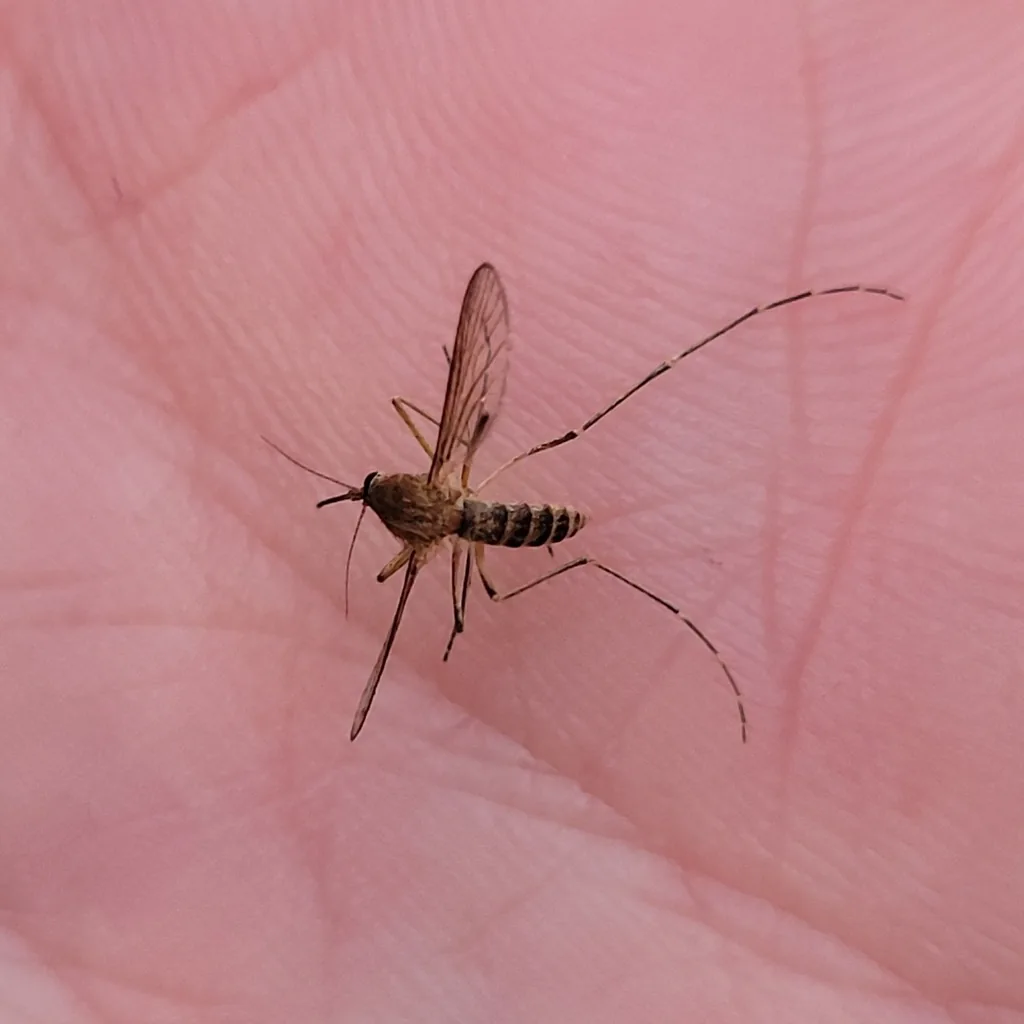
- A brownish Aedes. The thorax is light brown and covered with golden-brown scales, set off by a patch of long, pale scales at its rear edge, and the proboscis is dark with no pale band.[4]
- The top of the abdomen is dark, with whitish-yellow bands at the front of each segment that widen gradually toward the sides, and the last two or more segments are mostly covered with pale scales. As in other Aedes, the abdomen ends in a point.[4][5]
- The hind feet have narrow pale bands only at the base of each segment, a quarter of the segment's length or less, and the wings are dark-scaled.[4]
Look-alikes
| Look-alike | How to tell them apart |
|---|---|
| Eastern saltmarsh mosquito | By mid-May its larvae mix with brown saltmarsh mosquito larvae on the marsh, and it is usually the bigger nuisance of the two. It has a white band around the middle of the proboscis, which the brown saltmarsh mosquito lacks.[1][2][4] |
| Woodland pool mosquito | Can share freshwater pool margins with the brown saltmarsh mosquito in early spring, but its hind feet have pale bands at both ends of each segment rather than only at the base.[1][4] |
Where it lives
From Labrador, Newfoundland and Nova Scotia south along the East Coast of the United States to Virginia, with isolated populations reported inland east of the Mississippi River. It is most abundant along the Atlantic coast of New Jersey and around Delaware Bay, and Connecticut has records from all eight of its counties.[1][4]
Biology and life cycle
Eggs survive the winter, and there are several generations a year, with the largest broods in early spring. In southern New Jersey the first larvae appear along the upland edge of the salt marsh in April and peak by mid-May; later broods are smaller but spread over more of the marsh, and larvae can be found into the fall.[1][4][3]
Larvae are most common at the upland edge of the marsh among salt hay (Spartina patens), smooth cordgrass (Spartina alterniflora) and saltgrass (Distichlis spicata), in pools rich in organic matter, but they also move into freshwater floodwater pools. Inland they turn up in floodwater that collects runoff from roads salted in winter, and in roadside ditches, landfills and containers.[1]
In Connecticut, larvae are found from March to November and adults from May to October. Females feed on mammals and birds.[4]
Females bite in the daytime if you walk into their habitat, but most of the nuisance comes at dusk, when most of the population is out looking for a blood meal. They are drawn to light, so light-trap counts can overstate how many are actually biting.[1]
Damage and signs
Health risk
The Connecticut Agricultural Experiment Station has isolated eastern equine encephalitis, West Nile, Jamestown Canyon, Cache Valley and Highlands J viruses from it. Suffolk County considers it unlikely to be a vector of eastern equine encephalitis, because its biggest broods come in spring, and says it may not be an effective transmitter of West Nile virus.[4][3]
Control
Prevention
Near salt marshes at dusk, wear long pants, long sleeves, shoes and socks, and use an EPA-registered repellent on exposed skin and clothing, following the label directions.[1][6]
Keep them out
Keep window screens and screened rooms in good repair, with screen doors that close and latch on their own.[6]
When to call a professional
Control is rarely aimed at this species alone. Salt marsh mosquito control directed at the eastern saltmarsh mosquito, its frequent companion, generally takes care of it too.[1][3]
Common questions
- Why are mosquitoes biting by the marsh so early in spring?
- The brown saltmarsh mosquito is normally the first mosquito to appear on the salt marsh in spring, and its largest broods emerge from the upland edge of the marsh early in the season.[1][3]
- When does it bite?
- Mostly at dusk, when most of the population is looking for a blood meal, but it will also bite in the daytime if you walk into its habitat.[1]
Sources
- Rutgers Center for Vector Biology (New Jersey Agricultural Experiment Station), “Aedes cantator (Coquillett) (species account by W.J. Crans).” vectorbio.rutgers.edu/outreach/species/sp22.htm (accessed 2026-11-08)
- Rutgers Center for Vector Biology (New Jersey Agricultural Experiment Station), “The Eastern Saltmarsh Mosquito, Aedes sollicitans (G.F. O'Meara, Wing Beats 1992).” vectorbio.rutgers.edu/outreach/species/sp7.htm (accessed 2026-11-08)
- Suffolk County Department of Health Services (New York), “Suffolk County Mosquito Control Plan: Mosquito Species.” health.suffolkcountyny.gov/suffolkvectorplan/species_suffolk.htm (accessed 2026-11-08)
- Connecticut Agricultural Experiment Station, “Identification Guide to the Mosquitoes of Connecticut, Bulletin No. 966 (Andreadis, Thomas and Shepard, 2005).” portal.ct.gov/-/media/caes/documents/publications/bulletins/b966b996pdf.pdf (accessed 2026-11-08)
- Oklahoma Cooperative Extension Service (Oklahoma State University), “Guide to the Twelve Most-Important Oklahoma Mosquitoes of Concern for Pest Control Specialists, EPP-7335 (Bradt et al., October 2017).” pods.okstate.edu/fact-sheets/EPP-7335pod.pdf (accessed 2026-11-08)
- City of Jacksonville Mosquito Control (Florida), “Avoiding Mosquitoes.” www.jacksonville.gov/departments/neighborhoods/mosquito-control/avoiding-mosquitoes (accessed 2026-11-08)
- iNaturalist, “Aedes cantator taxon page (order and family).” www.inaturalist.org/taxa/212519 (accessed 2026-11-08)