On this page
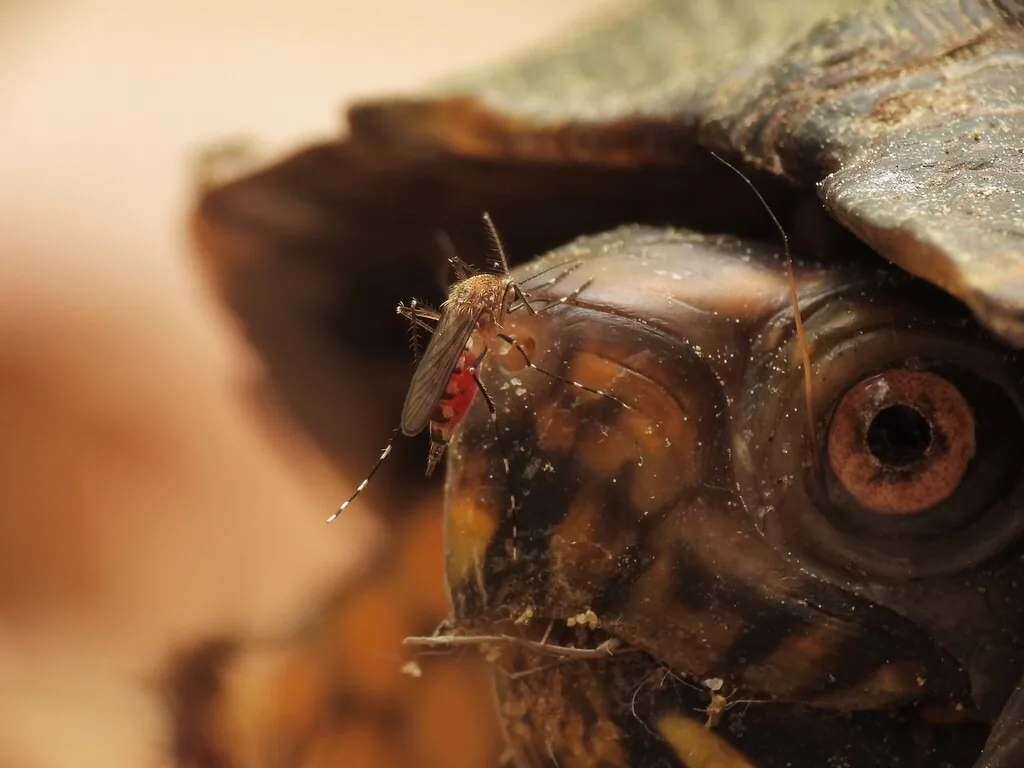
How to identify it
- The proboscis is dark with no pale band, and the top of the thorax is an even golden-brown without a dark center stripe.[4]
- The hind feet have pale bands at both ends of each segment.[4]
- The top of the abdomen is mostly dark, usually with narrow pale bands at the front of each segment and prominent triangular pale patches on the sides; the underside is pale, and the wings are all dark.[4]
- Adults appear to be very long-lived, and older ones are often found with most of their markings worn away.[1]
Look-alikes
| Look-alike | How to tell them apart |
|---|---|
| Brown saltmarsh mosquito | Can share freshwater pool margins with the woodland pool mosquito in early spring, but its hind feet have narrow pale bands only at the base of each segment, and it breeds mainly in brackish pools at the upland edge of salt marshes.[2][4] |
| Inland floodwater mosquito | Shares woodland pools later in the season. Its abdominal segments carry dingy white bands notched in the middle, its hind feet have narrow pale bands only at the base of each segment, and unlike the woodland pool mosquito it often flies a long way from where it breeds.[1][4] |
Where it lives
From Labrador south along the Atlantic seaboard to northern Florida and west through Canada into Alaska. Rutgers calls it common in every state east of the Mississippi River and widespread in the central plains, but absent from the Pacific coast and the arid Southwest; a darker form, often treated as a separate subspecies, lives in the southeastern part of the range. Connecticut and Suffolk County list it under the genus name Ochlerotatus. GBIF's public U.S. records since 1990 (about 11,400) come from 29 states on the map, most from Virginia, Maryland and Massachusetts.[1][4][3][17]
Biology and life cycle
Larvae hatch in early spring from eggs that spent the winter. In southern New Jersey they can be abundant by early March, while farther north they appear after the snow-pool mosquitoes and may not show up until late April; hatching is staggered, with new groups of larvae appearing through May.[1][4]
The favorite habitat is a shallow, leaf-lined pool in the woods, but larvae also turn up in deep snow pools, roadside ditches, vernal pools in open fields, along the edges of swamps and in acid bogs.[1][4]
It is usually described as having one generation a year, though summer rains can bring small extra hatches and a hurricane-season downpour can produce a major fall brood. Connecticut's data suggest two generations a year there, with larvae from March to June and again in September and October, and adults from May to October.[1][4]
In a 14-year survey of larvae in Burlington County, New Jersey, it was the second most common species in natural habitats such as forested depressions, after the inland floodwater mosquito.[16]
Females feed on a wide range of animals, including mammals, birds, reptiles and amphibians, and are especially drawn to turtles: Rutgers describes clouds of them following turtles crossing roads to lay eggs in May, and a 1967 note records them feeding on Blanding's turtle. A Connecticut bloodmeal study found that mosquitoes like it fed mainly on mammals, above all white-tailed deer, with occasional bird meals.[1][4][15][14]
Damage and signs
Health risk
CDC lists the woodland pool mosquito as a primary bridge vector of eastern equine encephalitis (EEE) virus in the Northeast, Mid-Atlantic and Southeast, one of the mosquitoes that can carry the virus from its bird cycle to people and horses. A New York analysis of 1971-2012 found years with human EEE cases strongly tied to finding the virus in this mosquito, but a Massachusetts lab study ranked it only third of six species as a likely epidemic vector, and Suffolk County notes its early-season emergence usually lessens the risk. It has carried La Crosse virus in Ohio, where 54% of infected lab mosquitoes passed it on, and Jamestown Canyon virus, though at a low infection rate in a New Hampshire study; Connecticut has also isolated West Nile, Cache Valley and Highlands J viruses from it.[8][10][11][3][12][13][4]
Control
Prevention
In spring woods near breeding pools, wear long pants, long sleeves, shoes and socks, consider permethrin-treated clothing, and use an EPA-registered repellent on exposed skin, following the label directions.[7][5]
When to call a professional
Suffolk County controls it mainly with larvicides in its breeding pools and adds adulticides only when eastern equine encephalitis is a concern.[3]
Common questions
- Why do mosquitoes swarm me in the woods in early spring?
- The woodland pool mosquito hatches from leaf-lined woodland pools in early spring, is New Jersey's most abundant early-season mosquito, and bites aggressively in shady areas near its breeding sites.[1][4]
- Is it a risk to my dog?
- Rutgers notes it has repeatedly been cited as an efficient vector of dog heartworm. FDA says heartworm spreads only through mosquito bites, has been reported in dogs in all 50 states, and is best prevented year-round with a prescription preventive from your veterinarian.[1][9]
Sources
- Rutgers Center for Vector Biology (New Jersey Agricultural Experiment Station), “Aedes canadensis canadensis (Theobald) (species account by W.J. Crans).” vectorbio.rutgers.edu/outreach/species/sp21.htm (accessed 2026-11-11)
- Rutgers Center for Vector Biology (New Jersey Agricultural Experiment Station), “Aedes cantator (Coquillett) (species account by W.J. Crans).” vectorbio.rutgers.edu/outreach/species/sp22.htm (accessed 2026-11-11)
- Suffolk County Department of Health Services (New York), “Suffolk County Mosquito Control Plan: Mosquito Species.” health.suffolkcountyny.gov/suffolkvectorplan/species_suffolk.htm (accessed 2026-11-11)
- Connecticut Agricultural Experiment Station, “Identification Guide to the Mosquitoes of Connecticut, Bulletin No. 966 (Andreadis, Thomas and Shepard, 2005).” portal.ct.gov/-/media/caes/documents/publications/bulletins/b966b996pdf.pdf (accessed 2026-11-11)
- City of Jacksonville Mosquito Control (Florida), “Avoiding Mosquitoes.” www.jacksonville.gov/departments/neighborhoods/mosquito-control/avoiding-mosquitoes (accessed 2026-11-11)
- iNaturalist, “Aedes canadensis taxon page (order and family).” www.inaturalist.org/taxa/1112064 (accessed 2026-11-11)
- Centers for Disease Control and Prevention, “Preventing Mosquito Bites.” www.cdc.gov/mosquitoes/prevention/index.html (accessed 2026-11-11)
- Centers for Disease Control and Prevention, “Guidelines for Eastern Equine Encephalitis Virus Surveillance and Control.” www.cdc.gov/eastern-equine-encephalitis/php/surveillance-and-control-guidelines/index.html (accessed 2026-11-11)
- U.S. Food and Drug Administration, Center for Veterinary Medicine, “Keep the Worms Out of Your Pet's Heart! The Facts about Heartworm Disease.” www.fda.gov/animal-veterinary/animal-health-literacy/keep-worms-out-your-pets-heart-facts-about-heartworm-disease (accessed 2026-11-11)
- Epidemiology and Infection, via PubMed, “Cases of eastern equine encephalitis in humans associated with Aedes canadensis, Coquillettidia perturbans and Culiseta melanura mosquitoes with the virus in New York State from 1971 to 2012 (Sherwood et al. 2020).” pubmed.ncbi.nlm.nih.gov/32234110/ (accessed 2026-11-11). Cited from the PubMed abstract.
- Journal of Medical Entomology, via PubMed, “Vector competence of mosquitoes from Massachusetts for a sympatric isolate of eastern equine encephalomyelitis virus (Vaidyanathan et al. 1997).” pubmed.ncbi.nlm.nih.gov/9151501/ (accessed 2026-11-11). Cited from the PubMed abstract.
- Journal of the American Mosquito Control Association, via PubMed, “Aedes canadensis, a vector of La Crosse virus (California serogroup) in Ohio (Berry et al. 1986).” pubmed.ncbi.nlm.nih.gov/3507473/ (accessed 2026-11-11). Cited from the PubMed abstract.
- Journal of Medical Entomology, via PubMed, “Jamestown Canyon virus vector ecology in a focus of human transmission in New Hampshire, USA (Poggi et al. 2023).” pubmed.ncbi.nlm.nih.gov/37071925/ (accessed 2026-11-11). Cited from the PubMed abstract.
- Journal of Medical Entomology, via PubMed, “Host-feeding patterns of potential mosquito vectors in Connecticut, U.S.A. (Molaei et al. 2008).” pubmed.ncbi.nlm.nih.gov/19058640/ (accessed 2026-11-11). Cited from the PubMed abstract.
- Journal of Medical Entomology, via PubMed, “Aedes canadensis (Theobald) feeding on Blanding's turtle (DeFoliart 1967).” pubmed.ncbi.nlm.nih.gov/5624226/ (accessed 2026-11-11). Cited from the PubMed record (title; the note has no abstract).
- Journal of Medical Entomology, via PubMed, “Species composition and seasonal distribution of mosquito larvae in southern New Jersey, Burlington County (Verna 2015).” pubmed.ncbi.nlm.nih.gov/26336214/ (accessed 2026-11-11). Cited from the PubMed abstract.
- Global Biodiversity Information Facility (GBIF), “Aedes canadensis: occurrence records in the U.S., 1990-2026 (GBIF occurrence search).” api.gbif.org/v1/occurrence/search?taxonKey=1651348&country=US&hasGeospatialIssue=false&occurrenceStatus=PRESENT&year=1990%2C2026&facet=stateProvince&facetLimit=400&limit=0 (accessed 2026-11-11). State counts are records reported (iNaturalist research-grade, museum specimens, surveys), not abundance.