On this page
How to identify it
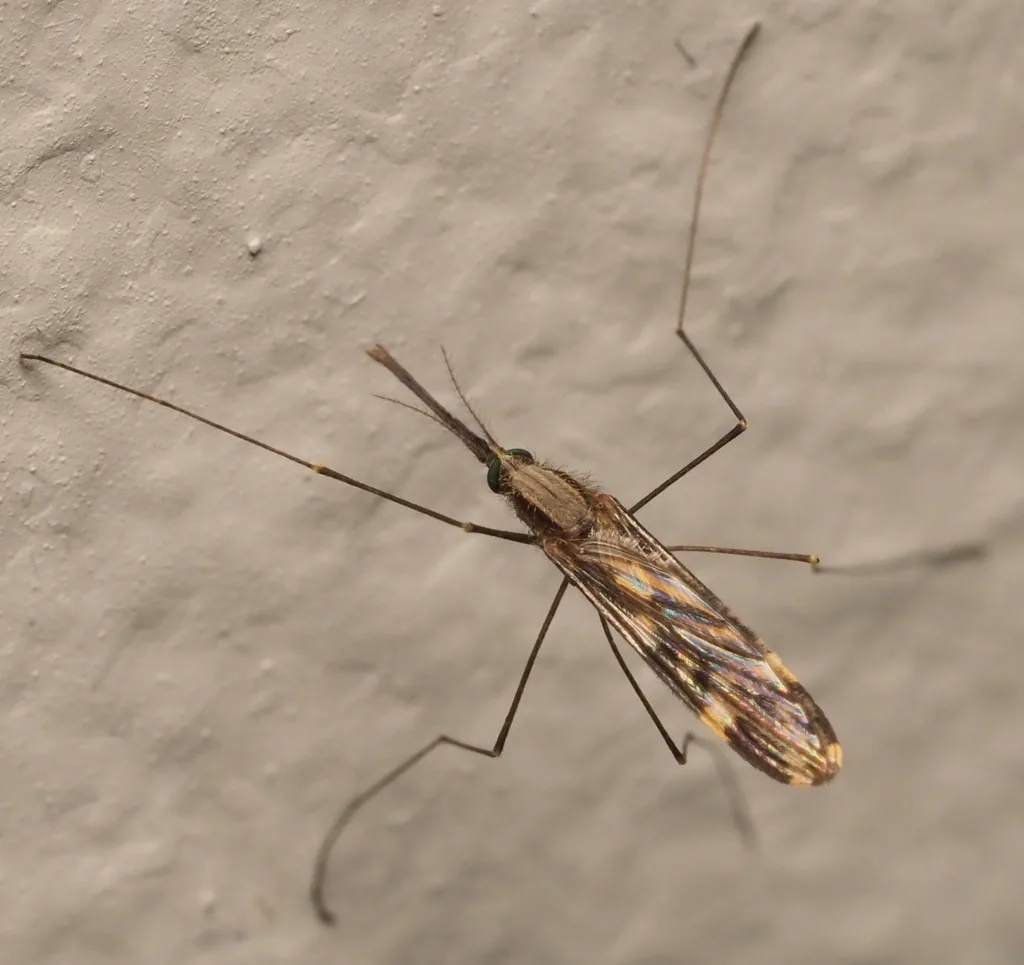
- Like other Anopheles, it is slender and long-legged, and its palps are as long as the proboscis.[3]
- The front edge of each wing carries two distinct cream-colored patches, and the wing veins mix dark and light scales.[1]
- The palps are dark with no bands and look shaggy at the base, where long scales stand upright. A broad, frosted stripe runs down the middle of the thorax, and the legs are dark except for pale tips on the femur and tibia.[1]
Look-alikes
| Look-alike | How to tell them apart |
|---|---|
| Common malaria mosquito | Its wings are dark-scaled, with the scales gathered into four distinct dark spots, and they lack the cream-colored patches on the front edge.[1][3] |
Where it lives
Recorded in all eight Connecticut counties and in Suffolk County on Long Island, New York, and listed among New Jersey's mosquito species.[1][2][4]
Biology and life cycle
Larvae live in semi-permanent and permanent ponds, rock pools, freshwater swamps, ditches and the margins of slow-moving streams with plants growing up through the water, and now and then in artificial containers. Early in their development the larvae lie on the water surface.[1][2]
There are several generations a year. In Connecticut larvae are found from May to September, and adults can be found year round; females spend the winter in sheltered places such as abandoned buildings, caves, hollow trees and animal burrows.[1]
Damage and signs
- Females are persistent biters of people, especially in the early evening, and they also bite during the day in shaded areas.[1]
Health risk
The Connecticut Agricultural Experiment Station has isolated eastern equine encephalitis, West Nile, Jamestown Canyon, Cache Valley, Highlands J and Trivittatus viruses from this mosquito.[1]
Control
Prevention
In the early evening and in shady areas, wear long pants, long sleeves, shoes and socks, and use an EPA-registered repellent on exposed skin and clothing, following the label directions.[1][5]
Keep them out
Keep window screens and screened rooms in good repair, with screen doors that close and latch on their own.[5]
Sanitation
Check around your home for standing water and get rid of it; the larvae occasionally use artificial containers.[5][1]
Common questions
- How can I tell it from the common malaria mosquito?
- Look at the wings. The woodland malaria mosquito has two cream-colored patches on the front edge of each wing, while the common malaria mosquito has dark wings with four distinct dark spots.[1][3]
- When does it bite?
- Mostly at dusk and in the early evening, but it will also bite during the day in shaded areas.[1][2]
Sources
- Connecticut Agricultural Experiment Station, “Identification Guide to the Mosquitoes of Connecticut, Bulletin No. 966 (Andreadis, Thomas and Shepard, 2005).” portal.ct.gov/-/media/caes/documents/publications/bulletins/b966b996pdf.pdf (accessed 2026-11-08)
- Suffolk County Department of Health Services (New York), “Suffolk County Mosquito Control Plan: Mosquito Species.” health.suffolkcountyny.gov/suffolkvectorplan/species_suffolk.htm (accessed 2026-11-08)
- Oklahoma Cooperative Extension Service (Oklahoma State University), “Guide to the Twelve Most-Important Oklahoma Mosquitoes of Concern for Pest Control Specialists, EPP-7335 (Bradt et al., October 2017).” pods.okstate.edu/fact-sheets/EPP-7335pod.pdf (accessed 2026-11-08)
- Rutgers Center for Vector Biology (New Jersey Agricultural Experiment Station), “New Jersey's 63 Mosquito Species (list updated October 2015).” vectorbio.rutgers.edu/outreach/species/njspp.php (accessed 2026-11-08)
- City of Jacksonville Mosquito Control (Florida), “Avoiding Mosquitoes.” www.jacksonville.gov/departments/neighborhoods/mosquito-control/avoiding-mosquitoes (accessed 2026-11-08)
- iNaturalist, “Anopheles punctipennis taxon page (order and family).” www.inaturalist.org/taxa/213719 (accessed 2026-11-08)