On this page
How to identify it
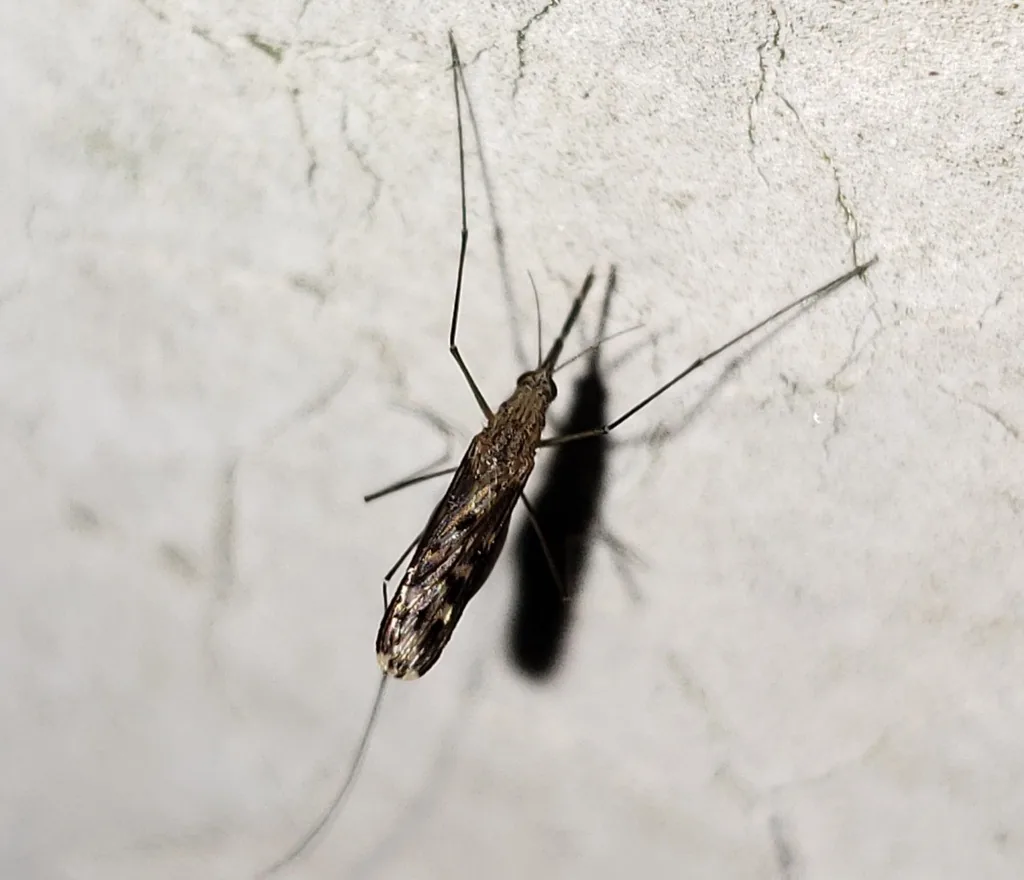
- Medium-sized, mostly dark mosquitoes with long, delicate legs. The wings look spotted, with patches of dark scales set among pale ones.[1]
- The palps beside the proboscis have a pale ring at the end of each segment, and the last segment is entirely white.[2]
- The front edge of the wing is dark except for a small light patch at the tip, and the rearmost wing vein carries three distinct dark spots.[2]
- The top of the thorax has a pair of dark stripes down the middle covered with yellowish bristles, and the dark brown abdomen bears long yellowish-brown hairs.[2]
Look-alikes
| Look-alike | How to tell them apart |
|---|---|
| Common malaria mosquito | Its palps have no pale rings, and its wing scales are all dark, gathered into four distinct dark spots.[2] |
| Woodland malaria mosquito | Its palps are unbanded and shaggy at the base, and the front edge of each wing has two distinct cream-colored patches, one of them at the tip.[2] |
Where it lives
Jacksonville's mosquito control program lists the complex among the common mosquitoes of Jacksonville, Florida, and a study in north central Florida found it inside gopher tortoise burrows during a survey of overwintering mosquitoes. It reaches north to Connecticut, where it is rarely encountered but has been recorded in six of the state's eight counties.[1][3][2]
Biology and life cycle
Females lay their eggs in water that stands for a long time, usually brown with tannins from decaying leaves and with plants growing in it. Most breeding sites are ponds and swamps, especially cypress swamps. One member of the complex prefers brackish water and another fresh water.[1]
In Connecticut, larvae are found in sphagnum bogs, acidic swamps and ponds, and the species spends the winter as a larva. It has several generations a year, with adults active from June to October.[2]
The females prefer to feed on mammals at night. In the Florida tortoise-burrow study, every blood-fed female examined had fed on white-tailed deer.[1][2][3]
Damage and signs
- The Connecticut guide reports it as a persistent biter of people, both inside houses and outdoors, though it is rarely encountered in that state.[2]
Health risk
Jacksonville's mosquito control program notes that Anopheles crucians is capable of harboring malaria but is not considered the main mosquito responsible for spreading the disease. No viruses have been isolated from it in Connecticut.[1][2]
Control
Prevention
These mosquitoes feed at night. When you are outside after dark near swamps or ponds, cover up with long sleeves and pants and use an EPA-registered repellent as the label directs.[1][5]
Keep them out
Females will bite indoors as well as out, so keep fine-mesh screens on windows and doors in good repair.[2][4]
When to call a professional
Jacksonville calls this a difficult mosquito for homeowners to control by draining or removing water. The city's mosquito control program instead monitors known breeding swamps and treats them when larvae are found, to keep adults from emerging.[1]
Common questions
- Can Anopheles crucians spread malaria?
- It is capable of harboring malaria, but Jacksonville's mosquito control program does not consider it the main mosquito responsible for transmitting the disease.[1]
- How is it different from the common malaria mosquito?
- Look at the wings and palps. Anopheles crucians has a small light patch at the wing tip, three dark spots on the rearmost wing vein and pale-ringed, white-tipped palps, while the common malaria mosquito has four dark spots on otherwise dark wings and unbanded palps. Telling the three members of the crucians complex from one another takes a microscope and the larvae.[2][1]
Sources
- City of Jacksonville Mosquito Control (Florida), “Anopheles crucians Complex.” www.jacksonville.gov/Departments/Neighborhoods/Mosquito-Control/Anopheles-crucians-Complex (accessed 2026-11-08)
- Connecticut Agricultural Experiment Station, “Identification Guide to the Mosquitoes of Connecticut, Bulletin No. 966 (Andreadis, Thomas and Shepard, 2005).” portal.ct.gov/-/media/caes/documents/publications/bulletins/b966b996pdf.pdf (accessed 2026-11-08)
- Journal of Medical Entomology, “Culex erraticus (Diptera: Culicidae) utilizes gopher tortoise burrows for overwintering in North Central Florida (McNamara and others), Journal of Medical Entomology 61(2):454-464 (2024), abstract.” pubmed.ncbi.nlm.nih.gov/38217415/ (accessed 2026-11-08)
- University of California Statewide IPM Program, “Pest Notes: Mosquitoes, Publication 7451 (revised April 2020).” ipm.ucanr.edu/legacy_assets/PDF/PESTNOTES/pnmosquitoes.pdf (accessed 2026-11-08)
- City of Jacksonville Mosquito Control (Florida), “Avoiding Mosquitoes.” www.jacksonville.gov/departments/neighborhoods/mosquito-control/avoiding-mosquitoes (accessed 2026-11-08)
- iNaturalist, “Anopheles crucians taxon page (order and family).” www.inaturalist.org/taxa/1098270 (accessed 2026-11-08)