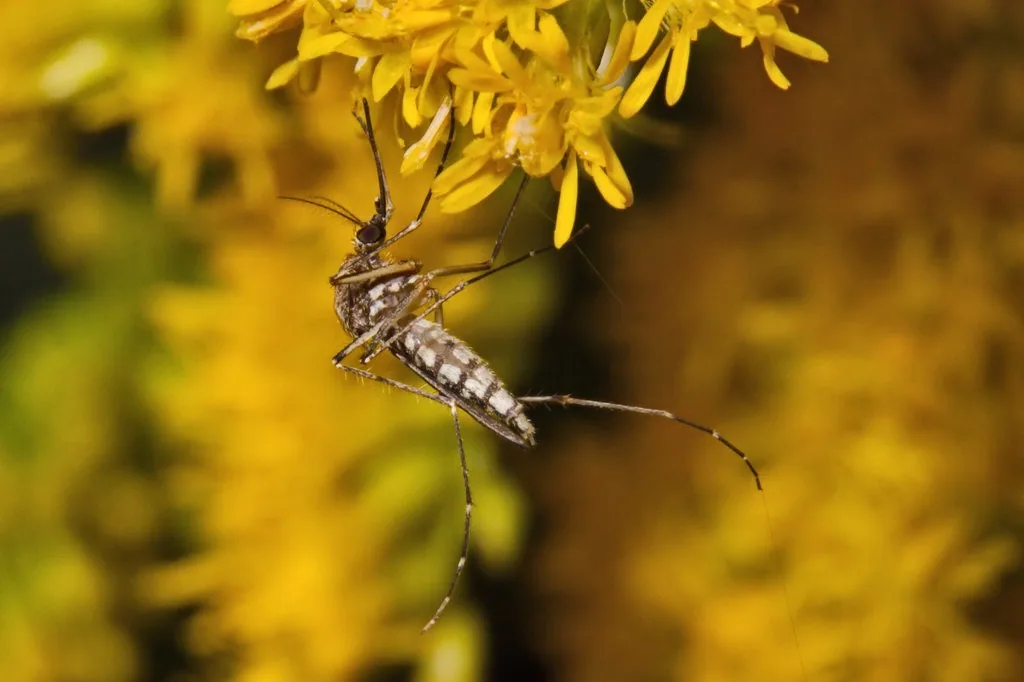
How to identify it
- A medium-sized mosquito with narrow white bands at the base of the leg segments, and a plain, unbanded proboscis.[2]
- The key mark is on the abdomen: dark segments with white bands along their bases, each band notched in a V shape at the back.[2]
- The tip of the female's abdomen is pointed, unlike the broad, blunt tip of Culex mosquitoes.[4]
Look-alikes
| Look-alike | How to tell them apart |
|---|---|
| Northern house mosquito | Culex mosquitoes have a blunt abdomen tip, lay egg rafts on standing water and usually stay within about a quarter mile of where they developed.[4][1] |
| Asian tiger mosquito | Breeds in containers such as discarded tires rather than flooded ground, and is an exotic species from Asia.[1] |
Where it lives
Found across southern Canada and throughout the United States except Hawaii, and in Europe, Asia and parts of Africa. It is one of the most common mosquitoes in Indiana and dominates trap counts in South Dakota.[2][3][1]
Biology and life cycle
Females lay single eggs on moist soil in low spots likely to flood; the eggs must dry out before they can hatch.[2][1]
Eggs survive the winter and can remain alive for years; not all hatch at the first flood, so later floods bring new broods.[2][1]
Larvae grow in rain pools, tire ruts, ditches, stormwater basins, flooded woods and overflowing stream banks, and in summer take about 6 to 8 days as larvae plus 2 to 3 days as pupae.[2]
Adults rest in shade by day and bite most actively at dusk, peaking 30 to 40 minutes after sunset, with most host-seeking at night.[2][3]
Females can fly 5 to 15 miles from where they hatched, so swarms can appear far from any visible water.[2][1][3]
Damage and signs
Health risk
Purdue and SDSU Extension call it mainly a nuisance that adds little to West Nile virus spread, since it rarely feeds on birds. It has been found to be a capable carrier of dog heartworm.[1][3][4][2]
Control
Prevention
Use a repellent with DEET, picaridin, IR3535 or oil of lemon eucalyptus, and wear long sleeves and pants outdoors at dusk.[1][3]
Keep them out
Keep window and door screens in good repair to keep biting mosquitoes outdoors.[5]
Sanitation
Drain standing water, fill low spots that puddle, avoid overwatering lawns, and empty or cover containers around the yard.[5][1]
Biological control
Ponds and water that can't be drained can be treated with Bti, a bacterium that kills only mosquito larvae and a few related flies.[5]
When to call a professional
Because floodwater mosquitoes fly in from miles away, area-wide control by local mosquito control agencies works better than spraying one yard, which gives only temporary relief.[3][5]
Common questions
- Why are there so many mosquitoes after a flood?
- Floodwater mosquito eggs lie dormant on dry ground and hatch together once water covers them, producing huge numbers of biting adults within a couple of weeks.[1][2]
- Do these mosquitoes spread West Nile virus?
- They can carry it, but extension entomologists consider them a minor factor because they feed mainly on mammals and rarely on birds, where the virus multiplies.[3][1]
- Why don't I see water near my house?
- Floodwater mosquitoes can fly 5 to 15 miles, so they often bite people far downwind from the flooded areas where they developed.[1]
Sources
- Purdue University Extension Entomology, “Mosquitoes (Public Health Entomology: Insects and Ticks).” extension.entm.purdue.edu/publichealth/insects/mosquito.html (accessed 2026-10-06)
- Rutgers Center for Vector Biology, “Aedes vexans (Meigen): An Old Foe (O'Malley, Proc. N.J. Mosquito Control Assoc. 1990).” vectorbio.rutgers.edu/outreach/species/sp13.htm (accessed 2026-10-06)
- South Dakota State University Extension, “Know Your Mosquitoes, Protect Yourself.” extension.sdstate.edu/know-your-mosquitoes-protect-yourself (accessed 2026-10-06)
- South Dakota State University Extension, “Will Mosquitos Be an Issue During This Summer? (June 8, 2021).” extension.sdstate.edu/will-mosquitos-be-issue-during-summer (accessed 2026-10-06)
- University of California Statewide IPM Program, “Pest Notes: Mosquitoes, Publication 7451 (revised April 2020).” ipm.ucanr.edu/legacy_assets/PDF/PESTNOTES/pnmosquitoes.pdf (accessed 2026-10-06)
- iNaturalist, “Aedes vexans taxon page (order and family).” www.inaturalist.org/taxa/155387 (accessed 2026-10-06)