On this page
How to identify it
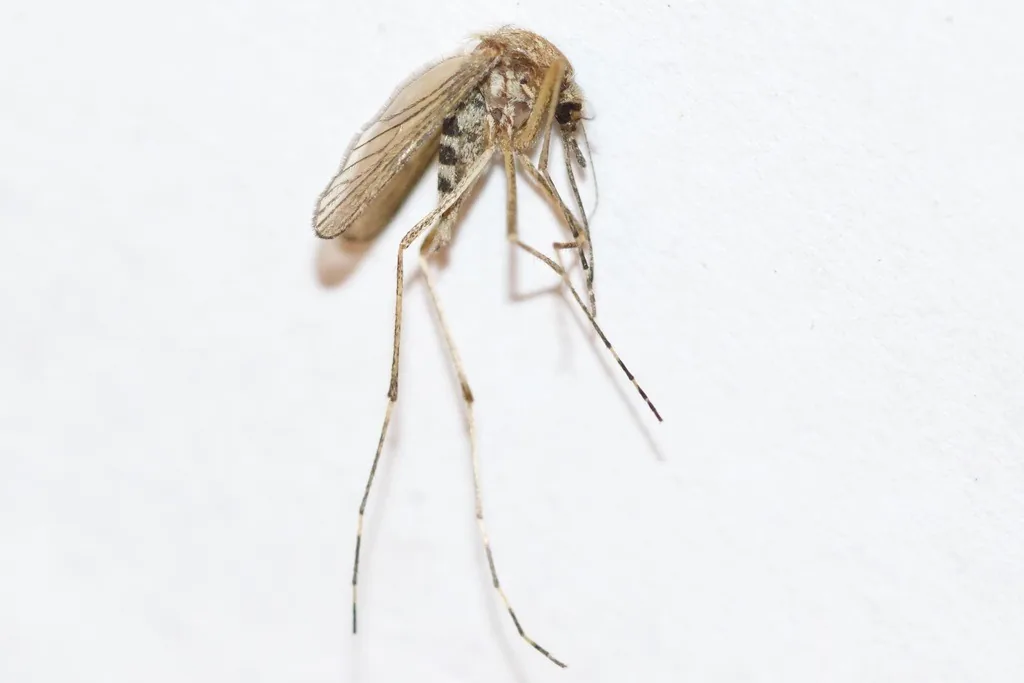
- The proboscis has no pale band but carries a mix of dark and pale scales. The top of the thorax is covered with golden-brown scales that lighten toward the rear, and the small plate behind it, the scutellum, bears long yellowish scales.[3]
- The abdomen has broad, dingy white bands at the front of each segment. The hind feet have broad pale bands at the base of each segment, covering more than a third of its length.[3]
- Legs and wings are both speckled with dark and pale scales, and the wing scales are a mix of narrow and broad ones.[3]
- The Connecticut Agricultural Experiment Station's identification guide lists it under the older name Ochlerotatus stimulans.[3]
Look-alikes
| Look-alike | How to tell them apart |
|---|---|
| Aedes excrucians | Breeds in the same early-season woodland pools, and the adults are hard to separate, so some bites blamed on Aedes stimulans may come from this species. Its wings are mostly dark, with pale scales mixed in mainly along the front edge, and the lower tooth of the claw on its front leg is long and runs nearly parallel to the upper tooth.[2][1][3] |
| Woodland pool mosquito | Another common companion in leaf-lined spring pools. Its proboscis is all dark, its hind feet have pale bands at both ends of each segment, and its wings are entirely dark.[1][3] |
Where it lives
Aedes stimulans lives in the northeastern United States and along the southern edge of eastern Canada, from Newfoundland south to Maryland, west to eastern Kansas and north to the upper Great Lakes. In the western United States, Canada's Northwest Territory and southwestern Alaska, a near-identical species, Aedes mercurator, once reported as Ae. stimulans, takes its place. In New Jersey it is most common in the northern third of the state, and Connecticut has records from all eight counties.[1][3]
Biology and life cycle
It has one generation a year. Eggs hatch in very early spring and the larvae grow in cold water; in northern New Jersey only two other snow-pool Aedes appear earlier.[1][3]
In woodland pools at higher elevations in northern New Jersey, larvae are usually present by late March and pupate toward the end of April, while populations in the Pine Barrens pupate in early April. Connecticut finds larvae from March to May.[1][3]
Females look for blood in May. As the trees leaf out and the pools shrink, they lay a band of eggs around the edge of the pool. The eggs then enter a resting state and won't hatch even if summer rains refill the pool; only a period of cold ends it, so they hatch the next spring.[1]
Larvae do best in shaded woodland pools with a heavy lining of fallen leaves, in temporary pools left when rivers and streams overflow in spring, and in drainage ditches cut through woods. They favor shade and tend to gather in the darkest part of a pool.[1][3]
Adults are exceptionally long-lived. Rutgers catches them in light traps into August, and Connecticut records adults from May to September. Females feed on mammals and birds.[1][3]
Damage and signs
- Housing developments built in wooded settings can have severe trouble when the surrounding woods hold breeding pools, and near floodplains Aedes sticticus joins in to add to the annoyance.[1]
- The Connecticut station describes females as aggressive human biters that stay close to the breeding site.[3]
Health risk
Because adults live so long, Rutgers considers this species a probable vector of dog heartworm in northern New Jersey. The Connecticut Agricultural Experiment Station has isolated Highlands J and Jamestown Canyon viruses from it.[1][3]
Control
Prevention
Females hunt for blood in May. When working or walking in wooded areas then, cover up with long pants, long sleeves, shoes and socks, keeping in mind that mosquitoes can bite through T-shirts and other thin, tight clothing, and use an EPA-registered repellent as its label directs.[1][5][4]
Keep them out
This species will leave the woods and enter neighborhoods in numbers, so keep fine-mesh screens on windows and doors in good repair.[1][4]
Common questions
- Why are mosquitoes so bad in my wooded subdivision every May?
- In the Northeast, Aedes stimulans may be the reason. It breeds in shaded, leaf-lined pools in the woods, females seek blood in May, and Rutgers notes that housing built in wooded settings can have severe problems when those woods hold its breeding pools.[1]
- Where does Aedes stimulans breed?
- In shaded woodland pools with a heavy lining of fallen leaves, in temporary pools left when rivers and streams overflow in spring, and in drainage ditches cut through forested areas.[1][3]
- Is Aedes stimulans a risk to dogs?
- Rutgers considers it a probable vector of dog heartworm in northern New Jersey because the adults live so long.[1]
Sources
- Rutgers Center for Vector Biology (New Jersey Agricultural Experiment Station), “Aedes stimulans (Walker) (species account by W.J. Crans).” vectorbio.rutgers.edu/outreach/species/sp24.htm (accessed 2026-11-08)
- Rutgers Center for Vector Biology (New Jersey Agricultural Experiment Station), “Aedes excrucians (Walker) (species account by W.J. Crans).” vectorbio.rutgers.edu/outreach/species/sp23.htm (accessed 2026-11-08)
- Connecticut Agricultural Experiment Station, “Identification Guide to the Mosquitoes of Connecticut, Bulletin No. 966 (Andreadis, Thomas and Shepard, 2005).” portal.ct.gov/-/media/caes/documents/publications/bulletins/b966b996pdf.pdf (accessed 2026-11-08)
- University of California Statewide IPM Program, “Pest Notes: Mosquitoes, Publication 7451 (revised April 2020).” ipm.ucanr.edu/legacy_assets/PDF/PESTNOTES/pnmosquitoes.pdf (accessed 2026-11-08)
- City of Jacksonville Mosquito Control (Florida), “Avoiding Mosquitoes.” www.jacksonville.gov/departments/neighborhoods/mosquito-control/avoiding-mosquitoes (accessed 2026-11-08)
- iNaturalist, “Aedes stimulans taxon page (order and family).” www.inaturalist.org/taxa/212543 (accessed 2026-11-08)