On this page
How to identify it
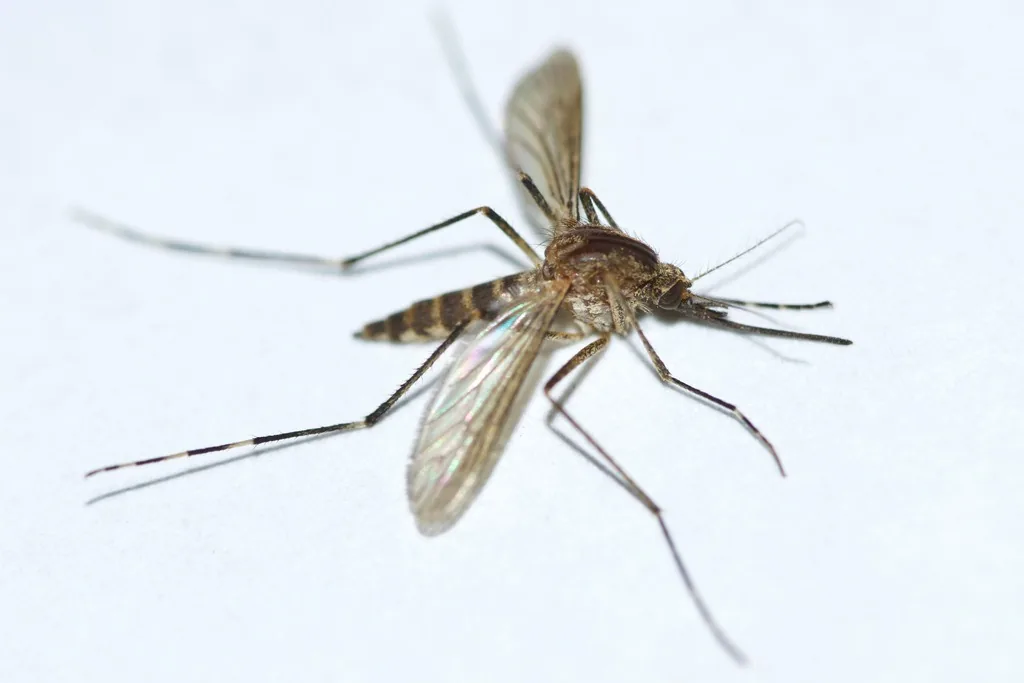
- The thorax is covered with reddish to yellowish-brown scales in a variable pattern, and the proboscis has no pale band but is flecked with dark and pale scales.[3]
- Each abdominal segment has a broad, dingy white band at the front. The hind feet carry broad pale bands at the base of each segment, more than a third of the segment long, and the rest of the legs are speckled dark and pale.[3]
- The wings are mostly dark-scaled, with pale scales mixed in, especially along the front edge.[3]
- Under magnification, the lower tooth of the claw on the front leg is long and runs nearly parallel to the upper tooth, one of the features that separates it from Aedes stimulans.[3]
Look-alikes
| Look-alike | How to tell them apart |
|---|---|
| Aedes stimulans | The two share spring woodland pools, and Rutgers says the adults are difficult to separate. Aedes stimulans has a golden-brown thorax that lightens toward the rear, wing veins with a mix of pale and dark scales, both narrow and broad, and a shorter lower claw tooth that is not parallel to the upper one. It is the more numerous of the two and is regarded as a pest in northern New Jersey, so some bites blamed on it may be from Aedes excrucians.[1][2][3] |
| Woodland pool mosquito | Another early-spring woodland pool species. Its proboscis is entirely dark, its wings are all dark, and its hind feet have pale bands at both ends of each segment.[1][3] |
Where it lives
It reaches its greatest numbers in the forests of northern North America. The range covers roughly the northern third of the United States and most of Canada and Alaska, with a southern edge running from New Jersey on the East Coast to southern Oregon in the West; in the mountain states, populations at higher elevations reach as far south as northern New Mexico. It is abundant in northern New Jersey but uncommon in the southern half of the state, and Connecticut records it in all eight counties.[1][3]
Biology and life cycle
There is one generation a year. The eggs hatch early in spring and the larvae develop mainly in April, may reach the last larval stage as early as the second week of April in the southern part of the range, and can still be found into early May at higher elevations farther north. Connecticut finds larvae from March to May.[1][3]
Larvae are most common in moderately deep snow pools in the woods lined with heavy leaf litter, often in very dark water, and also use shallower hollows that stay full from spring runoff and semi-permanent woodland pools. Toward the south of the range they can share pools in lowland red maple and sweet gum forests with Aedes grossbecki.[1][3]
Larvae that are slow to pupate usually show signs of parasitism by Vorticella and probably die before they become pupae.[1]
Adults are on the wing in May. Females lay their eggs around the edges of snow pools that are drying as the trees draw heavily on groundwater, and the eggs stay dormant until the next spring no matter how many times the pools flood over the summer.[1]
Adults are extremely long-lived, and Rutgers collects them into August. Females take blood from mammals and birds.[1][3]
Damage and signs
- Although common in the north of its range, it does not appear to be a significant pest in New Jersey. The bite is irritating, but because the mosquito does not fly far from its breeding habitat, the annoyance is very local.[1]
- The Connecticut Agricultural Experiment Station notes that females stay close to their breeding sites but will bite people at any time of day or night in wooded or shaded areas.[3]
Health risk
Rutgers reports evidence that it plays a role in dog heartworm transmission in some areas of the northern United States. The Connecticut Agricultural Experiment Station has isolated Jamestown Canyon virus from it.[1][3]
Control
Prevention
Since this mosquito stays close to its woodland breeding pools, the simplest protection is to avoid shaded woods near those pools when the adults are active, from May through August.[1][3][5]
If you have to be there, wear protective clothing and an EPA-registered repellent with an active ingredient such as DEET, picaridin, IR3535 or oil of lemon eucalyptus, and follow the directions on the label.[5][4]
Common questions
- Does Aedes excrucians bite during the day?
- Yes. In wooded or shaded areas, females will bite people at any time of the day or night, though they stay close to their breeding sites.[3]
- Why doesn't summer rain bring more of them?
- The eggs that females lay around drying snow pools go into an obligatory dormancy and do not hatch until the following spring, however many times the pools flood during the summer.[1]
Sources
- Rutgers Center for Vector Biology (New Jersey Agricultural Experiment Station), “Aedes excrucians (Walker) (species account by W.J. Crans).” vectorbio.rutgers.edu/outreach/species/sp23.htm (accessed 2026-11-08)
- Rutgers Center for Vector Biology (New Jersey Agricultural Experiment Station), “Aedes stimulans (Walker) (species account by W.J. Crans).” vectorbio.rutgers.edu/outreach/species/sp24.htm (accessed 2026-11-08)
- Connecticut Agricultural Experiment Station, “Identification Guide to the Mosquitoes of Connecticut, Bulletin No. 966 (Andreadis, Thomas and Shepard, 2005).” portal.ct.gov/-/media/caes/documents/publications/bulletins/b966b996pdf.pdf (accessed 2026-11-08)
- University of California Statewide IPM Program, “Pest Notes: Mosquitoes, Publication 7451 (revised April 2020).” ipm.ucanr.edu/legacy_assets/PDF/PESTNOTES/pnmosquitoes.pdf (accessed 2026-11-08)
- City of Jacksonville Mosquito Control (Florida), “Avoiding Mosquitoes.” www.jacksonville.gov/departments/neighborhoods/mosquito-control/avoiding-mosquitoes (accessed 2026-11-08)
- iNaturalist, “Aedes excrucians taxon page (order and family).” www.inaturalist.org/taxa/1112081 (accessed 2026-11-08)