On this page
How to identify it
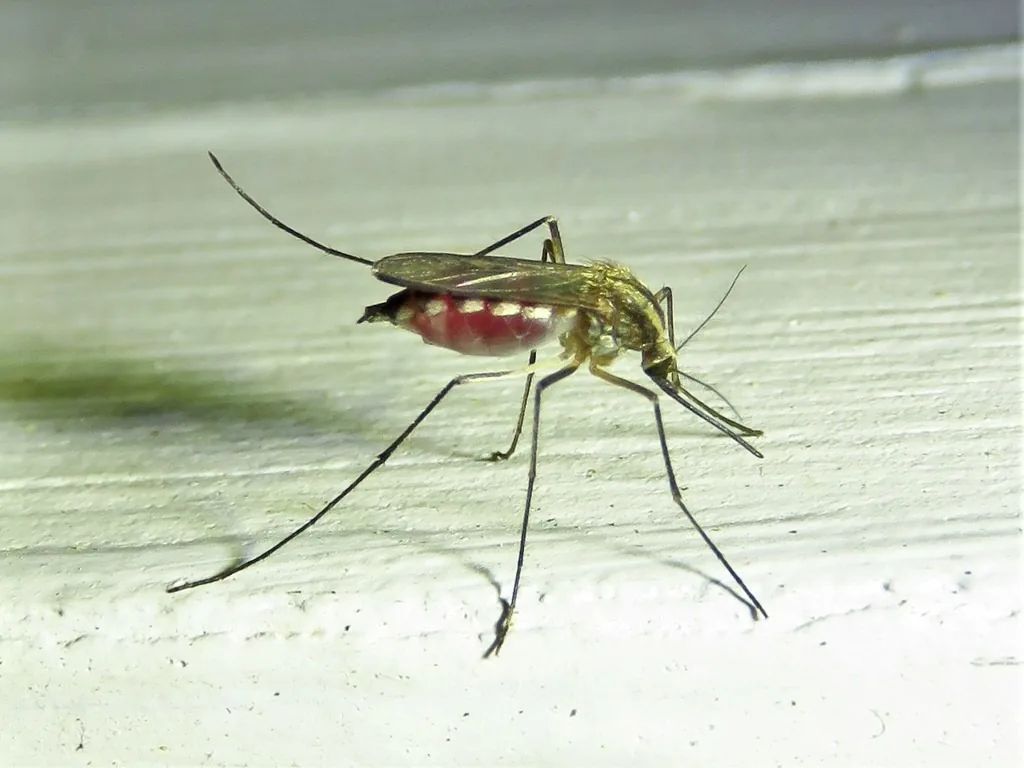
- A medium-sized mosquito whose most obvious mark is a pair of whitish stripes running down the top of the thorax, separated by a dark stripe.[1][3]
- The legs have no bands; the hind feet are dark, though the back sides of the femur and tibia are pale. The proboscis is dark and unbanded, and the wings are clear, with narrow dark scales.[3][1]
- The top of the abdomen is mostly dark, with or without complete white bands at the front of each segment, and there are prominent white patches on the sides; the underside is white-scaled.[3][1]
Look-alikes
| Look-alike | How to tell them apart |
|---|---|
| Inland floodwater mosquito | Shares the same floodwater pools and has a similar way of life, but it has bands on its legs. Its larvae are slightly bigger than plains floodwater mosquito larvae.[2][4][1] |
Where it lives
The United States east of the Rocky Mountains, north to the Canadian border. In New Jersey it is scarce along the coast but a severe nuisance in the northwest corner of the state, and Connecticut has records from all eight of its counties.[1][3]
Biology and life cycle
Larvae live in many kinds of fresh water: flooded woods, marshes, open pools, woodland pools and floodwater depressions. Suffolk County, New York, finds it especially common in recharge basins that hold water off and on.[1][3][2]
Eggs survive the winter, and larvae first appear with the warm floodwaters of late spring. Hatching is triggered when the oxygen content of the floodwater drops.[1][3]
In hot weather with warm nights, larvae can go from hatching to adult in as little as 5 days. There are several generations a year; in Connecticut, larvae are found from May to August and adults from June to October.[1][3][2]
Adults stay near where they hatched: Warren County, New Jersey, rarely sees nuisance problems half a mile or more from a breeding area. By day they rest in brushy areas and thick plant cover, and females feed on mammals.[1][3]
Damage and signs
- Near homes it can be a severe nuisance. Females are persistent, aggressive biters that often attack in swarms, will bite in bright sun and open areas, and give a bite most people find more painful and irritating than other mosquitoes'. In Warren County, New Jersey, it became the mosquito generating more complaints than any other.[1][3]
- Light traps catch few of them even when populations are high, so mosquito control programs check for them with landing counts and carbon dioxide traps instead.[1]
Health risk
The Connecticut Agricultural Experiment Station has isolated eastern equine encephalitis, West Nile, Jamestown Canyon, Cache Valley and Trivittatus viruses from it. Suffolk County considers it a potential West Nile vector but not an eastern equine encephalitis vector, and a 1990 New Jersey paper noted it had not been implicated as a vector there, though in Pennsylvania it had been linked to snowshoe hare virus.[3][2][1]
Control
Prevention
Because it bites day or night and even in full sun, cover up with long pants, long sleeves, shoes and socks near its breeding areas, and use an EPA-registered repellent on exposed skin and clothing, following the label directions.[3][1][5]
Keep them out
Keep window screens and screened rooms in good repair, with screen doors that close and latch on their own.[5]
When to call a professional
Suffolk County controls it in the recharge basins where it breeds with water management, fish stocking and larvicides.[2]
Common questions
- Why are mosquitoes biting me in broad daylight?
- The plains floodwater mosquito doesn't hesitate to bite in bright sun or open areas when you walk into its haunts, and it often attacks in swarms.[1]
- How far do they fly?
- Not far. Warren County, New Jersey, rarely sees nuisance problems half a mile or more from a breeding area, and Suffolk County notes its short flight range.[1][2]
Sources
- Rutgers Center for Vector Biology (reprint), “Aedes trivittatus in New Jersey (R.D. Duryea), Proceedings of the 77th Annual Meeting of the New Jersey Mosquito Control Association, 1990, pp. 73-78.” vectorbio.rutgers.edu/outreach/species/sp12.htm (accessed 2026-11-08)
- Suffolk County Department of Health Services (New York), “Suffolk County Mosquito Control Plan: Mosquito Species.” health.suffolkcountyny.gov/suffolkvectorplan/species_suffolk.htm (accessed 2026-11-08)
- Connecticut Agricultural Experiment Station, “Identification Guide to the Mosquitoes of Connecticut, Bulletin No. 966 (Andreadis, Thomas and Shepard, 2005).” portal.ct.gov/-/media/caes/documents/publications/bulletins/b966b996pdf.pdf (accessed 2026-11-08)
- Oklahoma Cooperative Extension Service (Oklahoma State University), “Guide to the Twelve Most-Important Oklahoma Mosquitoes of Concern for Pest Control Specialists, EPP-7335 (Bradt et al., October 2017).” pods.okstate.edu/fact-sheets/EPP-7335pod.pdf (accessed 2026-11-08)
- City of Jacksonville Mosquito Control (Florida), “Avoiding Mosquitoes.” www.jacksonville.gov/departments/neighborhoods/mosquito-control/avoiding-mosquitoes (accessed 2026-11-08)
- iNaturalist, “Aedes trivittatus taxon page (order and family).” www.inaturalist.org/taxa/1112144 (accessed 2026-11-08)