On this page
How to identify it
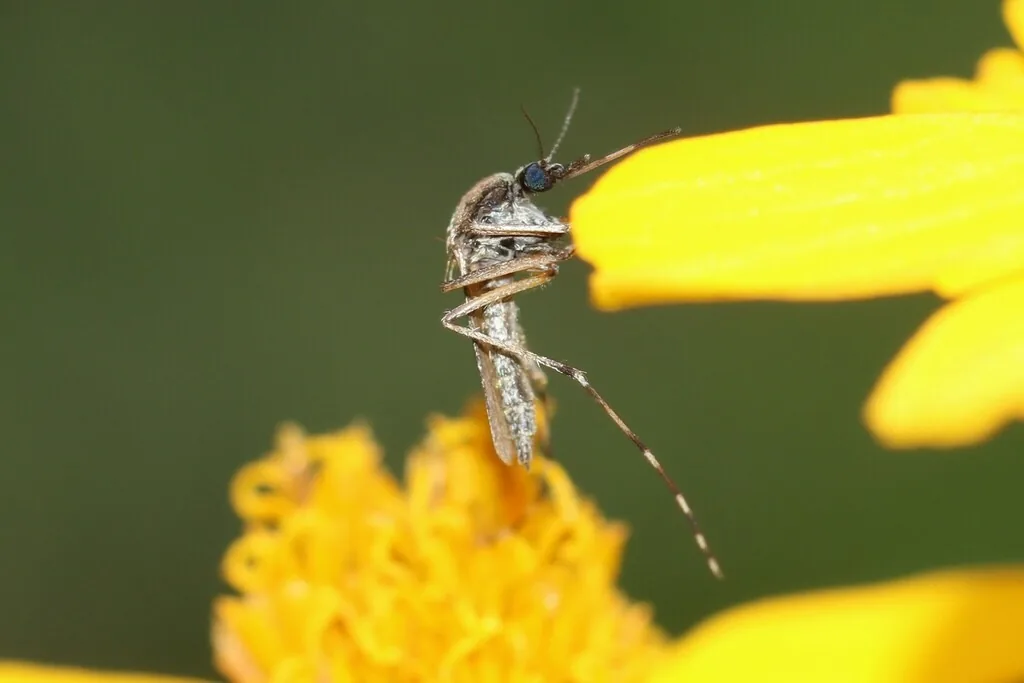
- A medium-sized, brightly marked mosquito. A band of pale scales rings the middle of the proboscis, and the segments of the hind feet have broad white bands at their bases.[1][7]
- A pale yellowish stripe runs lengthwise down the middle of the top of the abdomen. The first segment of each hind foot has a band of yellow scales in its middle, bordered by darker scales.[1][7][6][4]
- The sides of the thorax carry dense patches of white scales, the top is scaled in brown, yellow, gold and white, and the wings mix dark and pale scales. Jacksonville's mosquito control program calls it the golden salt marsh mosquito and describes it as a medium to large, dark brown mosquito with yellow to white accents.[1][4]
Look-alikes
| Look-alike | How to tell them apart |
|---|---|
| Black salt marsh mosquito | In the South its larvae often share marsh pools with the black salt marsh mosquito, which Jacksonville's mosquito control program describes as smaller and the more common of the two there. The black salt marsh mosquito has white cross bands on the abdomen rather than a stripe down the middle, and CDC's training guide says it bites mainly at night and is less likely to attack in bright sunlight.[1][4][6] |
| Inland floodwater mosquito | Also an aggressive biter that can fly long distances, but it is a freshwater species that prefers less salty water, and its broods emerge less often and follow rainfall or river flooding.[2] |
Where it lives
Along the Atlantic and Gulf coasts of North America from New Brunswick, Canada, to Texas, and in the Bahamas and Greater Antilles. It turns up at salty inland sites as far west as Arizona, and CDC's training guide lists inland records from New York, Indiana, Kentucky, Illinois, Oklahoma, Arkansas and New Mexico, but it does not occur on the Pacific Coast. GBIF holds about 3,700 US records since 1990 from 24 states, most from Florida, Iowa, Texas and Virginia.[1][6][19]
Biology and life cycle
Females lay their eggs one at a time on moist ground around low spots in the upper, grassy parts of salt marshes that daily tides don't reach, especially where salt meadow grass or saltgrass grows. Man-made sites such as dredge spoil areas, mine tailings and food-processing wastewater can also produce them.[1][6][7]
The eggs hatch together when unusually high tides or heavy rain flood them, so a whole brood of larvae grows, pupates and emerges as adults at about the same time. Because these pools dry up fast, development is quick: under ideal conditions adults emerge 4 to 5 days after the eggs hatch.[1][3]
There are many broods a year. Brunswick County, North Carolina, has recorded as many as 12 in one season, with adults usually collected there from April to November, and one female can lay over 100 eggs in her lifetime.[3][2]
In the South, adults are most numerous in spring and fall. In the North they peak in summer (June to October in Connecticut), and eggs laid by fall females stay dormant through the winter.[1][7]
Nearly every female needs a blood meal to make each batch of eggs, and most of that blood comes from mammals, with birds a lesser source. Host-seeking flights peak at twilight, more in the evening than the morning, but females resting in vegetation will bite anyone who walks into their territory during the day, even in full sun.[1][3]
Broods spread inland through gradual flights in search of food or mates, and wind direction and strength affect how far they go. Young females can cover about a mile a day, and after laying their first eggs females stay closer to the marsh.[1][2]
Damage and signs
- It can be a severe nuisance. Brunswick County calls it one of two salt marsh mosquitoes that can drive people indoors at twilight, Connecticut ranks it among the most important pest species on its coast, and CDC's training guide calls it one of the most severe mosquito pests known, one that held back the development of some coastal resort areas.[3][7][6]
- Many coastal mosquito control districts were set up mainly to deal with the pest and disease problems this species causes. It was one of the dominant mosquitoes collected after Hurricane Hugo in 1989.[1][3]
- In a study of ditched tidal salt marshes on Maryland's Delmarva Peninsula, it was the most common adult mosquito in landing counts.[18]
Health risk
CDC lists it among the primary bridge vectors of eastern equine encephalitis in the Northeast and Mid-Atlantic, the mosquitoes that carry the virus from birds to people and horses. The virus has been isolated from it during outbreaks in animals in New Jersey and Connecticut, and it has been found carrying West Nile virus in Louisiana. It also carries dog heartworm: infected females were found in coastal North Carolina, and in the laboratory it developed large numbers of infective larvae.[8][13][14][12][16][15]
Control
Prevention
During heavy mosquito activity, stay indoors when you can. Outdoors, wear long pants, long sleeves, shoes and socks, since mosquitoes can bite through T-shirts and other thin, tight clothing.[5]
Use an EPA-registered repellent on exposed skin and follow the label. CDC lists DEET, picaridin, IR3535, oil of lemon eucalyptus, para-menthane-diol and 2-undecanone as active ingredients, and recommends clothing and gear treated with permethrin.[9][10]
Keep them out
Keep window screens and screened rooms in good repair. Screen doors should open outward and close and latch on their own.[5]
When to call a professional
Its larvae come from salt marshes, and Jacksonville's program notes that eliminating its breeding sites is difficult for homeowners. Coastal mosquito control programs manage it with salt marsh water management, larvicides and adulticides; Jacksonville once dug ditches in the marsh and now treats larvae by aircraft over wide areas of salt marsh.[4][2]
Where sources disagree
How far it flies: Rutgers puts the usual inland movement of a brood at under five miles; Suffolk County says a female usually feeds within two miles but sometimes 10 miles or more; Jacksonville's program says up to 25 miles; and CDC's training guide says it very commonly flies 5 to 10 miles and may travel 40 miles or more.[1][2][4][6]
Development time: Rutgers says adults can emerge as soon as 4 to 5 days after the eggs hatch under ideal conditions, while CDC's training guide gives 7 to 10 days for the larval and pupal stages in warm weather and adds that eggs must be dry for at least 24 hours before they can hatch.[1][6]
Southern season: Rutgers describes spring and fall peaks in the South, while 17 years of light-trap data from northeastern Florida showed a single autumn peak, matching the season of the highest tides.[1][17]
Common questions
- Why are there so many mosquitoes after a high tide or a storm?
- Eastern saltmarsh mosquito eggs sit on the moist ground of the upper marsh and hatch together when unusually high tides or heavy rain flood them. Adults can emerge within 4 to 5 days of hatching, so a big brood can follow soon after.[1][3]
- Do I need to worry about my dog?
- It is one of the mosquitoes that carry dog heartworm; infected females have been found in coastal North Carolina. FDA says heartworm spreads only through mosquito bites and calls year-round prevention, prescribed by a veterinarian, the best approach.[16][15][11]
- Can I get rid of them by draining standing water in my yard?
- Usually not. They breed in salt marshes, and controlling them by eliminating breeding sites is difficult for homeowners, so control falls mainly to local mosquito control programs. Protect yourself with clothing, repellent and good screens.[4][2][5]
Sources
- Rutgers Center for Vector Biology (New Jersey Agricultural Experiment Station), “The Eastern Saltmarsh Mosquito, Aedes sollicitans (G.F. O'Meara, Wing Beats 1992).” vectorbio.rutgers.edu/outreach/species/sp7.htm (accessed 2026-11-11)
- Suffolk County Department of Health Services (New York), “Suffolk County Mosquito Control Plan: Mosquito Species.” health.suffolkcountyny.gov/suffolkvectorplan/species_suffolk.htm (accessed 2026-11-11)
- Brunswick County Mosquito Control (North Carolina), “Ochlerotatus sollicitans Biology (R. Hickman and J. Brown).” brunswickcountync.gov/DocumentCenter/View/1384/Ochlerotatus-Sollicitans-Biology-PDF (accessed 2026-11-11)
- City of Jacksonville Mosquito Control (Florida), “Aedes sollicitans, Golden Salt Marsh Mosquito.” www.jacksonville.gov/Departments/Neighborhoods/Mosquito-Control/Aedes-sollicitans (accessed 2026-11-11)
- City of Jacksonville Mosquito Control (Florida), “Avoiding Mosquitoes.” www.jacksonville.gov/departments/neighborhoods/mosquito-control/avoiding-mosquitoes (accessed 2026-11-11)
- U.S. Public Health Service, Communicable Disease Center (now CDC), via CDC Stacks, “Mosquitoes of Public Health Importance and Their Control (Training Guide, Insect Control Series; Pratt, Barnes and Littig, 1963).” stacks.cdc.gov/view/cdc/7613/cdc_7613_DS1.pdf (accessed 2026-11-11)
- Connecticut Agricultural Experiment Station, “Identification Guide to the Mosquitoes of Connecticut, Bulletin No. 966 (Andreadis, Thomas and Shepard, 2005).” portal.ct.gov/-/media/caes/documents/publications/bulletins/b966b996pdf.pdf (accessed 2026-11-11)
- U.S. Centers for Disease Control and Prevention, “Guidelines for Eastern Equine Encephalitis Virus Surveillance and Control.” www.cdc.gov/eastern-equine-encephalitis/php/surveillance-and-control-guidelines/index.html (accessed 2026-11-11)
- U.S. Centers for Disease Control and Prevention, “Preventing Mosquito Bites.” www.cdc.gov/mosquitoes/prevention/index.html (accessed 2026-11-11)
- U.S. Environmental Protection Agency, “Find the Repellent that is Right for You.” www.epa.gov/insect-repellents/find-repellent-right-you (accessed 2026-11-11)
- U.S. Food and Drug Administration, Center for Veterinary Medicine, “Keep the Worms Out of Your Pet's Heart! The Facts about Heartworm Disease.” www.fda.gov/animal-veterinary/animal-health-literacy/keep-worms-out-your-pets-heart-facts-about-heartworm-disease (accessed 2026-11-11)
- Journal of Medical Entomology, via PubMed, “Detection of West Nile virus RNA in mosquitoes and identification of mosquito blood meals collected at alligator farms in Louisiana (Unlu et al. 2010).” pubmed.ncbi.nlm.nih.gov/20695278/ (accessed 2026-11-11)
- Journal of the American Mosquito Control Association, via PubMed, “Isolation of eastern equine encephalitis virus from Aedes sollicitans during an epizootic in southern New Jersey (Crans et al. 1986).” pubmed.ncbi.nlm.nih.gov/2853203/ (accessed 2026-11-11)
- Journal of Medical Entomology, via PubMed, “Multiple isolations of eastern equine encephalitis and highlands J viruses from mosquitoes during a 1996 epizootic in southeastern Connecticut (Andreadis et al. 1998).” pubmed.ncbi.nlm.nih.gov/9615549/ (accessed 2026-11-11)
- Journal of Medical Entomology, via PubMed, “Density and distribution of Dirofilaria immitis third-stage larvae in Aedes sollicitans and Aedes taeniorhynchus (Parker 2000).” pubmed.ncbi.nlm.nih.gov/11004780/ (accessed 2026-11-11)
- Journal of Medical Entomology, via PubMed, “Variation of mosquito relative abundance and Dirofilaria immitis vector potential in coastal North Carolina (Parker 1993).” pubmed.ncbi.nlm.nih.gov/8096249/ (accessed 2026-11-11)
- Journal of the American Mosquito Control Association, via PubMed, “Seasonal abundance of Aedes sollicitans and Aedes taeniorhynchus related to temperature, rainfall and tidal levels in northeastern Florida (Dale, Qualls and Xue 2023).” pubmed.ncbi.nlm.nih.gov/37796734/ (accessed 2026-11-11)
- International Journal of Environmental Research and Public Health, via PubMed, “Mosquitoes associated with ditch-plugged and control tidal salt marshes on the Delmarva Peninsula (Leisnham and Sandoval-Mohapatra 2011).” pubmed.ncbi.nlm.nih.gov/21909293/ (accessed 2026-11-11)
- Global Biodiversity Information Facility (GBIF), “Aedes sollicitans: US occurrence records since 1990 by state (GBIF occurrence search API).” api.gbif.org/v1/occurrence/search?taxonKey=1652205&country=US&hasGeospatialIssue=false&occurrenceStatus=PRESENT&year=1990%2C2026&facet=stateProvince&facetLimit=400&limit=0 (accessed 2026-11-11)
- iNaturalist, “Aedes sollicitans taxon page (order and family).” www.inaturalist.org/taxa/1112129 (accessed 2026-11-11)