On this page
How to identify it
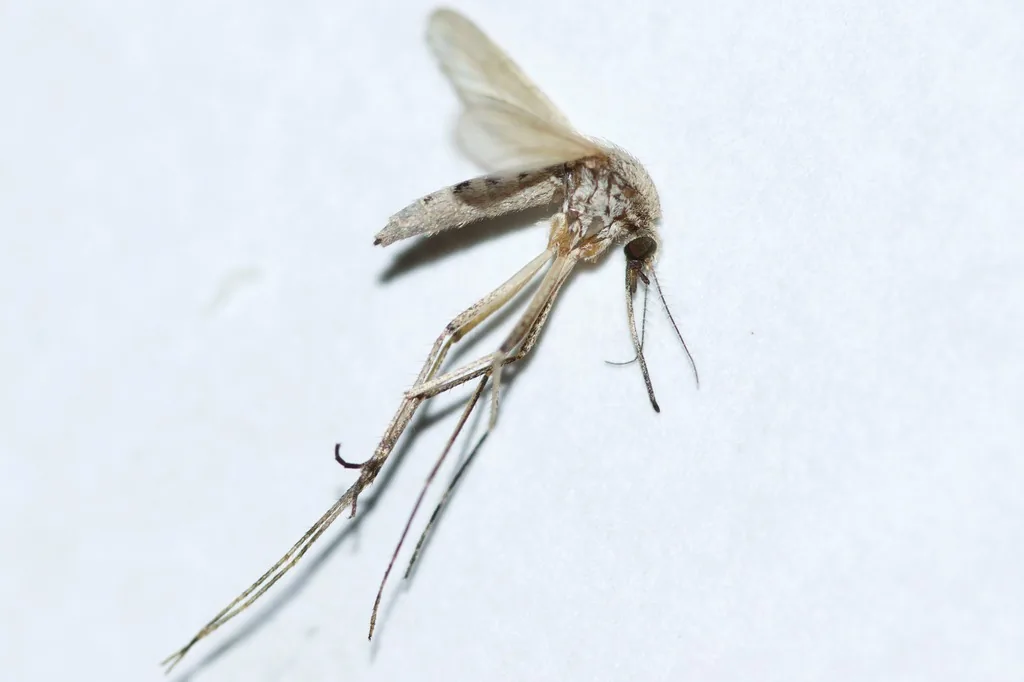
- The top of the abdomen is mostly pale-scaled, with a pair of dark spots near the midline, and the last two segments are often entirely pale.[2]
- The thorax has a brown stripe down the middle, with yellowish-white scales along the sides and toward the rear.[2]
- The legs are speckled dark and pale. Each hind-foot segment has pale bands at both ends, and the last segment is mostly white.[2]
- The wings mix dark and pale scales, with the front edge mostly pale, and the proboscis is dark with pale scales mixed in, especially near the base.[2]
Look-alikes
| Look-alike | How to tell them apart |
|---|---|
| Eastern saltmarsh mosquito | Shares salty breeding sites with Aedes dorsalis in New York. It has a distinct pale band around the middle of the proboscis, a yellowish stripe or row of spots running down the banded abdomen, and a pale yellow band in the middle of the first hind-foot segment.[1][2] |
| Inland floodwater mosquito | Breeds alongside Aedes dorsalis in Utah. It is a small, dark mosquito with banded legs and a two-lobed light marking on each abdominal segment, rather than a mostly pale abdomen.[1][3][2] |
Where it lives
Aedes dorsalis occurs over much of North America and in northern Europe and into Asia. In the United States it is most abundant from the Plains states to the Pacific coast; farther east it has been reported in smaller numbers across the Great Lakes states to Massachusetts, Connecticut and New Jersey. It is rare in New Jersey, where the first one was caught in 1957, and Connecticut's only record is a June 1904 collection from New Haven County.[1][2]
Biology and life cycle
Females lay about 130 eggs on average, in one to six batches, in the moist soil of shallow hollows that flood from time to time. The eggs survive the winter and hatch when flooded in the first warm weather of spring, but only after at least five days of partial drying, and some hold back to hatch on a later flood.[1][2]
Because each hatch depends on the pools flooding again, breeding can continue all through the warm season, and ten broods in a single season were common in Utah. In the western United States the breeding cycle runs from March until freezing weather in October or early November.[1]
Larvae live in brackish or fresh water: Pacific coast tidal marshes, the margins of Great Salt Lake, freshwater marshes, rain pools, springs, irrigation water and even waste lagoons. They tolerate very salty water, up to 12 percent salt in Utah pools, and in New York they have turned up in roadside ditches and ponds holding salt from winter de-icing.[1][2]
Most larvae are found in shallow, grassy water in full sun, in sites ranging from a cattle hoof print to a shallow marsh of 10,000 acres. At the time of the New Jersey report, larvae there had been found only in two salt meadow cordgrass (Spartina patens) marshes, one used for salt hay farming and one partly surrounded by housing.[1]
Adults are strong fliers that have been traced 22 miles in Utah and more than 30 miles in California. Most females live less than 90 days, and adults are active between 50 and 95°F but stop below 42°F.[1]
Damage and signs
- In western North America it is an important pest that feeds avidly on people and domestic animals, and it has been called the most annoying pest species in western Canada. The bite has been described as vicious.[1]
- It attacks at any time of day or night, with peak activity toward evening, on calm cloudy days and in humid weather. People and other large mammals seem to be its preferred hosts, though it will feed on large birds when no mammals are available, and a female interrupted while feeding keeps coming back until she finishes.[1][2]
Health risk
It has been implicated as a vector of both California encephalitis and western equine encephalitis viruses. No viruses have been isolated from it in Connecticut, where it is a rare, marginal species.[1][2]
Control
Prevention
It bites day and night and is most active toward evening and on calm, cloudy or humid days. When outdoors at those times, wear long sleeves, long pants, shoes and socks, and use an EPA-registered repellent following its label.[1][5]
Keep them out
Keep fine-mesh screens on windows and doors in good repair.[4]
When to call a professional
Adults can fly more than 20 miles from where they hatch, and mosquito management is often handled on an areawide basis by public agencies, either local health departments or independent mosquito and vector control districts.[1][4]
Common questions
- Why are there mosquitoes miles from the nearest marsh?
- Aedes dorsalis is known for long flights: adults have been traced 22 miles in Utah and more than 30 miles in California, and in some areas it turns up as a chance migrant.[1]
- Can road salt create mosquito habitat?
- For this species, it can. Its larvae tolerate salty water and have been collected in New York from roadside ditches and ponds holding de-icing salt, and Rutgers suggests looking for it in ditches beside heavily salted roads and in wet spots near road salt storage.[1]
Sources
- Rutgers Center for Vector Biology (reprint), “Aedes dorsalis in New Jersey: Larval Habit and Identification (M. Romanowski), Proceedings of the 76th Annual Meeting of the New Jersey Mosquito Control Association, 1989.” vectorbio.rutgers.edu/outreach/species/sp14.htm (accessed 2026-11-08)
- Connecticut Agricultural Experiment Station, “Identification Guide to the Mosquitoes of Connecticut, Bulletin No. 966 (Andreadis, Thomas and Shepard, 2005).” portal.ct.gov/-/media/caes/documents/publications/bulletins/b966b996pdf.pdf (accessed 2026-11-08)
- Oklahoma Cooperative Extension Service (Oklahoma State University), “Guide to the Twelve Most-Important Oklahoma Mosquitoes of Concern for Pest Control Specialists, EPP-7335 (Bradt et al., October 2017).” pods.okstate.edu/fact-sheets/EPP-7335pod.pdf (accessed 2026-11-08)
- University of California Statewide IPM Program, “Pest Notes: Mosquitoes, Publication 7451 (revised April 2020).” ipm.ucanr.edu/legacy_assets/PDF/PESTNOTES/pnmosquitoes.pdf (accessed 2026-11-08)
- City of Jacksonville Mosquito Control (Florida), “Avoiding Mosquitoes.” www.jacksonville.gov/departments/neighborhoods/mosquito-control/avoiding-mosquitoes (accessed 2026-11-08)
- iNaturalist, “Aedes dorsalis taxon page (order and family).” www.inaturalist.org/taxa/155381 (accessed 2026-11-08)