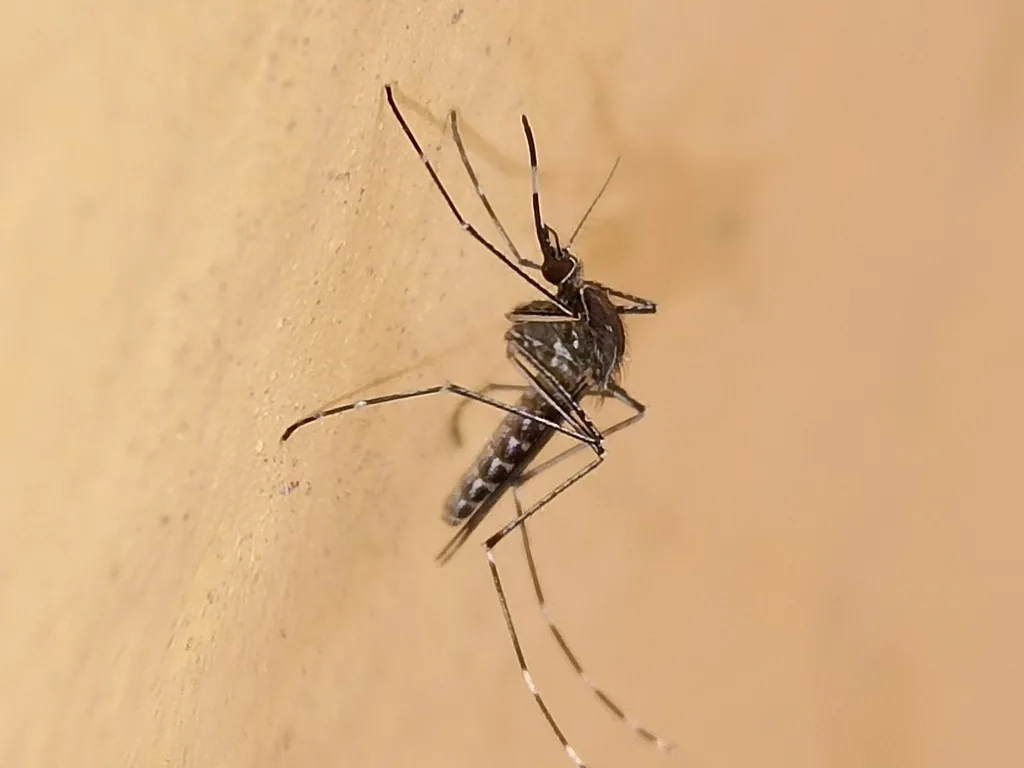
How to identify it
- The quickest field mark is a white band around the middle of the proboscis, the long beak-like mouthpart.[1][4]
- The legs have white bands that overlap the joints of the feet, and the middle legs carry white lengthwise stripes.[1]
- Seen from below, the abdomen shows dark V-shaped chevrons on each segment.[1]
- The tip of the female's abdomen is blunt and broad rather than pointed.[4]
Look-alikes
| Look-alike | How to tell them apart |
|---|---|
| Northern house mosquito | A related Culex mosquito that lacks the white band on the proboscis and the banded leg joints that set Culex tarsalis apart from other North American Culex.[1] |
| Inland floodwater mosquito | Has a plain proboscis with no white band and a pointed abdomen tip, and it prefers to bite people rather than birds.[4] |
Where it lives
Found from northern Mexico to southern Canada and from the Pacific coast east to the southern Atlantic coast. It is abundant in summer across the Midwest and West but fairly rare east of the Mississippi River.[1]
Biology and life cycle
Females lay floating rafts of about 190 eggs on new, sunlit pools, often edged with grass and weeds.[1]
Larvae thrive in irrigation tailwater, wetlands, alkaline lake beds, treated sewage effluent and water-filled hoof prints around livestock, but not in heavily polluted water.[1][2]
Development from larva to adult takes from about a week to almost four weeks, depending on water temperature and food.[1]
In spring most females feed on birds just after sunset; by late summer many switch to mammals such as horses, cattle and people, which matters for virus spread.[1]
Females fly as far as 10 to 15 miles from where they developed, so they can bite in towns far from farm fields.[2][1]
In northern areas, mated females spend the winter in a dormant state and need a blood meal in spring before laying eggs.[1]
Damage and signs
- Its bites matter more for disease than for nuisance; in South Dakota traps it ranks second in numbers behind the floodwater mosquito Aedes vexans.[3]
Health risk
It is the primary carrier of West Nile virus to people in the West and the main vector of western equine encephalitis in the United States; St. Louis encephalitis virus also spreads through it.[5][2][1][7]
Control
Prevention
Limit time outdoors from dusk to dawn, when this mosquito bites, and wear long sleeves and long pants after dark.[3][4][2]
Use an EPA-registered repellent such as DEET, picaridin, IR3535, oil of lemon eucalyptus or PMD, and consider permethrin-treated clothing, never applied to skin.[9][2]
Keep them out
Install or repair window and door screens and keep doors closed so mosquitoes stay outside.[8][6]
Sanitation
Once a week, empty, scrub, turn over or cover anything outdoors that holds water, and manage irrigation so it doesn't leave standing pools.[8][2]
Biological control
Water you can't drain can be treated with Bti, a bacterial larvicide that targets mosquito larvae.[6][8]
When to call a professional
Because these mosquitoes travel miles, area-wide surveillance, larviciding and adult spraying by local mosquito control agencies do more than treating a single yard.[3][2]
Common questions
- Why is this mosquito so important for West Nile virus?
- West Nile virus multiplies in birds. Culex tarsalis bites both birds and people, so it acts as a bridge that carries the virus from birds to humans.[3][7]
- When is the risk of being bitten highest?
- Females seek blood from early evening well into the night. In South Dakota their numbers build in July and stay high through August.[2][3]
- Can people catch West Nile virus from each other?
- No, except rarely through blood transfusions, organ transplants or from mother to baby; it is mainly spread by mosquito bites.[7]
Sources
- Rutgers Center for Vector Biology, “The Western Encephalitis Mosquito, Culex tarsalis (Reisen, Wing Beats 4(2):16, 1993).” vectorbio.rutgers.edu/outreach/species/sp6.htm (accessed 2026-10-06)
- Purdue University Extension Entomology, “Western Equine Encephalitis (Public Health Entomology: Mosquito-Borne Diseases).” www.extension.entm.purdue.edu/publichealth/diseases/mosquito/western.html (accessed 2026-10-06)
- South Dakota State University Extension, “Know Your Mosquitoes, Protect Yourself.” extension.sdstate.edu/know-your-mosquitoes-protect-yourself (accessed 2026-10-06)
- South Dakota State University Extension, “Will Mosquitos Be an Issue During This Summer? (June 8, 2021).” extension.sdstate.edu/will-mosquitos-be-issue-during-summer (accessed 2026-10-06)
- University of Wyoming Extension Entomology, “Mosquitoes and West Nile Virus in Wyoming.” www.uwyo.edu/entomology/mosquitoes/index.html (accessed 2026-10-06)
- University of California Statewide IPM Program, “Pest Notes: Mosquitoes, Publication 7451 (revised April 2020).” ipm.ucanr.edu/legacy_assets/PDF/PESTNOTES/pnmosquitoes.pdf (accessed 2026-10-06)
- U.S. Centers for Disease Control and Prevention, “West Nile: Causes and How It Spreads (reviewed July 15, 2026).” www.cdc.gov/west-nile-virus/causes/index.html (accessed 2026-10-06)
- U.S. Centers for Disease Control and Prevention, “Mosquito Control at Home (reviewed April 16, 2024).” www.cdc.gov/mosquitoes/mosquito-control/mosquito-control-at-home.html (accessed 2026-10-06)
- U.S. Centers for Disease Control and Prevention, “Preventing Mosquito Bites.” www.cdc.gov/mosquitoes/prevention/index.html (accessed 2026-10-06)
- iNaturalist, “Culex tarsalis taxon page (order and family).” www.inaturalist.org/taxa/259078 (accessed 2026-10-06)