The short answer
- Most bugs that look like mosquitoes are crane flies, non-biting midges, winter crane flies, phantom or dixid midges, or mayflies. None of them is a known biter of people, so the big one on the porch or the cloud over the lawn is very likely harmless.[5][3][10][6]
- A real mosquito has a long, straw-like beak and scales along the wing veins and edges, according to Missouri Department of Conservation. Crane flies and midges have a short snout and no wing scales.[1][3][5]
- Crane flies, often called mosquito hawks, neither bite nor eat adult mosquitoes. Mississippi State University Extension calls both ideas folklore.[4][5]
- If something is actually biting you, it's a female mosquito or one of the true biters such as no-see-ums or black flies. Those have their own guides, linked below.[2][5]
Related profiles
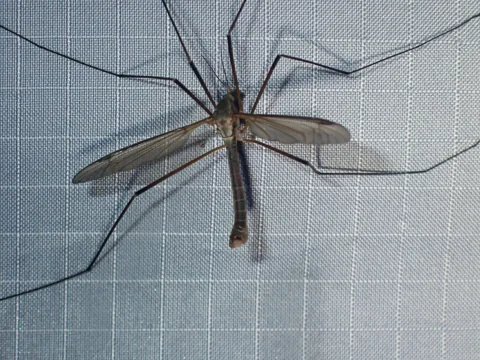 Crane Flies
Family Tipulidae (e.g., Tipula paludosa, the European crane fly)
Adult crane flies are long-legged, mosquito-shaped insects that bump around walls and ceilings in late summer. They don't bite or eat mosquitoes. The concern is the larvae of two invasive European species, called leatherjackets, which feed on lawn roots, crowns and shoots.
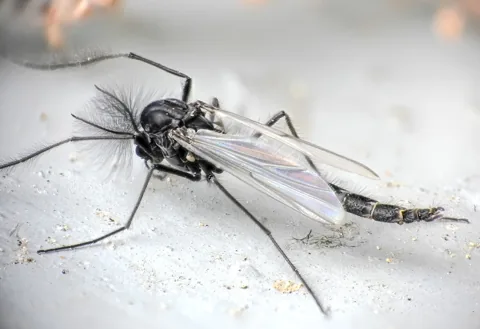 Non-Biting Midges
Family Chironomidae
Non-biting midges (family Chironomidae) are small, delicate flies that grow up in water and emerge in large swarms near ponds, lakes and streams. They are often mistaken for mosquitoes, but they don't bite; the problem is sheer numbers.
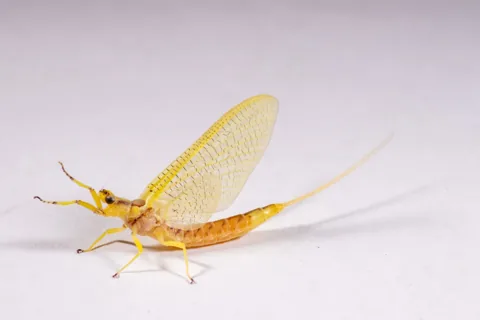 Mayflies
Order Ephemeroptera (e.g., Hexagenia limbata, the giant mayfly)
Mayflies spend most of their lives as aquatic nymphs, then emerge as winged adults that live only a few days at most. Big hatches near lakes and rivers can coat walkways, roads and lit buildings.
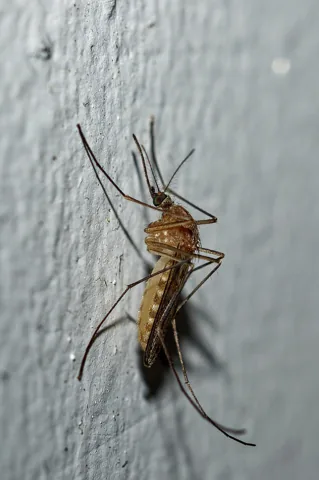 Mosquito
Culicidae (shown: Culex pipiens complex)
Mosquitoes are small, delicate flies whose females feed on blood and can pass on viruses such as West Nile; the control that works best goes after the larvae in standing water.
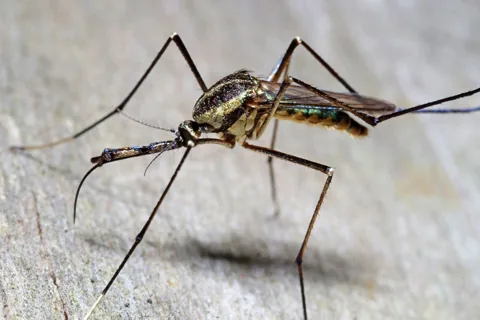 Elephant Mosquito
Toxorhynchites rutilus
The elephant mosquito never takes blood: adults can't take a blood meal and feed only on nectar. Its larvae prey on the larvae of other mosquitoes, including container breeders such as the yellow fever and Asian tiger mosquitoes.
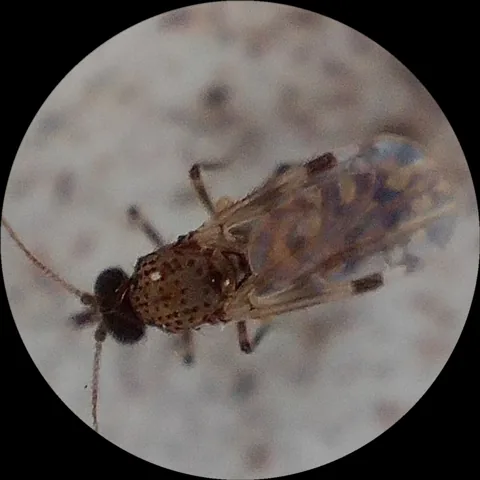 Biting Midges
Culicoides spp.
No-see-ums, also called biting midges, punkies, sand gnats or sand flies, are tiny flies, mostly in the genus Culicoides, whose bites itch intensely; most people feel them without ever seeing them.
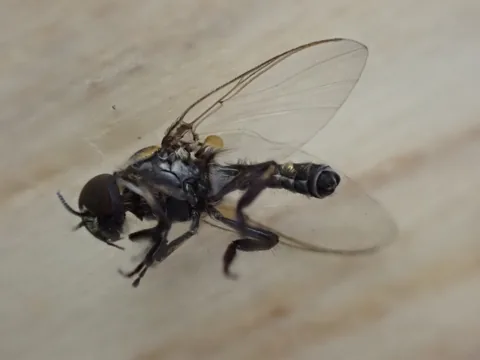 Black Flies
Simulium and related genera (family Simuliidae)
Black flies are tiny, stout, humpbacked biting flies, often called gnats or buffalo gnats. Their larvae live only in running water, and the females swarm around people and animals for blood, mostly in spring and early summer.
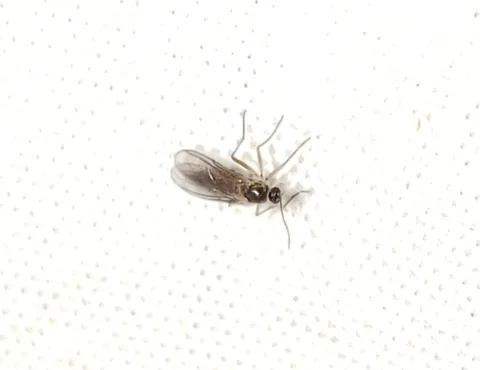 Fungus Gnat
Bradysia and related species
Fungus gnats are small flies whose larvae live in moist potting mix and organic matter. Indoors the adults emerge from houseplants and become a nuisance; they don't bite, and Colorado State calls the larvae minor pests of houseplants.
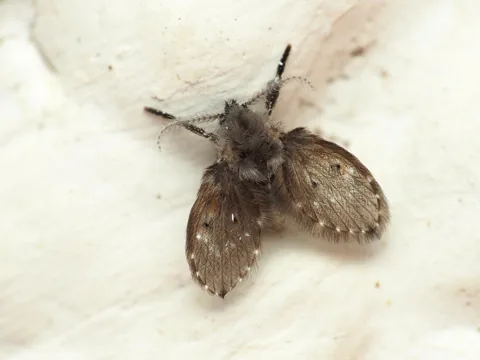 Drain Fly (Moth Fly)
Psychodidae (shown: Clogmia albipunctata)
Drain flies, also called moth flies or filter flies, are small, fuzzy, non-biting flies whose larvae live in the slimy film inside drains, toilets and other places where water stands.
First, check for a real mosquito
You can sort most of these insects on a window or wall with a close look, and a hand lens helps with the wings.[1][5]
- Beak: Missouri Department of Conservation describes the mosquito's mouthparts as a long straw used for drinking. A crane fly's mouthparts look like a snout instead, and Ventura County says midges and dixid midges have no beak at all.[1][3][5]
- Wing scales: mosquito wings have a fringe of hairs and scales along the edges and veins, Missouri Department of Conservation says. Crane flies, midges and dixid midges have no scales on the wings.[1][3][5]
- Resting pose: Ventura County says a mosquito folds its wings over its back and grips the surface with its front legs, while a resting midge holds its wings in an upside-down V with the front legs stretched out.[5]
- Size: Missouri Department of Conservation gives about ¼ to ½ inch for an adult mosquito, not counting legs and beak. Crane flies reach about 1½ inches.[1][3]
- Who bites: CDC says only female mosquitoes bite, because they need a blood meal to produce eggs. Males feed on nectar and fruit juices, and their beak is not strong enough to pierce skin.[2]
- Missouri Department of Conservation also notes that females of a few mosquito species don't need blood to reproduce, so a mosquito-shaped insect that never tries to bite isn't proof it's a look-alike. The types of mosquitoes guide covers the non-biting elephant mosquitoes.[1]
Crane flies (mosquito hawks)
Missouri Department of Conservation says nearly all of the more than 500 North American crane fly species look like giant mosquitoes. Adults have slender bodies, very long legs and one pair of wings, often held out at a 45-degree angle, and can be up to about 1½ inches long. Ventura County says they are usually many times larger than a typical mosquito.[3][5]
Besides the snout-like mouthparts and bare wing veins, Missouri Department of Conservation points to a V-shaped groove on the thorax as a way to tell them from mosquitoes. Mississippi State says the long legs break off easily, which helps them escape predators.[3][4]
- Do they bite? No. Missouri Department of Conservation says crane flies do not bite and are completely harmless, and Ventura County agrees.[3][5]
- Do they eat mosquitoes? The adults don't. Mississippi State says crane flies do not eat mosquitoes, and Ventura County says the so-called mosquito hawks are not predators. Missouri Department of Conservation says many adults don't eat at all and the rest drink nectar. It does note that the aquatic larvae of some species eat other insects, including mosquito larvae.[4][5][3]
- When they show up: Mississippi State says crane flies are around much of the year but are especially common in spring. Ventura County says adults are strongly drawn to porch lights and that large spring hatches can produce big swarms.[4][5]
- Lawn damage: the larvae, called leatherjackets, are tan, legless grubs about two inches long when mature, according to Mississippi State. A few species damage turf. Missouri Department of Conservation says some can be lawn pests, and the crane fly lawn guide covers checking for them and treating.[4][3]
Winter crane flies: mosquito look-alikes in the cold months
A mosquito-like fly bobbing in the air on a mild winter afternoon is probably a winter crane fly (family Trichoceridae). The University of Wisconsin-Milwaukee Field Station says there are 27 or 28 species in North America, nearly all in the genus Trichocera, and that they are about half again as large as mosquitoes. They look much like small crane flies.[6]
- Cold-season activity: the Field Station says many species spend winter as adults in sheltered spots and fly in the chilly air of early spring and late fall, even during midwinter thaws, when they may be seen walking on snow. A 2021 paper in Environmental Management says adults of one species can emerge through the snow layer and stay active on the snow surface.[6][7]
- Dancing swarms: males form mating swarms that bob up and down a few feet above the ground, the Field Station says, sometimes over lawns and open woods.[6]
- Where they breed: the larvae live in damp, decaying organic matter. The Field Station lists leaf litter, fungi, manure, rodent burrows and stored root vegetables, and the 2021 paper adds composting plant matter, excrement, drainage chambers and sewage treatment plants.[6][7]
- Feeding: the Field Station says most sources describe the adults as eating nothing, though they have been collected at molasses traps.[6]
Non-biting midges
Ventura County calls non-biting midges (Chironomidae) the most common mosquito-like flies mistaken for mosquitoes. Clemson Extension says they don't bite and have a much shorter beak than a mosquito. Their larvae develop in rivers, lakes, canals and ornamental ponds, according to Ventura County.[5][9]
They can't pierce skin, but a UC Riverside urban entomology text notes they can still be serious nuisances in cities and in the country when they emerge in swarms. The midge and mayfly swarm guide covers the swarms, lights and cleanup.[10]
Phantom midges
Phantom midges (Chaoborinae, which some authors treat as a family, Chaoboridae) are somewhat like mosquitoes but lack the long beak and do not bite, according to the UC Riverside text. It says they have scales only on the rear edges of the wings, with few or none along the veins. The name comes from the larvae, which are nearly transparent and hard to see even in clear water.[10][11]
The sources aren't unanimous on biting. The University of Wisconsin-Milwaukee Field Station says an adult has a very short beak and the usual view is that it does not or cannot bite, but notes a 2010 publication suggesting the mouthparts of some may be long enough to bite.[11]
- Swarms: the Field Station says adults live only a few days and sometimes gather by the thousands in smoke-like plumes.[11]
- Known nuisance species: the UC Riverside text names the Clear Lake gnat (Chaoborus astictopus) in California and says Chaoborus punctipennis is a pest in Florida and along the Atlantic seacoast.[10]
- Larvae: the Field Station says the larvae hunt small water animals, including small mosquito larvae.[11]
Dixid (meniscus) midges
Dixid midges (Dixidae) also look like mosquitoes, and Ventura County says they swarm in the evening near the water where they breed. Like non-biting midges they have no beak and no wing scales.[5]
Missouri Department of Conservation says the family is also called meniscus midges because the larvae rest in a U shape at the meniscus, the curve the water surface makes at its edges. Ventura County says the larvae are often confused with those of Anopheles (malaria) mosquitoes, and that big emergences happen only now and then and only in certain local spots.[8][5]
Mayflies
Ventura County says mayflies don't closely resemble mosquitoes but draw attention when they gather at porch lights and on walls near water. They are easy to tell apart once you look: Missouri Department of Conservation describes four veined wings held upright and together over the back like a butterfly's, short antennae, large eyes and two long, threadlike tails. Ventura County gives two or three tails.[5][12]
Adult mayflies can't bite. Missouri Department of Conservation says they have only remnant mouthparts and cannot eat or drink, and Mississippi State says the adults don't feed and live a day or two, just long enough to mate and lay eggs. Mississippi State adds that heavy emergences can show up on weather radar. The midge and mayfly swarm guide covers what to do about them.[12][13]
Other small flies people mistake for mosquitoes
Ventura County's list of mosquito-like flies includes a few more that turn up around homes. None of these bites.[5]
- Fungus gnats: small dark flies, mostly 1/8 to 3/8 inch long, that breed in damp, decaying organic matter such as leaf mold, manure and mulch, and sometimes in houseplant pots, according to Ventura County. See the fungus gnat guide.[5]
- Moth flies: small, fuzzy flies with speckled wings held like a tent over the body. Ventura County says they can emerge indoors from sink traps and bathtub drains and are often seen on bathroom and shower walls. See the drain fly guide.[5]
- Dance flies: Ventura County says they swarm in sunlit, sheltered spots in yards during the day, while mosquitoes typically start flying shortly after sunset. CDC notes that some mosquitoes bite during the day too, so daytime flight alone doesn't rule one out.[5][2]
If something is biting
None of the flies above takes blood, so a bite points to something else.[5][3]
- Mosquitoes: CDC says only females bite, and that a bite commonly causes itching and swelling. See the types of mosquitoes guide to work out which kind you have.[2]
- No-see-ums (biting midges): Ventura County describes tiny bloodsucking flies, most under 1/16 inch long, that bite during the day and are rarely seen in the act. In sensitive people the bites can leave itchy sores that last several weeks.[5]
- Black flies: small, humpbacked, grayish-black flies that Ventura County says can give a painful, irritating bite during daylight. Their larvae live attached to rocks and plants in flowing streams.[5]
- The no-see-um and biting midge guide covers both of these biters, along with repellents and screens.[5][9]
What to do about the harmless ones
Usually nothing beyond keeping them outside. Mississippi State says crane flies are not really pests except when they get indoors, that insecticide sprays are not very useful against them, and that window screens and closed doors are the best defense.[4]
Because many of these flies are drawn to lights, Clemson suggests keeping outdoor lights off for about 45 minutes after sundown during midge swarms. The swarm guide has more on lighting and cleanup, and the crane fly lawn guide covers leatherjackets in turf.[9][5]
Common questions
- Do mosquito hawks eat mosquitoes?
- No. Mosquito hawk is a common name for crane flies, and Mississippi State says they do not eat mosquitoes. Missouri Department of Conservation says most adults don't eat at all or only drink nectar, though some species' aquatic larvae eat mosquito larvae.[4][3]
- Can a crane fly bite you?
- No. Missouri Department of Conservation says crane flies do not bite and are completely harmless. The pointed tip on a female's abdomen is for laying eggs and is harmless too.[3][4]
- What are the mosquito-looking bugs flying in winter?
- Most likely winter crane flies. The University of Wisconsin-Milwaukee Field Station says they fly on chilly days in late fall and early spring and during midwinter thaws, and males gather in bobbing swarms. Most sources say the adults don't eat at all.[6]
- Why are there swarms of mosquito-like bugs by the lake?
- Swarms near water are usually male non-biting midges. Clemson says most swarms are males listening for the wingbeat of a female, and that these midges don't bite.[9][5]
Photo credits
- Crane Flies: (c) Louis Imbeau, some rights reserved (CC BY) — via iNaturalist, CC BY 4.0
- Non-Biting Midges: (c) Robert Roach, some rights reserved (CC BY) — via iNaturalist, CC BY 4.0
- Mayflies: (c) DiegoH, some rights reserved (CC BY) — via iNaturalist, CC BY 4.0
- Mosquito: (c) Donald Davesne, some rights reserved (CC BY) — via iNaturalist, CC BY 4.0
- Elephant Mosquito: (c) Chris Baer, some rights reserved (CC BY) — via iNaturalist, CC BY 4.0
- Biting Midges: Sinaloa Silvestre, public domain (CC0), via iNaturalist
- Black Flies: Stephen James McWilliam, public domain (CC0), via iNaturalist
- Fungus Gnat: (c) aispinsects, some rights reserved (CC BY) — via iNaturalist, CC BY 4.0
- Drain Fly (Moth Fly): (c) Katja Schulz, some rights reserved (CC BY) — via iNaturalist, CC BY 4.0
Sources
- Missouri Department of Conservation, “Mosquitoes (Field Guide).” mdc.mo.gov/discover-nature/field-guide/mosquitoes (accessed 2026-11-10)
- Centers for Disease Control and Prevention, “About Mosquitoes.” www.cdc.gov/mosquitoes/about/index.html (accessed 2026-11-10)
- Missouri Department of Conservation, “Large Crane Flies (Field Guide).” mdc.mo.gov/discover-nature/field-guide/large-crane-flies (accessed 2026-11-10)
- Mississippi State University Extension Service, “Crane Fly, Bug's Eye View Vol. 5 No. 5.” extension.msstate.edu/newsletters/bugs-eye-view/2019/crane-fly-vol-5-no-5 (accessed 2026-11-10)
- County of Ventura Environmental Health Division, Vector Control Program, “Insects Resembling Mosquitoes.” rmadocs.venturacounty.gov/environmental-health/programs/vector-control/publications/environmental-health-insects-resembling-mosquitoes.pdf (accessed 2026-11-10)
- University of Wisconsin-Milwaukee Field Station, “Winter Crane Fly (Family Trichoceridae), Bug of the Week.” uwm.edu/field-station/winter-crane-fly/ (accessed 2026-11-10)
- Environmental Management, via PubMed Central, “León et al. (2021), International Response under the Antarctic Treaty System to the Establishment of a Non-native Fly in Antarctica, Environ Manage 67(6):1043-1059.” pmc.ncbi.nlm.nih.gov/articles/PMC8106607/ (accessed 2026-11-10)
- Missouri Department of Conservation, “Midges (Field Guide).” mdc.mo.gov/discover-nature/field-guide/midges (accessed 2026-11-10)
- Clemson Cooperative Extension Home & Garden Information Center, “Midges, HGIC.” hgic.clemson.edu/factsheet/midges/ (accessed 2026-11-10)
- UC Riverside Department of Entomology, “Urban Entomology, Chapter 9 part 4: Pestiferous arthropods that do not envenomate (Walter Ebeling).” entomology.ucr.edu/we-ch-9-4 (accessed 2026-11-10)
- University of Wisconsin-Milwaukee Field Station, “Phantom Midge (Family Chaoboridae), Bug of the Week.” uwm.edu/field-station/?p=4285 (accessed 2026-11-10)
- Missouri Department of Conservation, “Mayflies (Field Guide).” mdc.mo.gov/discover-nature/field-guide/mayflies (accessed 2026-11-10)
- Mississippi State University Extension Service, “Mayfly, Bug's Eye View Vol. 4 No. 11.” extension.msstate.edu/newsletters/bugs-eye-view/2018/mayfly-vol-4-no-11 (accessed 2026-11-10)