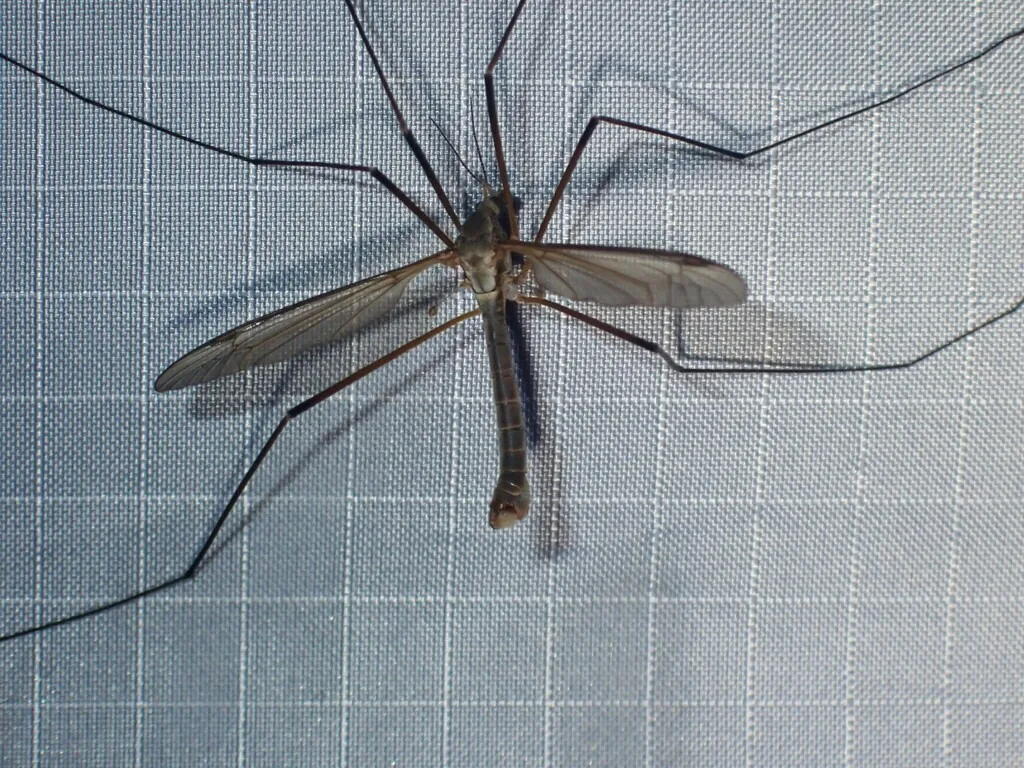
How to identify it
- European crane fly adults are tan, about 1 inch long, with a long, thin abdomen and wings and legs that stretch the length of the abdomen.[1]
- They have one pair of working wings plus a pair of tiny knobbed balancing organs called halteres, a feature of true flies.[1]
- The wings are unpatterned except for a narrow smoky band along the leading edge.[2]
- Larvae, called leatherjackets, are gray, legless maggots up to 1 to 1.5 inches long, with no well-defined head and fingerlike projections at the rear.[1]
Look-alikes
| Look-alike | How to tell them apart |
|---|---|
| Mosquitoes | Crane flies are much larger and, despite nicknames like mosquito hawk, adults don't feed at all; they only drink water and don't eat mosquitoes.[1] |
| Native crane flies | Hundreds of native crane fly species exist, and some with clear wings also emerge from lawns; many have spotted or patterned wings, and a specialist may be needed to confirm.[2] |
| Cutworm damage | Leatherjacket surface feeding on turf can look like black cutworm damage, so dig and look for the gray, legless larvae.[2] |
Where it lives
The two lawn-damaging species, Tipula paludosa and T. oleracea, are invasive from Europe and now widespread across much of North America, especially in rainy regions such as the Pacific Northwest.[1][2]
Biology and life cycle
Tipula paludosa has one generation a year; the marsh crane fly, T. oleracea, has two.[1][2]
Adults live only briefly. They emerge in late summer, mate and lay eggs within days in moist, low-lying soil.[1][2]
Each female lays up to about 300 eggs at or near the soil surface. Eggs and young larvae need damp conditions and survive best in rainy fall weather.[2][1]
Larvae feed in the top inch or so of soil through fall, winter and spring, reaching full size by midwinter.[1][2]
Damage and signs
- Leatherjackets eat roots, crowns and grass blades. Lawns thin starting in late winter, and wet, low-lying areas can be stripped bare by spring.[1][2]
- Birds, skunks and raccoons dig and peck for the larvae, tearing up infested turf further.[1][2]
- Damage is worst where drainage is poor and thatch has built up.[2]
Health risk
Adult crane flies don't feed and live only briefly, so they pose no threat to people. Their importance is as lawn and pasture pests in the larval stage.[1][2]
Control
Prevention
Keep turf healthy with regular mowing, appropriate fertilizing and summer irrigation, which helps lawns resist and recover from larval feeding.[1]
Improve drainage, and cut back irrigation around early September, when females seek wet soil to lay eggs; drier soil kills eggs and young larvae.[1][2]
Ignore the adults; they are short-lived, so management should target the larvae.[2]
Traps and physical control
Scout from late fall into midwinter: cut a 1-foot-square piece of sod about 1 inch deep where grass is thinning, flip it, and count larvae.[1]
Pesticides
Consider an insecticide only after cultural steps, when counts exceed about 25 larvae per square foot. Oregon State advises winter applications, before damage shows; spring treatments come too late.[1]
Oregon State lists chlorantraniliprole, imidacloprid, bifenthrin and esfenvalerate; some may require a license. Don't apply bee-toxic products while weeds or flowers are blooming.[1]
Common questions
- Do crane flies eat mosquitoes?
- No. Despite nicknames like mosquito hawk and skeeter eater, adults don't eat mosquitoes or anything else; they only drink water.[1]
- Do crane flies bite?
- No. Adults don't feed, and they live only a short time as they mate and lay eggs.[1][2]
- Why is my lawn dying in early spring?
- In wet regions, leatherjackets feeding through winter can thin turf beginning in February. Dig a sod sample to check for gray, legless larvae.[1]
Sources
- Oregon State University Extension Service, “Managing Crane Fly in Lawns, EM 9296 (September 2020).” extension.oregonstate.edu/sites/default/files/documents/em9296.pdf (accessed 2026-10-06)
- Cornell University, College of Agriculture and Life Sciences, Integrated Pest Management, “European Crane Flies (Tipula paludosa and Tipula oleracea), Ornamental IPM Fact Sheet (updated May 2026).” cals.cornell.edu/integrated-pest-management/outreach-education/fact-sheets/european-crane-flies-tipula-paludosa-and-tipula-oleracea-ornamental-ipm-fact-sheet (accessed 2026-10-06)
- iNaturalist, “Tipula paludosa taxon page (order and family).” www.inaturalist.org/taxa/61917 (accessed 2026-10-06)