On this page
How to identify it
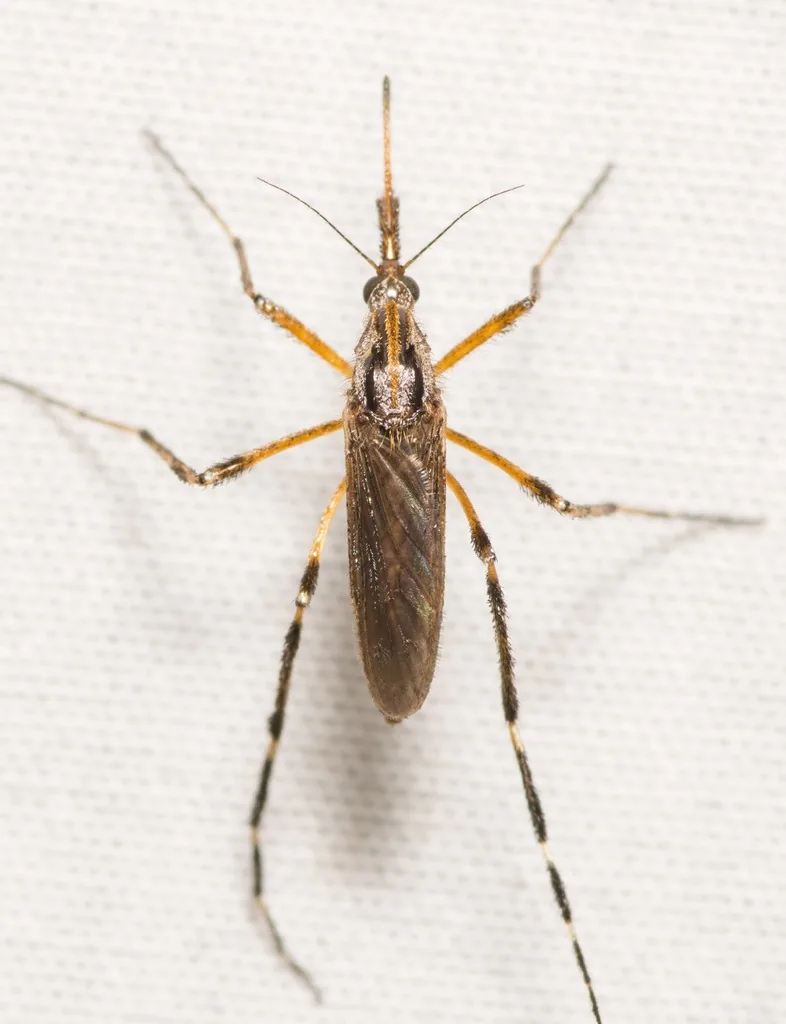
- Very large for a mosquito: Brunswick County, North Carolina, describes it as about the size of a quarter and one of the county's largest mosquitoes. In a lab study of field-caught females, its body weight and wing length were significantly greater than those of the white-footed woods mosquito.[3][7]
- The legs are banded yellow and black and so heavily scaled that they look feathered, which is why it is also called the feather-legged gallinipper.[1]
- The thorax is black and golden brown, with pale stripes along the sides.[1]
Look-alikes
| Look-alike | How to tell them apart |
|---|---|
| Dark ricefield mosquito | A related floodwater Psorophora whose larvae often share rain-filled pools with gallinipper larvae, which eat them. In a Maryland wetland survey it was the most common species in temporary pools.[3][13] |
| White-footed woods mosquito | Another large Psorophora, but in a lab comparison of field-caught females it was significantly smaller and lighter than the gallinipper and laid shorter eggs.[7] |
Where it lives
Mosquito control programs in northeast Florida (Jacksonville) and coastal North Carolina (Brunswick County) report it, Rutgers counts it among New Jersey's mosquito species, and on Maryland's Eastern Shore it was collected mainly from ponds and flooded woodlands. Its status at the northern edge is unsettled: the first confirmed Maine specimen came from a light trap in South Berwick in 2006, yet a 2026 checklist lists it among seven new state records for Maine. GBIF's public U.S. records since 1990 (about 11,000) come from 28 states on the map, most from Florida, Texas and Iowa.[1][3][4][13][5][11][14]
Biology and life cycle
Females lay eggs in small depressions or cracks in the soil. Brunswick County notes they probably don't hatch until after a winter, and Jacksonville says the eggs can hatch several years after they are laid.[3][1]
The larvae live mainly in unshaded temporary pools filled by rain and in flooded fields. They develop fast, usually in 4 to 6 days, and the pupal stage usually takes 2 days.[3][1]
The larvae are predators that eat other mosquito larvae sharing their pools. High-speed filming shows them propelling the head toward prey while fanning brushes beside the mouth into a basket and opening sharp-toothed mandibles.[3][6]
A gallinipper larva hangs almost vertically from the water surface. In Brunswick County, larvae are found from June to October.[3]
In a lab study of field-caught females, gallinippers laid an average of 81 eggs each after a blood meal.[7]
Damage and signs
Health risk
The bite is painful, and evidence that gallinippers spread disease is thin and mixed. In a lab study, 83 percent of gallinippers that fed on a hamster infected with Rift Valley fever virus became infected, but none of the three with a spread infection passed the virus on by bite, because of a strong salivary gland barrier. South Carolina surveillance in 1996-98 isolated Tensaw virus from one pool of gallinippers.[9][10]
Control
Prevention
Wear long pants, long sleeves, shoes and socks where gallinippers are active, since mosquitoes can bite through T-shirts and other thin, tight clothing. During heavy mosquito activity, stay indoors when you can.[2]
Use an EPA-registered repellent on exposed skin and on clothing, following the label. Jacksonville lists DEET, picaridin, IR3535 and oil of lemon eucalyptus; in a lab test against gallinippers, a 15% DEET product protected longest (5 hours 41 minutes), ahead of 5% picaridin (3 hours 46 minutes) and 10% citronella (2 hours 26 minutes).[2][12]
Keep them out
Keep window screens and screened rooms in good repair, with screen doors that close and latch on their own.[2]
When to call a professional
Its breeding sites are flooded fields and wetlands, and Jacksonville's mosquito control program notes it is difficult for homeowners to control by eliminating them. The program monitors wetlands known to produce it and treats them when they are wet and breeding is found.[1]
Common questions
- Why do gallinippers show up after hurricanes and floods?
- Their eggs wait in cracks and low spots in the soil, sometimes for years, and hatch when rain floods the ground. The larvae develop in about 4 to 6 days, and Brunswick County notes that large numbers are not uncommon after hurricanes.[3][1]
- Are gallinippers dangerous?
- Mostly they are a painful nuisance. Lab work found them a poor transmitter of Rift Valley fever virus despite high infection rates, and surveillance has turned up only occasional virus isolations from wild gallinippers.[9][10]
Sources
- City of Jacksonville Mosquito Control (Florida), “Psorophora ciliata, Feather-legged Gallinipper Mosquito.” www.jacksonville.gov/departments/neighborhoods/mosquito-control/psorophora-ciliata (accessed 2026-11-11)
- City of Jacksonville Mosquito Control (Florida), “Avoiding Mosquitoes.” www.jacksonville.gov/departments/neighborhoods/mosquito-control/avoiding-mosquitoes (accessed 2026-11-11)
- Brunswick County Mosquito Control (North Carolina), “Psorophora ciliata Biology (R. Hickman and J. Brown).” www.brunswickcountync.gov/DocumentCenter/View/1396/Psorophora-Ciliata-Biology-PDF (accessed 2026-11-11)
- Rutgers Center for Vector Biology (New Jersey Agricultural Experiment Station), “New Jersey's 63 Mosquito Species (list updated October 2015).” vectorbio.rutgers.edu/outreach/species/njspp.php (accessed 2026-11-11)
- Journal of the American Mosquito Control Association (abstract via PubMed), “New record of Psorophora ciliata in Maine, United States (Foss and Deyrup), J Am Mosq Control Assoc 23(4):476-477, 2007.” pubmed.ncbi.nlm.nih.gov/18240523/ (accessed 2026-11-11)
- Annals of the Entomological Society of America (abstract via PubMed), “Mosquitoes Eating Mosquitoes: How Toxorhynchites amboinensis, Psorophora ciliata, and Sabethes cyaneus Capture Prey (Hancock et al.), Ann Entomol Soc Am 115(6):461-471, 2022.” pubmed.ncbi.nlm.nih.gov/36382104/ (accessed 2026-11-11)
- Journal of Medical Entomology (abstract via PubMed), “Body size, blood feeding activity, and fecundity of Psorophora howardii, Psorophora ciliata, and Psorophora ferox (Zhu et al.), J Med Entomol 51(2):382-386, 2014.” pubmed.ncbi.nlm.nih.gov/24724287/ (accessed 2026-11-11)
- iNaturalist, “Psorophora ciliata taxon page (order and family).” www.inaturalist.org/taxa/259131 (accessed 2026-11-11)
- Journal of Medical Entomology, via PubMed, “Potential for Psorophora columbiae and Psorophora ciliata mosquitoes to transmit Rift Valley fever virus (Turell et al. 2015).” pubmed.ncbi.nlm.nih.gov/26336233/ (accessed 2026-11-11). Cited from the PubMed abstract.
- Journal of the American Mosquito Control Association, via PubMed, “Arbovirus surveillance in South Carolina, 1996-98 (Wozniak et al. 2001).” pubmed.ncbi.nlm.nih.gov/11345423/ (accessed 2026-11-11). Cited from the PubMed abstract.
- Journal of the American Mosquito Control Association, via PubMed, “An updated checklist of mosquito species in Maine with new state records (Schneider 2026).” pubmed.ncbi.nlm.nih.gov/42031369/ (accessed 2026-11-11). Cited from the PubMed abstract.
- Journal of the American Mosquito Control Association, via PubMed, “Laboratory evaluation of citronella, picaridin, and deet repellents against Psorophora ciliata and Psorophora howardii (Scott et al. 2014).” pubmed.ncbi.nlm.nih.gov/25102599/ (accessed 2026-11-11). Cited from the PubMed abstract.
- Journal of the American Mosquito Control Association, via PubMed, “Mosquitoes associated with US Department of Agriculture managed wetlands on Maryland's DelMarVa Peninsula (Wagner et al. 2007).” pubmed.ncbi.nlm.nih.gov/17939519/ (accessed 2026-11-11). Cited from the PubMed abstract.
- Global Biodiversity Information Facility (GBIF), “Psorophora ciliata: occurrence records in the U.S., 1990-2026 (GBIF occurrence search).” api.gbif.org/v1/occurrence/search?taxonKey=1654657&country=US&hasGeospatialIssue=false&occurrenceStatus=PRESENT&year=1990%2C2026&facet=stateProvince&facetLimit=400&limit=0 (accessed 2026-11-11). State counts are records reported (iNaturalist research-grade, museum specimens, surveys), not abundance.