On this page
How to identify it
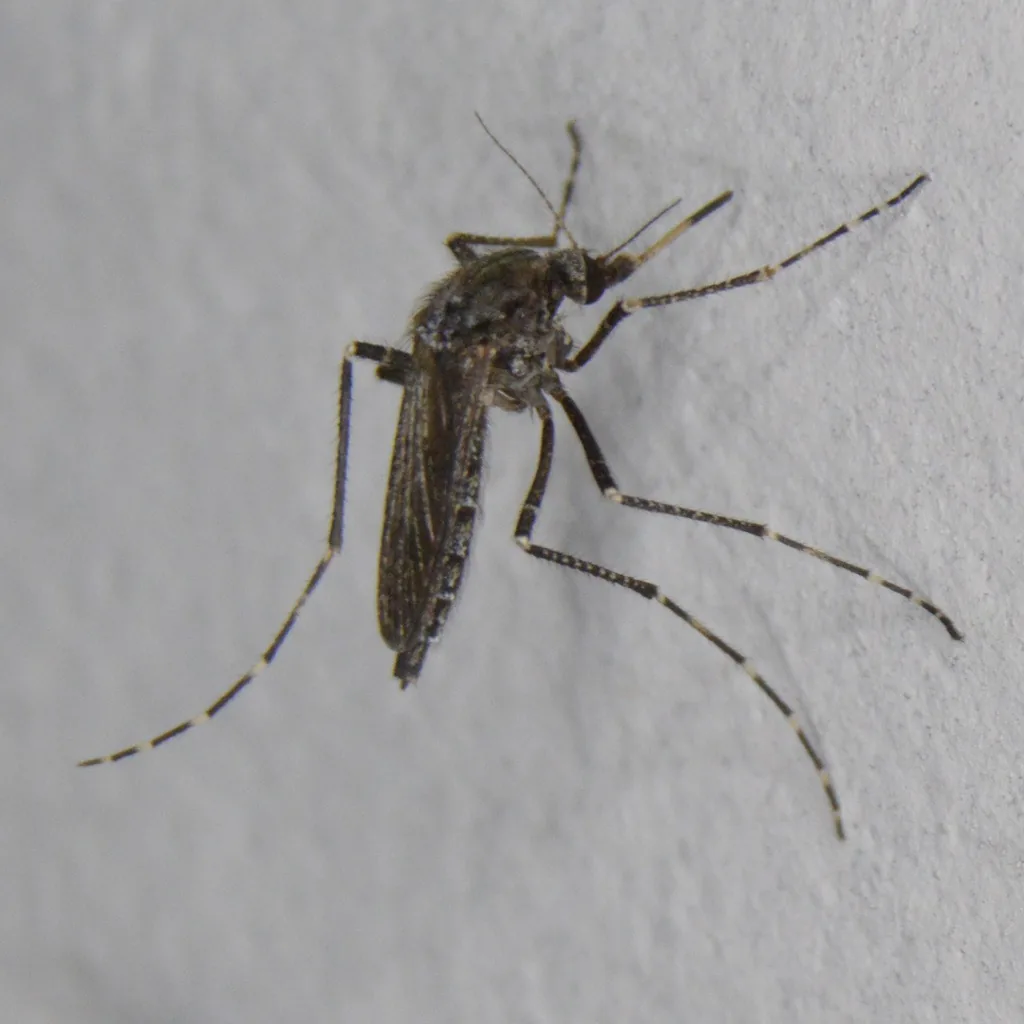
- A medium-to-large dark mosquito with white or yellowish markings.[1][4]
- A wide yellowish-white band rings the middle of the otherwise dark proboscis.[5][1]
- The hind femur has a narrow white band near its tip and white knee spots, and the first segment of the hind foot is brown with a white ring in the middle.[1][4][5]
- The top of the abdomen carries triangles or paired patches of pale yellow scales, and the wings are speckled with dark and pale scales mixed in no set pattern.[5][1]
Look-alikes
| Look-alike | How to tell them apart |
|---|---|
| Gallinipper | The gallinipper is a much bigger Psorophora, about the size of a quarter by Brunswick County's description, with heavily scaled yellow-and-black banded legs. Its larvae prey on other mosquito larvae, including those of the dark ricefield mosquito.[2][3][4] |
| White-footed woods mosquito | Another large, dark Psorophora, but the last two segments of each hind foot are entirely white, its wing scales are dark, and it breeds in shaded woodland pools rather than open, flooded fields.[5][4] |
Where it lives
Reported from Florida, where it is known as the glades mosquito, north to New York, with scattered populations west to California; CDC's training guide also names Nebraska, Iowa and Massachusetts and says it is most abundant in the Florida Everglades and the rice fields of Arkansas and Mississippi. Connecticut's only record is a single female caught in 2003. It belongs to a complex of near-identical species in the Americas, and populations in the southwestern US and western Mexico are now treated as a separate species, Psorophora toltecum. GBIF holds about 35,000 US records since 1990 from 16 states, most from Florida.[1][4][5][12][18]
Biology and life cycle
Females lay eggs on damp soil that floods from rain, overflow or irrigation, and drained rice fields are among the most favorable sites. Larvae turn up in rice fields, grassy roadside ditches and swales, rain pools, irrigation water and seepage pools, and occasionally in slightly brackish water.[1][4][5]
In the rice-growing areas of Arkansas eggs incubate about 3 to 5 days before they can hatch, and eggs also overwinter and hatch in spring.[1][4][5]
Development is fast: in hot summer weather larvae can go from first instar to pupa in as little as 3.5 days.[1]
Numbers explode after floods. After Hurricane Harvey it was the major floodwater nuisance mosquito collected in Texas, and Rutgers says it reaches astronomical numbers in the rice-growing areas of the southwestern US.[15][1]
Adults travel: the normal flight range is at least 6 to 8 miles, with much longer flights recorded, and they are drawn to lights.[1][4]
Females bite furiously by day or night. They feed on any warm-blooded animal, including people, but appear to prefer cattle.[1][4][5]
Damage and signs
Health risk
In laboratory tests eastern populations could be infected with Venezuelan equine encephalitis virus, though a Texas population was less susceptible than one from Mexico, and western populations now treated as Psorophora toltecum were more susceptible. It has been found carrying West Nile virus at Louisiana alligator farms, and it carries dog heartworm: infective heartworm larvae turned up in dark ricefield mosquitoes collected at house doorways in Arkansas.[13][9][14]
Control
Prevention
Avoid excessive irrigation and drain standing water from irrigated lawns and fields. Where larvae must be treated, Bti (Bacillus thuringiensis israelensis) kills mosquito larvae that eat it and spares most other insects, but it does not work on pupae, which don't feed, so timing matters for a species that can reach the pupal stage in a few days.[11][1]
Use an EPA-registered repellent and follow the label, and cover arms and legs. In an Arkansas rice-land field test, some spatial repellent devices also cut catches of this mosquito at stand-in human sites.[6][7][10]
Pesticides
After hurricanes and other big floods, mosquito control programs may spray from the air. After Hurricane Harvey about 6.8 million acres were treated in Texas, and the two adulticides used cut dark ricefield mosquito numbers by 49 to 95 percent, depending on the product and rate.[15]
Treating cattle with permethrin every two weeks lowered blood feeding by this mosquito near the treated herd in a Louisiana field test, though the effect faded between treatments and with heavy rain; a simulation of another Louisiana test estimated the cattle treatment cut local numbers by 83 percent.[17][16]
Where sources disagree
Size: Rutgers calls it a large dark mosquito, while CDC's training guide describes it as medium to large.[1][4]
Name and range: older sources, including CDC's 1963 training guide, call it Psorophora confinnis and extend its range to southern California. A 2015 genetic study treats Ps. confinnis as a South American species, Ps. columbiae as the North American one, and populations in the southwestern US and western Mexico as a separate species, Ps. toltecum.[4][1][12]
Common questions
- Why do these mosquitoes appear right after heavy rain?
- Their eggs sit on damp ground that floods only now and then. When rain or irrigation floods them they hatch, and in hot weather the larvae can reach the pupal stage in as little as 3.5 days, so swarms can follow within days.[1][4]
- Can mosquitoes really kill cattle?
- This one has been reported to, when swarms are huge. Heavy feeding also cuts weight gain and milk production.[1][4]
- Is it a heartworm risk for dogs?
- It can be. Infective heartworm larvae were found in dark ricefield mosquitoes collected at house doorways in Arkansas. FDA says heartworm spreads only through mosquito bites and calls year-round prevention, prescribed by a veterinarian, the best approach.[14][8]
Sources
- Rutgers Center for Vector Biology (New Jersey Agricultural Experiment Station), “The Dark Ricefield Mosquito, Psorophora columbiae (M.V. Meisch, Wing Beats 1994).” vectorbio.rutgers.edu/outreach/species/sp4.htm (accessed 2026-11-11)
- Brunswick County Mosquito Control (North Carolina), “Psorophora ciliata Biology (R. Hickman and J. Brown).” www.brunswickcountync.gov/DocumentCenter/View/1396/Psorophora-Ciliata-Biology-PDF (accessed 2026-11-11)
- City of Jacksonville Mosquito Control (Florida), “Psorophora ciliata, Feather-legged Gallinipper Mosquito.” www.jacksonville.gov/departments/neighborhoods/mosquito-control/psorophora-ciliata (accessed 2026-11-11)
- U.S. Public Health Service, Communicable Disease Center (now CDC), via CDC Stacks, “Mosquitoes of Public Health Importance and Their Control (Training Guide, Insect Control Series; Pratt, Barnes and Littig, 1963).” stacks.cdc.gov/view/cdc/7613/cdc_7613_DS1.pdf (accessed 2026-11-11)
- Connecticut Agricultural Experiment Station, “Identification Guide to the Mosquitoes of Connecticut, Bulletin No. 966 (Andreadis, Thomas and Shepard, 2005).” portal.ct.gov/-/media/caes/documents/publications/bulletins/b966b996pdf.pdf (accessed 2026-11-11)
- U.S. Centers for Disease Control and Prevention, “Preventing Mosquito Bites.” www.cdc.gov/mosquitoes/prevention/index.html (accessed 2026-11-11)
- U.S. Environmental Protection Agency, “Find the Repellent that is Right for You.” www.epa.gov/insect-repellents/find-repellent-right-you (accessed 2026-11-11)
- U.S. Food and Drug Administration, Center for Veterinary Medicine, “Keep the Worms Out of Your Pet's Heart! The Facts about Heartworm Disease.” www.fda.gov/animal-veterinary/animal-health-literacy/keep-worms-out-your-pets-heart-facts-about-heartworm-disease (accessed 2026-11-11)
- Journal of Medical Entomology, via PubMed, “Detection of West Nile virus RNA in mosquitoes and identification of mosquito blood meals collected at alligator farms in Louisiana (Unlu et al. 2010).” pubmed.ncbi.nlm.nih.gov/20695278/ (accessed 2026-11-11)
- Journal of the American Mosquito Control Association, via PubMed, “Field evaluation of four spatial repellent devices against Arkansas rice-land mosquitoes (Dame et al. 2014).” pubmed.ncbi.nlm.nih.gov/24772674/ (accessed 2026-11-11)
- University of California Statewide IPM Program, “Pest Notes: Mosquitoes, Publication 7451 (revised April 2020).” ipm.ucanr.edu/legacy_assets/PDF/PESTNOTES/pnmosquitoes.pdf (accessed 2026-11-11)
- Journal of Medical Entomology, via PubMed, “Defining genetic, taxonomic, and geographic boundaries among species of the Psorophora confinnis complex in North and South America (Lanzaro et al. 2015).” pubmed.ncbi.nlm.nih.gov/26336224/ (accessed 2026-11-11)
- American Journal of Tropical Medicine and Hygiene, via PubMed, “Vector competence of eastern and western forms of Psorophora columbiae mosquitoes for enzootic and epizootic Venezuelan equine encephalitis virus (Moncayo et al. 2008).” pubmed.ncbi.nlm.nih.gov/18337337/ (accessed 2026-11-11)
- Veterinary Parasitology, via PubMed, “Potential mosquito vectors of Dirofilaria immitis from residential entryways in Northeast Arkansas (Todorovic and McKay 2020).” pubmed.ncbi.nlm.nih.gov/32417600/ (accessed 2026-11-11)
- Journal of the American Mosquito Control Association, via PubMed, “Texas mosquito control response following Hurricane Harvey (Qualls and Breidenbaugh 2020).” pubmed.ncbi.nlm.nih.gov/33647147/ (accessed 2026-11-11)
- Journal of the American Mosquito Control Association, via PubMed, “Effect of permethrin treatment of cattle on Psorophora columbiae populations: preliminary field test of a host management concept (Focks et al. 1991, USDA).” pubmed.ncbi.nlm.nih.gov/1675250/ (accessed 2026-11-11)
- Journal of Medical Entomology, via PubMed, “Effect of topically treating cattle with permethrin on blood feeding of Psorophora columbiae in a southwestern Louisiana rice-pasture ecosystem (Nasci et al. 1990).” pubmed.ncbi.nlm.nih.gov/2280387/ (accessed 2026-11-11)
- Global Biodiversity Information Facility (GBIF), “Psorophora columbiae: US occurrence records since 1990 by state (GBIF occurrence search API).” api.gbif.org/v1/occurrence/search?taxonKey=1654668&country=US&hasGeospatialIssue=false&occurrenceStatus=PRESENT&year=1990%2C2026&facet=stateProvince&facetLimit=400&limit=0 (accessed 2026-11-11)
- iNaturalist, “Psorophora columbiae taxon page (order and family).” www.inaturalist.org/taxa/294275 (accessed 2026-11-11)