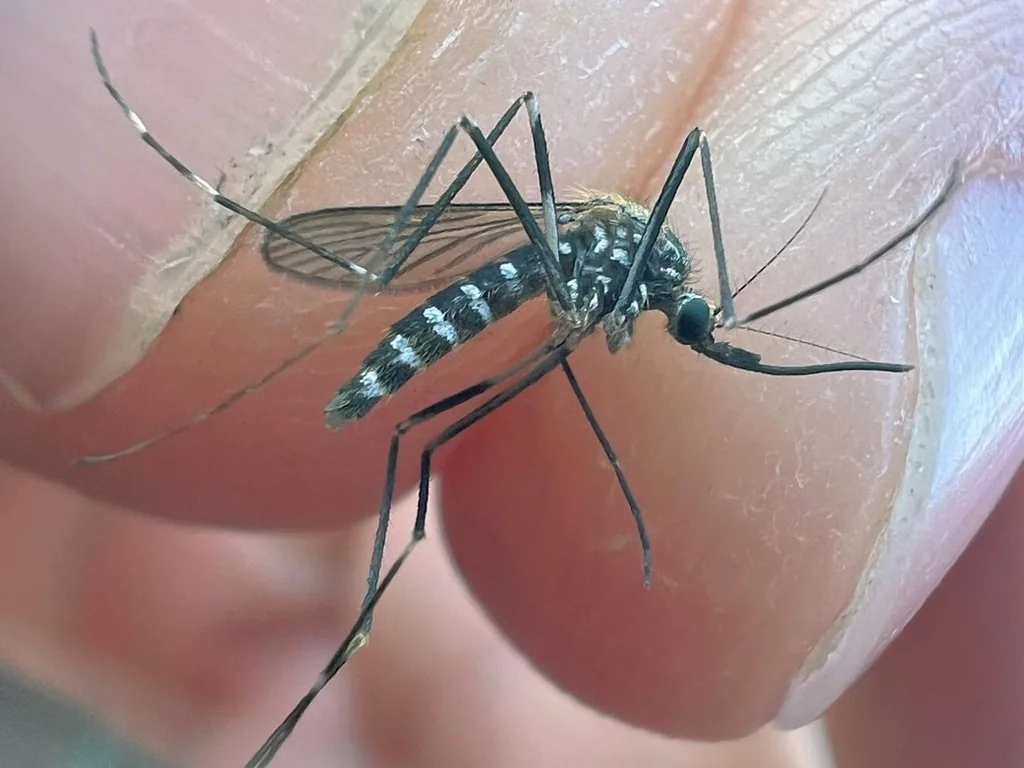
How to identify it
Look-alikes
| Look-alike | How to tell them apart |
|---|---|
| Asian tiger mosquito | Has a single silver-white line running down the middle of the thorax instead of a golden lyre pattern.[1] |
| Yellow fever mosquito | Carries a silver, not golden, lyre-shaped pattern on the top of the thorax.[1] |
Where it lives
Native to Japan, Korea, Taiwan, southern China and Russia. In the United States it is found in every state east of the Mississippi River and in parts of the Midwest, Arkansas, Oklahoma, Oregon, Washington and Hawaii, plus parts of Canada and Europe.[1]
Biology and life cycle
Females lay small black, cigar-shaped eggs just above the waterline inside containers; the eggs survive drying and freezing and can wait out the winter.[1]
Larvae grow in natural containers such as tree holes, rock pools and bamboo, and in tires, flowerpots, rain barrels, debris and concrete structures.[1][2]
It shows up earlier in the year than other Aedes; in the Northeast larvae develop from March to November and adults fly from May to November.[1]
Where container water does not stay frozen for long stretches, larvae can survive the winter.[1]
Used tires moved in international trade are the likely way it reached new countries.[1]
Damage and signs
Health risk
It is not considered an important disease carrier so far, but wild-caught mosquitoes have tested positive for West Nile and La Crosse viruses, and in the lab it can transmit several other viruses.[1]
Control
Prevention
Wear long sleeves and pants and use an EPA-registered repellent such as DEET, picaridin, IR3535, oil of lemon eucalyptus or PMD.[4][1]
Keep them out
Cover rain barrels and water storage containers tightly with lids or wire mesh, and keep window and door screens repaired.[3]
Sanitation
Empty, scrub, turn over, cover or throw out water-holding containers once a week, including buckets, planters, tires and uncovered trash cans.[3][1]
Pesticides
Where containers can't be removed, a larvicide applied to the water adds to the effect of container cleanup; this combination has reduced Asian bush mosquito numbers.[1][3]
Common questions
- How do I tell an Asian bush mosquito from an Asian tiger mosquito?
- Look at the top of the thorax: the Asian bush mosquito has golden stripes, while the Asian tiger mosquito has one silver-white stripe down the center.[1]
- Why do I see these mosquitoes so early in spring?
- This species tolerates cool temperatures better than other Aedes, so its larvae develop earlier in the year and its eggs survive freezing winters.[1]
Sources
- University of Florida IFAS Extension (EDIS), “Asian Bush Mosquito, Asian Rock Pool Mosquito, Aedes japonicus japonicus (Theobald, 1901) (IN1307).” edis.ifas.ufl.edu/publication/IN1307 (accessed 2026-10-06)
- Purdue University Extension Entomology, “Mosquitoes (Public Health Entomology: Insects and Ticks).” extension.entm.purdue.edu/publichealth/insects/mosquito.html (accessed 2026-10-06)
- U.S. Centers for Disease Control and Prevention, “Mosquito Control at Home (reviewed April 16, 2024).” www.cdc.gov/mosquitoes/mosquito-control/mosquito-control-at-home.html (accessed 2026-10-06)
- U.S. Centers for Disease Control and Prevention, “Preventing Mosquito Bites.” www.cdc.gov/mosquitoes/prevention/index.html (accessed 2026-10-06)
- iNaturalist, “Aedes japonicus taxon page (order and family).” www.inaturalist.org/taxa/1112094 (accessed 2026-10-06)