On this page
How to identify it
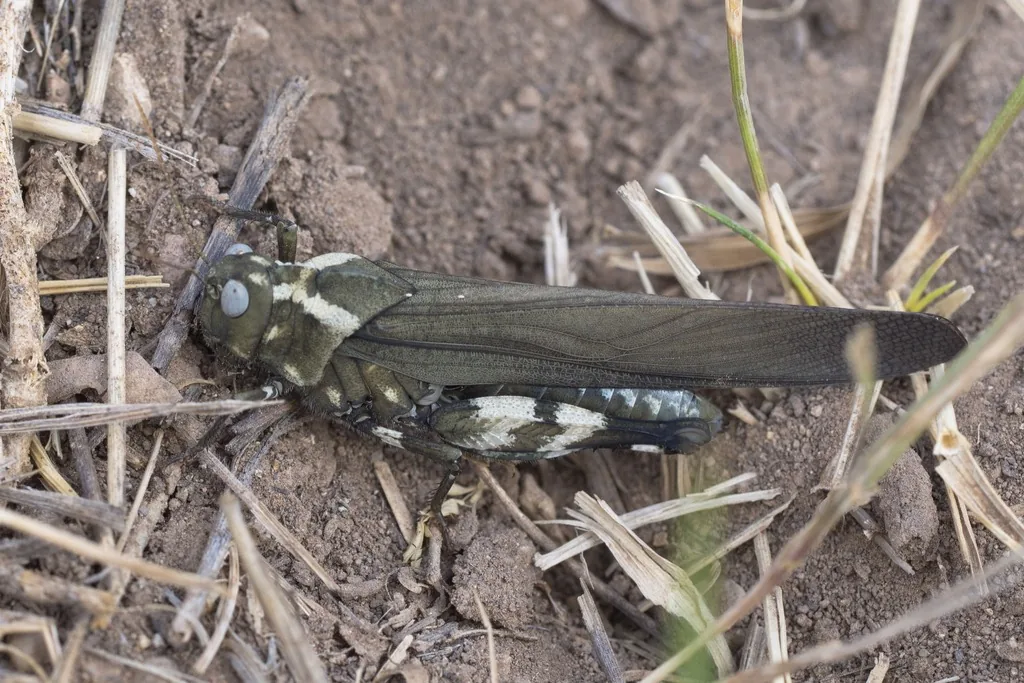
- Adults are about 1 1/2 to 2 inches long and gray-brown, well camouflaged on bare soil.[1]
- Outspread hind wings are black with a pale yellow border, resembling a mourning cloak butterfly; the shield behind the head is ridged lengthwise.[1][2]
- Flight makes a crackling, buzzing or ticking sound, and males hover 4 to 6 feet up in short display flights.[1][2]
Look-alikes
| Look-alike | How to tell them apart |
|---|---|
| Mourning cloak butterfly | In flight its black, yellow-bordered hind wings look like a mourning cloak.[2] |
Where it lives
One of North America's most widely distributed insects, found in every continental U.S. state and southern Canada.[1]
Biology and life cycle
Most often flushed in late summer and fall from plowed fields, dirt roads and other sparsely vegetated ground.[1]
Damage and signs
- It occasionally reaches damaging numbers elsewhere but rarely in the Southeast, where high rainfall keeps grasshopper outbreaks uncommon.[1]
Health risk
Control
Prevention
Control is rarely needed in the Southeast.[1]
Common questions
- What is the grasshopper that looks like a butterfly when it flies?
- Likely a Carolina grasshopper, with black, yellow-edged hind wings.[1][2]
- Why does it make a crackling sound?
- Band-winged grasshoppers like this one crackle or buzz as they fly.[2]
- Is it a crop pest?
- Only occasionally, and rarely in the Southeast.[1]
Sources
- Mississippi State University Extension (Bug's Eye View), “Carolina Grasshopper, Vol. 2, No. 31.” extension.msstate.edu/newsletters/bugs-eye-view/2016/carolina-grasshopper-vol-2-no-31 (accessed 2026-10-15)
- Missouri Department of Conservation, “Carolina Grasshopper (Field Guide).” mdc.mo.gov/discover-nature/field-guide/carolina-grasshopper (accessed 2026-10-15)
- iNaturalist, “Dissosteira carolina taxon page (order and family).” www.inaturalist.org/taxa/126206 (accessed 2026-10-06)