On this page
How to identify it
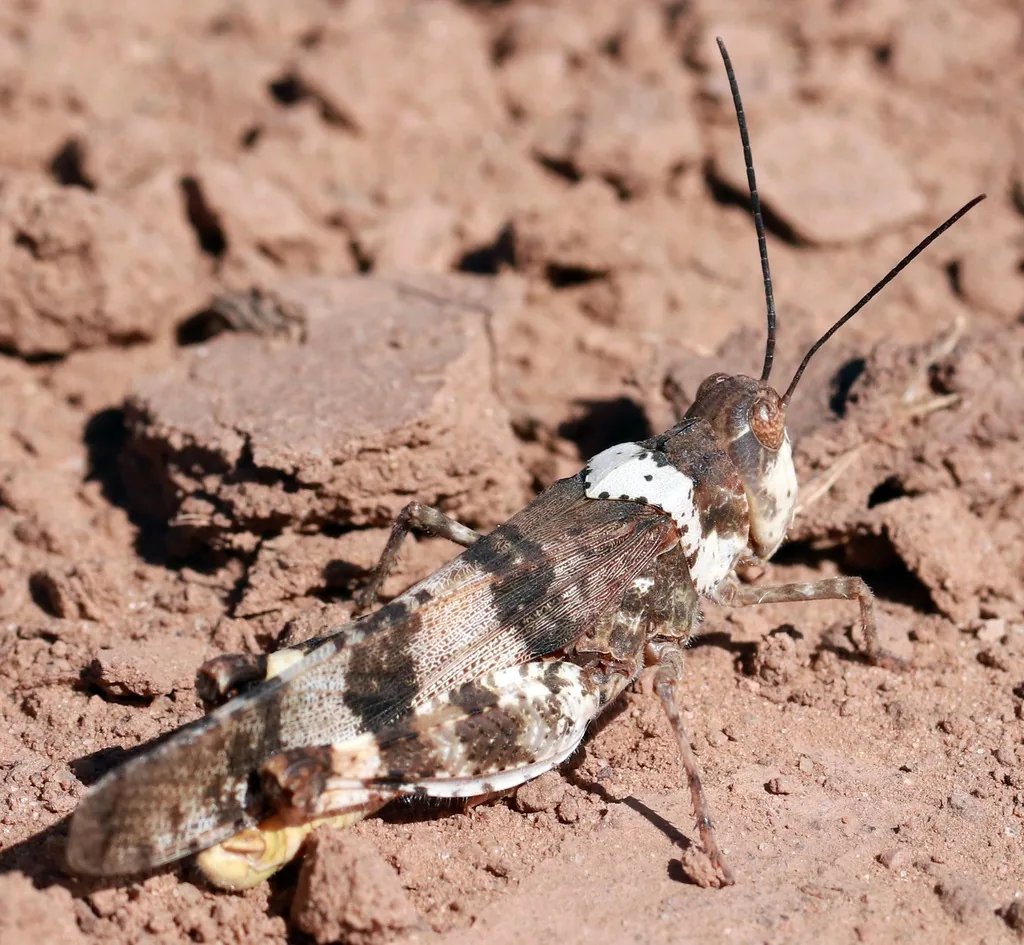
- A relatively large band-winged grasshopper, tan to medium brown mottled with darker brown. Males are 23 to 30 mm long and females 30 to 42 mm.[1][2]
- The forewings are crossed by three dark bands, the outermost sometimes faint. The hind wings are pale yellow with a broad dark band across the middle.[1][2]
- The hind shins are orange, and the inner face of the hind thigh is orange crossed by two or three dark bands.[1][2]
- The crest along the top of the pronotum is low and is notched by a single groove in front of the middle (occasionally two).[1][2]
Look-alikes
| Look-alike | How to tell them apart |
|---|---|
| Campestral grasshopper (Spharagemon campestris) | Very similar, with the same orange shins and banded inner thighs. Look at the top of the pronotum: in the campestral grasshopper the midline ridge is cut by two grooves rather than one. In Nebraska the campestral grasshopper is found in the Panhandle on barren, eroded or rocky shortgrass sites.[2] |
Where it lives
Widely distributed in grasslands of the western United States and Canada: tallgrass, mixedgrass, shortgrass, bunchgrass and desert prairie and Great Basin shrub-grass. In Nebraska it is found mainly in the western half, with local populations in the east on heavy soils with sparse vegetation.[1][2]
Biology and life cycle
It eats a broad mix of grasses, sedges and forbs. Diets vary by place: blue grama in western Nebraska, milkvetch in northern Colorado, and no clear favorite among 27 plants eaten in North Dakota sand prairie. Caged adults preferred dandelion, blue grama, needleandthread and downy brome; old reports that it prefers mustards have not been confirmed.[1][2]
In eastern Wyoming eggs hatch between late May and mid-June, two to three weeks after the bigheaded grasshopper, and hatching is over in 7 to 11 days. Nymphs take 49 to 64 days, about 55 on average, to pass through five stages.[1]
Adults appear from mid-July to early August and are most common in August and September, lasting into early October in mild falls. Females begin laying three to four weeks after becoming adults, in patches of bare soil that range from a few square inches to cattle trails; each pod holds 24 to 26 eggs.[1][2]
It is a strong flier with wings that extend well past the abdomen. Flushed adults fly 3 to 60 feet, usually crackling as they go. Strays have turned up on downtown sidewalks in Billings, Montana, and at lights at night in Boise, Idaho, but migrating swarms have not been seen.[1]
Damage and signs
- It is a minor member of rangeland grasshopper communities, usually at 0.1 to 0.3 young adults per square yard, and its feeding is of little economic importance. When other species reach outbreak numbers, it may climb to about two per square yard.[1][2]
- There are exceptions: in 1921 it and another band-winged grasshopper, Metator nevadensis, did considerable damage to cattle range on British Columbia bunchgrass prairie.[1]
Health risk
It is a plant-feeding grasshopper, and the sources mention no health concerns for people.[1][2]
Control
Prevention
Treatment aimed at this species is rarely justified given its usual low numbers. Weigh the forage value of the range against expected grasshopper losses before deciding on any control.[1][3]
Biological control
Its numbers rise and fall with the same factors that drive other rangeland grasshoppers, and predators, parasites and diseases take a share every year.[1][3]
Common questions
- What is the big grasshopper with orange legs that crackles when it flies?
- In western grassland it is often the orange-legged grasshopper, which flashes yellow, dark-banded hind wings and usually crackles in flight.[1][2]
- Will orange-legged grasshoppers eat garden mustards and weeds?
- Caged adults did eat tumble mustard, kochia and lambsquarters, but not by preference, and early claims that the species favors mustards have not held up.[1]
Sources
- USDA Agricultural Research Service, Northern Plains Agricultural Research Laboratory, “Orangelegged Grasshopper, Spharagemon equale (Say): species fact sheet, Grasshoppers: Their Biology, Identification and Management.” www.ars.usda.gov/plains-area/sidney-mt/northern-plains-agricultural-research-laboratory/pest-management-research/pmru-docs/grasshoppers-their-biology-identification-and-management/id-tools-apps/fact-sheets/oedipodinae-subfamily/fs-orangelegged/ (accessed 2026-11-09)
- University of Nebraska-Lincoln Extension, “The Grasshoppers (Orthoptera: Acrididae and Romaleidae) of Nebraska, EB3 (M. L. Brust, W. W. Hoback and R. J. Wright).” extensionpubs.unl.edu/publication/eb3/2009/pdf/view/eb3-2009.pdf (accessed 2026-11-09)
- Utah State University Extension, “Grasshoppers (E. Evans and E. Hodgson, June 2008).” extension.usu.edu/planthealth/research/grasshoppers (accessed 2026-11-09)
- iNaturalist, “Spharagemon equale taxon page (order and family).” www.inaturalist.org/taxa/231354 (accessed 2026-11-09)