On this page
How to identify it
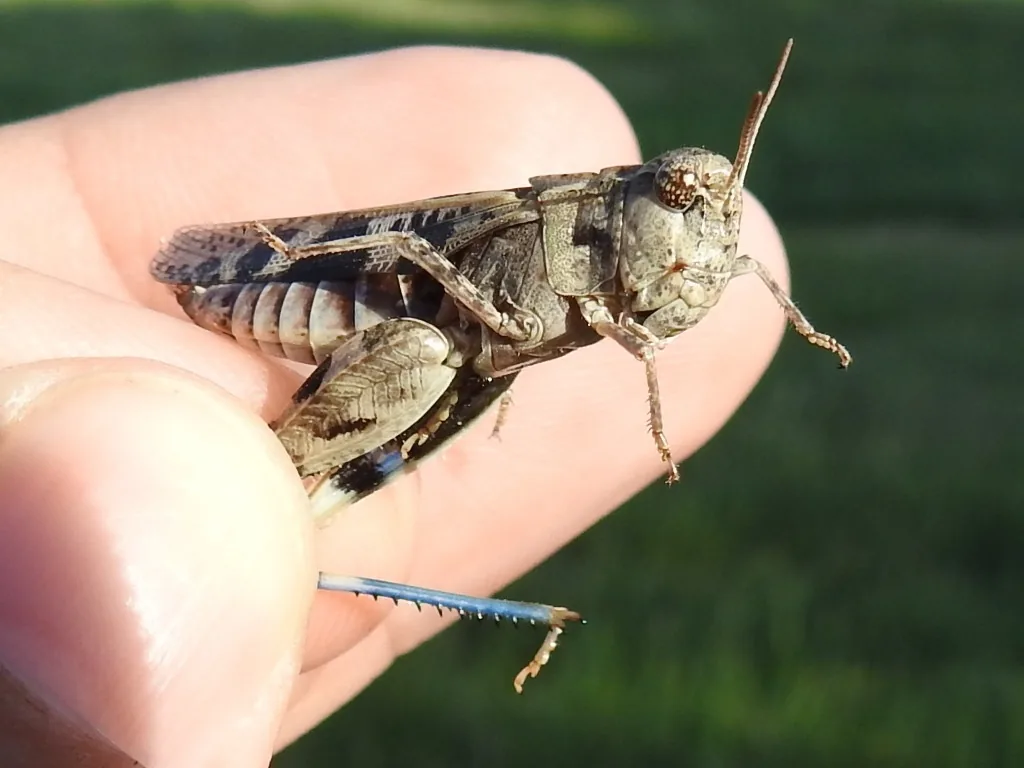
- A medium-sized band-winged grasshopper, dark brown or grayish brown and occasionally greenish, with faint darker bands on the forewings and the hind thighs. Females are much heavier than males; males are 17 to 22 mm long and females 23 to 28 mm.[1][2]
- The wings are long, reaching 1 to 4 mm past the tip of the abdomen. The hind wings are nearly clear with a greenish tint and a hazy dark area near the outer edge.[1][2]
- The hind shins are blue with a whitish ring near the base, and the knee is dark.[1][2]
- Young nymphs are usually green. Their antennae are slightly clubbed, and the front and middle legs have four lengthwise ridges, usually with black lines between them.[1]
Look-alikes
| Look-alike | How to tell them apart |
|---|---|
| Green-striped grasshopper nymphs (Chortophaga viridifasciata) | Young nymphs of both are green and similar in build. Green-striped nymphs have flattened, sword-shaped antennae instead of slightly clubbed ones, only two clear ridges on the front and middle legs with no black lines, and an all-green hind thigh in the first stage, where the dusky grasshopper's is pink toward the tip. Older green-striped nymphs have a steep, roof-shaped crest on the pronotum.[1] |
| Encoptolophus sordidus | A close relative that replaces the dusky grasshopper in the eastern third of Nebraska and lives in weedy fields, overgrown pastures and woodland edges rather than rangeland. Its hind shins are black to dark brown rather than blue, and the dark area of its hind wing covers nearly the outer half. University of Nebraska-Lincoln's guide uses the name dusky grasshopper for this eastern species, so check the scientific name when reading about either.[2] |
Where it lives
Western North America from Canada to Mexico, in mixed-grass, shortgrass, bunchgrass and desert prairie. It is most abundant in the northern mixed-grass prairie and dominates some Saskatchewan rangeland. It has been recorded throughout Nebraska and is most numerous in the Panhandle and central loess plains.[1][2]
Biology and life cycle
Western wheatgrass and needleleaf sedge are its main foods, along with other wheatgrasses, needlegrasses, blue grama and a range of other grasses. In an alfalfa field or along a roadside it will eat forbs, and it has been seen nibbling dry plant litter and dry cow dung.[1][2]
It spends almost all its time on the ground. After sunrise it basks on bare soil, side turned to the sun, then walks, feeds and mates through the middle of the day, and shelters in shade or perches just off the hot ground when the soil surface tops about 125°F.[1]
On the northern plains eggs begin hatching in early to mid-June and keep hatching for six to eight weeks. Nymphs take 56 to 66 days and five molts to mature, and adults appear in early to mid-August and are common into early October. In northeastern Texas it has at least two generations a year.[1][2]
Females lay in bare ground among the grasses, starting as soon as about two weeks after reaching adulthood. Each slightly curved pod is about three-quarters of an inch long and holds 14 to 20 eggs.[1]
It is a strong flier. Flushed adults buzz and crackle softly over 3 to 9 feet, and in fall adults have moved from depleted rangeland into winter wheat and landed in downtown Cheyenne, Wyoming, in a mixed swarm.[1][2]
Damage and signs
- It usually does little damage by itself. Even where it made up about three-quarters of the grasshoppers on a Saskatchewan prairie, the population ate only 1.5 to 2.4 percent of the year's grass production with no visible damage, and Nebraska's guide rates its economic importance as none.[1][2]
- It has been reported as a minor pest of alfalfa in Arizona and North Dakota and as a pest of fall wheat in Nebraska after adults moved in from depleted rangeland.[1]
Health risk
It is a grass-feeding grasshopper, and the sources describe no health concerns for people.[1][2]
Control
Prevention
Control aimed at this species is rarely needed. Females need bare ground to lay eggs, and in one Saskatchewan study the population dropped after several years of heavy plant growth shaded the soil, then moved into a burned patch with plenty of bare ground.[1]
Biological control
Predators, parasites and diseases help keep grasshopper numbers down every year; weigh the forage value of rangeland against expected losses before treating any grasshopper population.[3]
Common questions
- What is the dark grasshopper with blue legs that buzzes when it flies?
- On western prairie it is often the dusky grasshopper. Its hind shins are blue, and members of its genus fly with a distinctive buzzing sound.[1][2]
- Why did grasshoppers show up in my winter wheat in the fall?
- Dusky grasshoppers and other species can fly in from nearby depleted rangeland, as recorded in western Nebraska and southeastern Wyoming.[1]
Sources
- USDA Agricultural Research Service, Northern Plains Agricultural Research Laboratory, “Dusky Grasshopper, Encoptolophus costalis (Scudder): species fact sheet, Grasshoppers: Their Biology, Identification and Management.” www.ars.usda.gov/plains-area/sidney-mt/northern-plains-agricultural-research-laboratory/pest-management-research/pmru-docs/grasshoppers-their-biology-identification-and-management/id-tools-apps/fact-sheets/oedipodinae-subfamily/fs-dusky/ (accessed 2026-11-09)
- University of Nebraska-Lincoln Extension, “The Grasshoppers (Orthoptera: Acrididae and Romaleidae) of Nebraska, EB3 (M. L. Brust, W. W. Hoback and R. J. Wright).” extensionpubs.unl.edu/publication/eb3/2009/pdf/view/eb3-2009.pdf (accessed 2026-11-09)
- Utah State University Extension, “Grasshoppers (E. Evans and E. Hodgson, June 2008).” extension.usu.edu/planthealth/research/grasshoppers (accessed 2026-11-09)
- iNaturalist, “Encoptolophus costalis taxon page (order and family).” www.inaturalist.org/taxa/179301 (accessed 2026-11-09)