On this page
How to identify it
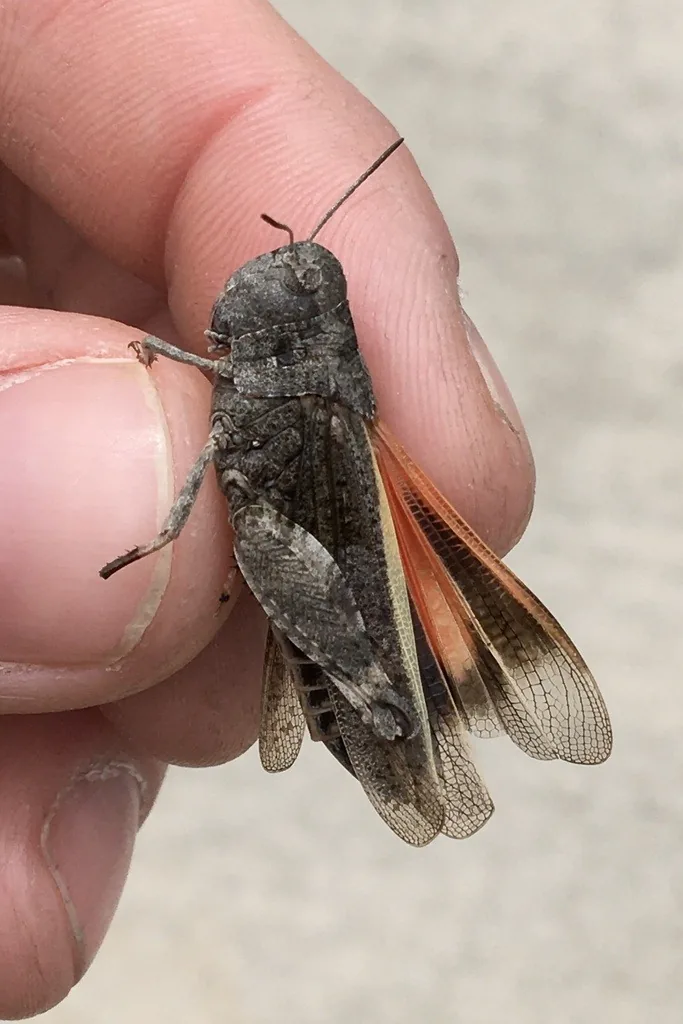
- A large band-winged grasshopper in which the female is much bigger than the male: in Nebraska, males are 19 to 22 mm long and females 28 to 37 mm.[2][1]
- The body is dark to light brown or gray-brown, with a yellow abdomen, and the brown forewings are speckled with dark brown. Folded, the forewings often show a pale tan or yellow stripe down the middle of the back.[1][2]
- The hind wings are usually red or pinkish red with a broad dark band, but some populations are yellow- or orange-winged, including high-elevation ones in the Nebraska panhandle and in central Colorado.[1][2]
- The ridge along the top of the pronotum is low. The hind tibiae are pale yellowish green to pale blue with a dark ring at each end, though often dark brown in eastern Nebraska.[1][2]
Look-alikes
| Look-alike | How to tell them apart |
|---|---|
| Red-winged grasshopper (Arphia pseudonietana) | Equally widespread in the West and also red-winged, with scarlet hind wings and a broad black band, but its adults are out in late summer and fall rather than spring, and its hind tibiae are dark brown to nearly black with a pale ring near the base.[1][2] |
Where it lives
A western North American species that ranges from Alaska to Mexico. It lives in all the grassland prairies, reaches into desert shrublands wherever grasses grow, and has been found in mountain meadows up to 11,000 feet in Colorado and Idaho. In Nebraska it occurs statewide in suitable habitat.[1][2]
Biology and life cycle
It eats mainly grasses and sedges: 16 grasses and three sedges have been found in its crop, with the mix depending on what grows locally. Kentucky bluegrass made up half its diet in a North Dakota sand prairie and prairie junegrass two-thirds in central Nebraska. It also eats small amounts of broadleaf plants (forbs), fungi and arthropods.[1]
It feeds mostly on the ground, eating dry grass litter, leaves lying on the ground and leaves it cuts itself: it rears up on its hind legs and clips a standing leaf about half an inch to an inch above the base.[1]
It hatches late. Nymphs appear from mid-July in eastern Wyoming and eastern Colorado, grow quickly and spend the winter mostly as fifth-stage nymphs, which can survive freezing to as low as -16 degrees C (about 3 degrees F). They become adults in early spring: in April on the plains of eastern Wyoming, but not until July in Colorado's high mountains.[1]
In Nebraska, adults are most common from mid-April to mid-June, and they can appear as early as late March in an unusually warm spring.[2]
Depending on climate, the life cycle takes one year or two; studies in central Saskatchewan and the Colorado mountains point to two years.[1]
It flies strongly, with wings longer than the abdomen in both sexes. Males make short display flights with a crackling sound from the wings, called crepitation, and both sexes crackle during sinuous escape flights of 4 to 45 feet, often landing and turning to face the intruder.[1]
Females bore more than 2 inches into bare ground to lay a pod of 20 to 21 eggs, then pull debris over the hole and tamp it down.[1]
In Nebraska it lives in grasslands from tallgrass to shortgrass prairie, favoring spots with exposed bare soil, and is most common on heavier soils such as clay or loess.[2]
Damage and signs
Health risk
It is a grass-feeding grasshopper, and neither the ARS fact sheet nor the Nebraska guide describes any risk to people.[1][2]
Control
Prevention
No control is needed for this species. Its populations have been small everywhere they have been measured, and the University of Nebraska gives it no economic importance.[1][2]
Common questions
- How can I tell it from the red-winged grasshopper?
- Mostly by season: speckle-winged grasshopper adults are out in spring, while red-winged grasshopper adults appear in late summer and fall. The red-winged grasshopper's hind tibiae are also dark brown to nearly black.[1][2]
- Why does it crackle when it flies?
- The crackling, called crepitation, is made by the wings. Males crackle in short display flights, and both sexes crackle during escape flights. Exactly how the wings make the sound is still debated.[1]
- Does it hurt pasture or rangeland?
- Very little. It does eat forage grasses, but its populations stay low, so its impact on grazing land is minimal.[1]
Sources
- USDA Agricultural Research Service, Northern Plains Agricultural Research Laboratory, “Specklewinged Grasshopper, Arphia conspersa Scudder: species fact sheet (Wyoming Agricultural Experiment Station Bulletin 912, September 1994), Grasshoppers: Their Biology, Identification and Management.” www.ars.usda.gov/plains-area/sidney-mt/northern-plains-agricultural-research-laboratory/pest-management-research/pmru-docs/grasshoppers-their-biology-identification-and-management/id-tools-apps/fact-sheets/oedipodinae-subfamily/fs-specklewinged/ (accessed 2026-11-09)
- University of Nebraska-Lincoln Extension, “The Grasshoppers (Orthoptera: Acrididae and Romaleidae) of Nebraska, EB3 (M. L. Brust, W. W. Hoback and R. J. Wright).” extensionpubs.unl.edu/publication/eb3/2009/pdf/view/eb3-2009.pdf (accessed 2026-11-09)
- iNaturalist, “Arphia conspersa taxon page (order and family).” www.inaturalist.org/taxa/155257 (accessed 2026-11-09)