On this page
How to identify it
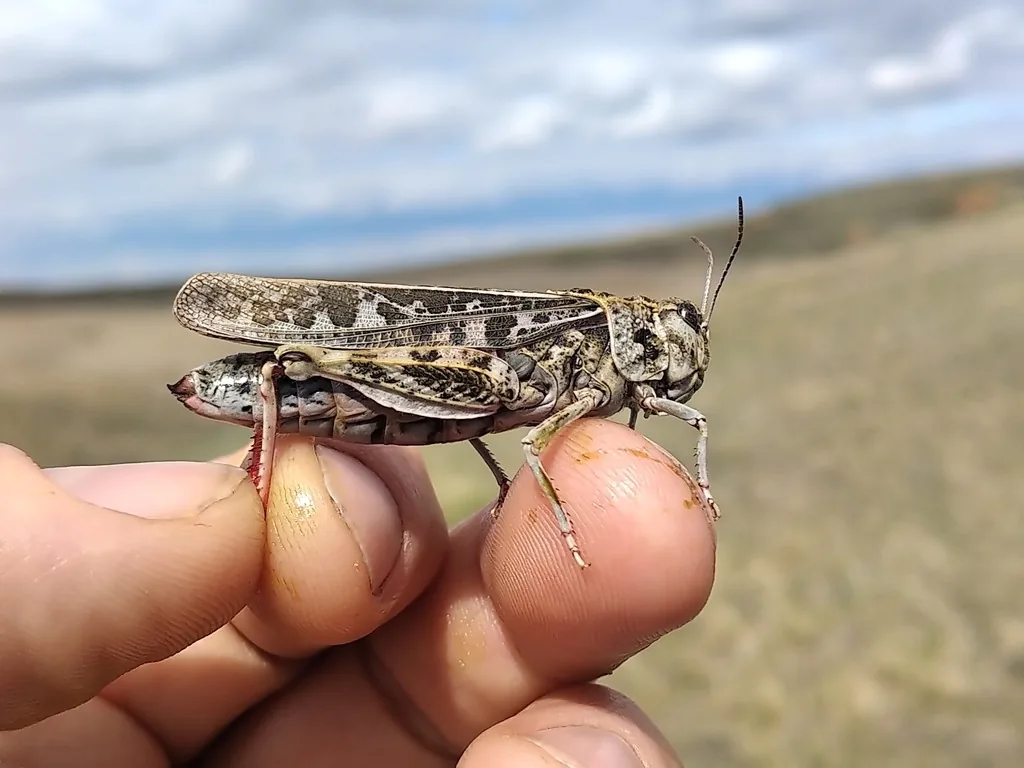
- A large, gray-brown grasshopper. Males are 25 to 33 mm long and females 35 to 44 mm.[2][1]
- The forewings carry clearly outlined dark brown spots, the feature ARS calls diagnostic. The top of the thorax (pronotum) is heavily bumpy and wrinkled, with a low midline ridge notched twice in front of the middle.[1][2]
- In flight it shows yellow hind wings crossed by a dark band, and it crackles loudly as it flies.[1][2]
- The outer face of the hind thigh has three slanting dark brown bands. The inner face is solid red (ARS notes that some are deep blue), and the hind shins are red, or yellow on the outside and red on the inside.[1][2]
- Nymphs are brown or gray with many dark spots. Nymphs that grow up on red soil turn red and lose most of their markings.[1]
Look-alikes
| Look-alike | How to tell them apart |
|---|---|
| Xanthippus montanus | A close relative of sandy blowouts and dunes. It is light brown with fewer forewing spots, and the red inner hind thigh has at least some blackish color.[2] |
| Pardalophora haldemani | The Nebraska guide warns the two are easily confused. The sculpturing of the pronotum is the most reliable difference; the color of the inner hind thigh separates them most of the time, but not always.[2] |
Where it lives
Ranges widely in western North America, in grasslands and grass-shrub country, and also in clearings in mountain forests and open ground above timberline. In Nebraska it is found across the western half of the state and is most common at the higher elevations of the Panhandle.[1][2]
Biology and life cycle
Northern populations take two years to complete a generation, while southern populations take one. In the south, eggs hatch in midsummer: from mid-July in western North Dakota, the last week of July in northeastern Colorado and mid-August in eastern Wyoming, with hatching spread over about four weeks.[1]
Nymphs grow through late summer and fall and pass the winter as large nymphs, sheltering under litter or in small dips in the soil. They become active again in March and reach adulthood in April and May. Adults are most common from April to June.[1][2]
It eats almost nothing but grasses and sedges. In spring it feeds on cool-season plants such as western wheatgrass, needleandthread, junegrass, needleleaf sedge and downy brome, then shifts to blue grama as that grass greens up.[1][2]
Males court by chirping: they rub a ridge on the inside of the hind thigh against a row of small bumps on a forewing vein, and may raise the hind legs to show the bright inner faces.[1]
Females lay eggs in bare soil, 2 to 3 inches deep. Each pod is about 2 3/4 inches long and holds around 32 eggs.[1]
Damage and signs
- Most years the adults are scattered, at less than 0.1 to 0.2 per square yard, and they feed in spring while grasses still have plenty of moisture, so most populations do no measurable damage to forage.[1]
- Populations occasionally explode. In western Utah in 1989, 18 to 20 adults per square yard damaged range grasses and planted crested wheatgrass, in places eating everything green to the ground. The outbreak carried into the next year, when adults flew from drought-stricken grassland into alfalfa fields.[1][2]
Health risk
The sources treat it purely as a grass- and sedge-feeding rangeland grasshopper and mention no harm to people or animals.[1][2]
Control
Prevention
At the low numbers usual for this species, spring feeding does no measurable damage, so no treatment is called for. Weigh the value of the forage against likely losses before spending money on control.[1][3]
Scout rangeland for local hot spots where grasshoppers concentrate, so a rare outbreak like Utah's is caught early.[3][1]
Pesticides
If an outbreak does need treatment, area-wide programs generally work better than spot treatments because grasshoppers move so readily. Follow label directions for any product.[3]
Common questions
- Why are big grasshoppers flying in April and May, before others have hatched?
- In grassland country these are often red-shanked grasshoppers. They spend the winter as nearly grown nymphs and become adults in April and May, so they are flying while most other grasshoppers are still eggs.[1][2]
- Is the red-shanked grasshopper a serious range pest?
- Usually not. It is normally present at very low numbers, but outbreaks do happen, as in western Utah in 1989 and 1990 when it stripped rangeland and moved into alfalfa.[1]
Sources
- USDA Agricultural Research Service, Northern Plains Agricultural Research Laboratory, “Redshanked Grasshopper, Xanthippus corallipes (Haldeman): species fact sheet, Grasshoppers: Their Biology, Identification and Management.” www.ars.usda.gov/plains-area/sidney-mt/northern-plains-agricultural-research-laboratory/pest-management-research/pmru-docs/grasshoppers-their-biology-identification-and-management/id-tools-apps/fact-sheets/oedipodinae-subfamily/fs-redshanked/ (accessed 2026-11-09)
- University of Nebraska-Lincoln Extension, “The Grasshoppers (Orthoptera: Acrididae and Romaleidae) of Nebraska, EB3 (M. L. Brust, W. W. Hoback and R. J. Wright).” extensionpubs.unl.edu/publication/eb3/2009/pdf/view/eb3-2009.pdf (accessed 2026-11-09)
- Utah State University Extension, “Grasshoppers (E. Evans and E. Hodgson, June 2008).” extension.usu.edu/planthealth/research/grasshoppers (accessed 2026-11-09)
- iNaturalist, “Xanthippus corallipes taxon page (order and family).” www.inaturalist.org/taxa/233680 (accessed 2026-11-09)