On this page
How to identify it
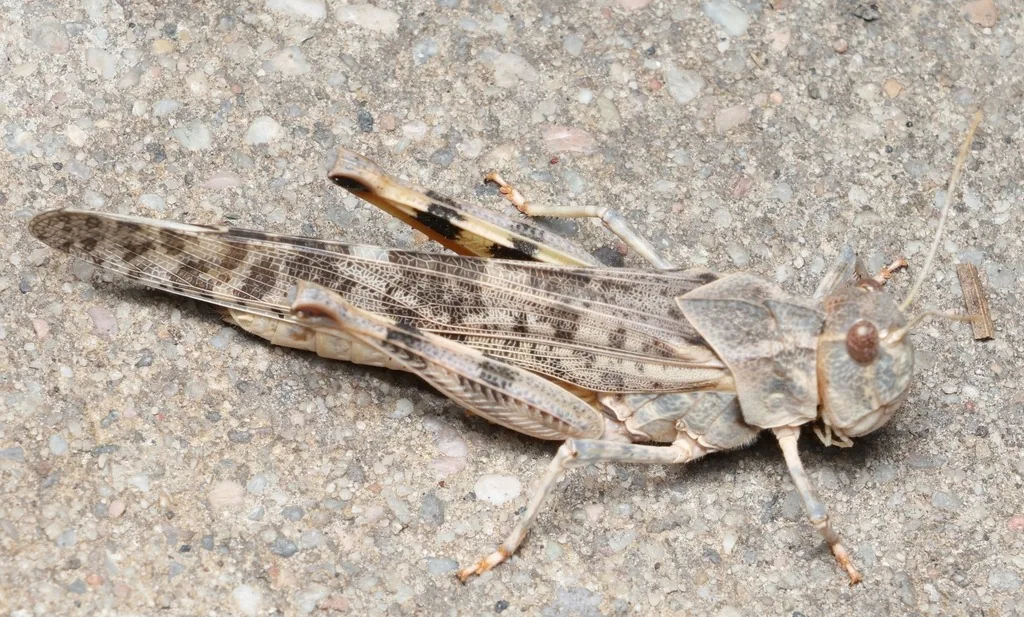
- A very large grasshopper: males are 38 to 50 mm long and females 46 to 62 mm. The wingspan is about 2 1/2 to 3 3/8 inches in males and 3 1/4 to 4 inches in females.[1][2]
- The hind wings are mostly black, with a clear or whitish outer edge covering at least the outer third and a bluish area near the base.[1][2]
- The forewings are pale tan with many large brown spots, and the body is light brown mottled with darker brown.[1][2]
- The ridge on top of the pronotum is raised into a notably high crest that is deeply notched once. The hind shins are golden or pale yellow, and the inner face of the hind thigh is yellow with two large dark marks.[1][2]
- Nymphs are tan with round brown spots and already show the high pronotal crest; older nymphs also have golden hind shins.[1]
Look-alikes
| Look-alike | How to tell them apart |
|---|---|
| Carolina grasshopper (Dissosteira carolina) | A smaller relative (males 26 to 33 mm, females 33 to 44 mm) of roadsides, lawns, parking lots and gardens. Its hind wing is mostly black with the pale edge limited to the outer third or quarter, without the High Plains grasshopper's bluish base.[2] |
Where it lives
Shortgrass prairie of the western Great Plains, where blue grama and buffalograss dominate. It breeds in limited areas of Colorado and New Mexico; swarming adults have reached much wider areas during outbreaks. In Nebraska it has been recorded from 11 counties, mostly in the west.[1][2]
Biology and life cycle
It eats grasses, preferring blue grama and buffalograss but feeding just as readily on sand dropseed, needleandthread and galleta. It feeds from the ground or with its front half raised onto the plant, and it wastes little, eating the green part of a leaf and dropping only dry tissue.[1][2]
Eggs hatch about two to three weeks after those of the bigheaded grasshopper; in Colorado the first hatch came on May 2 in 1939 and about May 14 in 1997. Nymphs take about 44 to 45 days and five or six molts to mature, and the first adults appear in June.[1]
Females need six to seven weeks after becoming adults before they lay. They dig into bare ground at the edges of grass clumps and lay nearly 2 inches deep, with several males often in attendance. Pods are 1 to 2 inches long and average about 65 eggs. Egg beds were concentrated in sandy loam soil during the 1930s outbreak.[1][2]
In outbreaks, nymphs hatching at up to 2,000 per square yard crawl away from the egg beds; one band in 1937 traveled 2 1/2 miles in a day. Adults then rise in swarms that fly day and night with the wind. Marked grasshoppers were recovered 17 to 175 miles away, and city lights drew swarms down to land.[1]
Outbreaks build during drought and unusually warm years. Cold, wet weather during hatching kills many young nymphs, while warm, clear weather helps them survive.[1]
Damage and signs
- During outbreaks it can completely strip the grass from its range. Nymph bands consume rangeland and any wheat, barley, corn or millet in their path, and adult swarms destroy forage and crops where they land.[1]
- The worst outbreak on record ran from 1934 to 1940. Ranchers who moved cattle to distant pastures saw those pastures eaten by arriving swarms, and many had to sell their entire herds. Nebraska's guide calls it a very important rangeland pest in the shortgrass plains of Colorado and New Mexico but only sporadic elsewhere.[1][2]
Health risk
It is a grass-feeding grasshopper, and the sources describe no health concerns for people.[1][2]
Control
Prevention
Outbreaks start from concentrated egg beds, so scouting for these hot spots, where grasshoppers gather to lay eggs, gives the best chance of acting before bands and swarms spread. Waiting until large populations have dispersed makes control far harder and costlier.[1][3]
Biological control
Predatory birds, rodents and insects took a toll during the 1930s outbreak, though many adults still survived into September.[1]
When to call a professional
Large range outbreaks are handled area-wide: USDA APHIS runs programs on public land, and owners of private rangeland with more than 8 grasshoppers per square yard over at least 10,000 contiguous acres can join a cooperative program with state and federal aid.[3]
Common questions
- What is the huge grasshopper with black wings on the shortgrass prairie?
- If it is very large, with black hind wings that have a pale outer edge and a bluish base, a high crest on the thorax and golden shins, it is likely the High Plains grasshopper.[1][2]
- Does the High Plains grasshopper swarm like a locust?
- In outbreaks, yes. Nymphs march in bands and adults fly in swarms over long distances; marked grasshoppers in 1937 were found up to 175 miles from where they were released.[1]
Sources
- USDA Agricultural Research Service, Northern Plains Agricultural Research Laboratory, “High Plains Grasshopper, Dissosteira longipennis (Thomas): species fact sheet, Grasshoppers: Their Biology, Identification and Management.” www.ars.usda.gov/plains-area/sidney-mt/northern-plains-agricultural-research-laboratory/pest-management-research/pmru-docs/grasshoppers-their-biology-identification-and-management/id-tools-apps/fact-sheets/oedipodinae-subfamily/fs-high-plains/ (accessed 2026-11-09)
- University of Nebraska-Lincoln Extension, “The Grasshoppers (Orthoptera: Acrididae and Romaleidae) of Nebraska, EB3 (M. L. Brust, W. W. Hoback and R. J. Wright).” extensionpubs.unl.edu/publication/eb3/2009/pdf/view/eb3-2009.pdf (accessed 2026-11-09)
- Utah State University Extension, “Grasshoppers (E. Evans and E. Hodgson, June 2008).” extension.usu.edu/planthealth/research/grasshoppers (accessed 2026-11-09)
- iNaturalist, “Dissosteira longipennis taxon page (order and family).” www.inaturalist.org/taxa/218608 (accessed 2026-11-09)