On this page
How to identify it
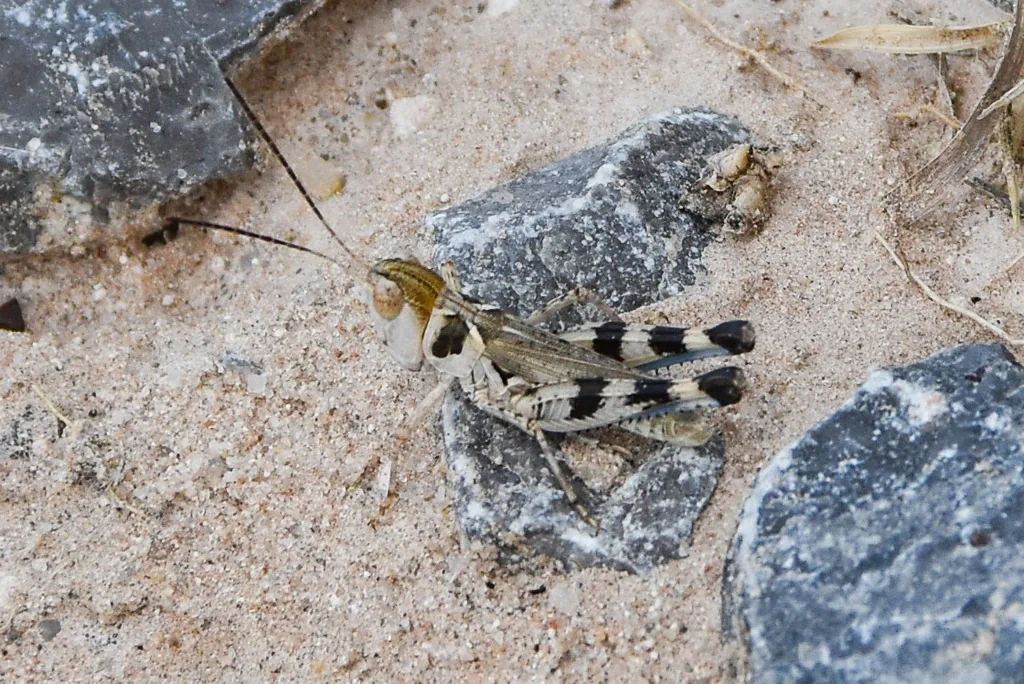
- Gray-brown with a noticeably large head. Light lines cross the dark top of the pronotum in an X, and the side of the pronotum usually has a prominent blackish patch.[1][2]
- The hind thigh is cream with distinct blackish cross bands, three in the ARS description, and the hind shins are blue. The abdomen is largely yellowish and the hind wings are clear.[1][2]
- Wings are short. In males the forewings never reach the tip of the abdomen; in females wing length varies. Males are 13 to 17 mm long and females 20 to 26 mm.[1][2]
- Most individuals have a short dark vertical streak on the side of the head just below the eye.[1]
- Nymphs are light tan or cream with sharply contrasting dark markings, and the X on the pronotum becomes visible in the last two nymphal stages. Their hind shins turn light blue from the third stage on.[1]
Look-alikes
| Look-alike | How to tell them apart |
|---|---|
| Bigheaded grasshopper (Aulocara elliotti) | Very similar, and females can be hard to tell apart. The rear edge of the white-crossed female's eighth underside plate on the abdomen has two deep clefts, which the bigheaded female lacks, and bigheaded nymphs are a drab gray with less contrasting markings.[1][2] |
Where it lives
Western grasslands, mostly mixed-grass prairie where the mid grasses western wheatgrass and needleandthread grow among blue grama, and also bunchgrass, shortgrass and desert prairie. Its range covers only about 60 percent of the bigheaded grasshopper's. In Nebraska it occurs in the panhandle and the southwestern corner of the state.[1][2]
Biology and life cycle
It feeds on many range grasses and sedges. At one eastern Wyoming site it had eaten all eight perennial grasses and sedges present, mostly western wheatgrass and needleleaf sedge, but not dried-out annual grasses such as downy brome. In southwest Texas desert prairie it ate mainly buffalograss and blue grama.[1][2]
Males and females eat differently. Males walk the ground looking for females and eat more short grass and sedge, while the more settled females climb nearby mid grasses to feed. A feeding grasshopper turns head down on a leaf and eats along one edge toward the base, leaving a narrow strip standing.[1]
Eggs hatch 10 to 14 days after those of the bigheaded grasshopper, normally starting in the first week of June in Montana and Wyoming, partly because the eggs lie deeper in the soil. Males go through four nymphal stages in at least 30 days, and females through five in at least 42 days. Adults appear in the first half of July.[1][2]
Females lay in a small bare spot ringed by blue grama or other short grass. The pod stands upright in the top three-quarters inch of soil, has unusually thick, strong walls, and holds 9 to 11 pale yellow eggs. It overwinters as eggs, probably with one generation a year.[1]
It lives on the ground and spends the night on small bare patches between grass clumps. As the soil heats up during the day it stands tall on its legs, then climbs onto short grass or up mid-grass stems 2 to 7 inches to get off the hot surface. Despite its short wings it flies 2 to 6 feet when flushed.[1]
Damage and signs
- Because it eats valuable forage grasses and can build to high numbers in some mixed-grass habitats, it is occasionally an important pest, at up to 13 adults per square yard where it dominates. It does less harm than the bigheaded grasshopper because it is smaller, less common, usually less dense, and clips little grass.[1]
- It turns up at far fewer sites than its cousin. A 1991 survey of Wyoming mixed-grass prairie found it at 4 of 419 sites, against 47 for the bigheaded grasshopper, and it is more common in Montana. Populations can jump from low to high numbers in one year and drop just as fast the next. High densities in Nebraska are local.[1][2]
Health risk
It eats range grasses and sedges, and the sources record no risk to people.[1][2]
Control
Prevention
Weigh the condition and forage value of the range against the damage grasshoppers are likely to cause before deciding that control is worth the cost.[3]
Pesticides
White-crossed grasshoppers feed on bran bait. Utah State's guide describes carbaryl bait, wheat bran laced with carbaryl, as a good alternative to spraying in pastures, fence rows and roadsides, because it kills only insects that eat it. Follow the label.[1][3]
Common questions
- How do I tell a white-crossed grasshopper from a bigheaded grasshopper?
- Look for the pale X on top of the pronotum and the blackish patch on its side. Females are the hardest to separate; the white-crossed female has two deep clefts on the rear edge of the eighth plate under the abdomen.[1][2]
- Can a white-crossed grasshopper fly?
- Yes. Its wings are short, but it flies 2 to 6 feet when disturbed, and one was found about 10 miles from the nearest known population at a mountain site near Boulder, Colorado.[1]
Sources
- USDA Agricultural Research Service, Northern Plains Agricultural Research Laboratory, “Whitecrossed Grasshopper, Aulocara femoratum Scudder: species fact sheet, Grasshoppers: Their Biology, Identification and Management.” www.ars.usda.gov/plains-area/sidney-mt/northern-plains-agricultural-research-laboratory/pest-management-research/pmru-docs/grasshoppers-their-biology-identification-and-management/id-tools-apps/fact-sheets/gomphocerinae-subfamily/fs-whitecrossed/ (accessed 2026-11-09)
- University of Nebraska-Lincoln Extension, “The Grasshoppers (Orthoptera: Acrididae and Romaleidae) of Nebraska, EB3 (M. L. Brust, W. W. Hoback and R. J. Wright).” extensionpubs.unl.edu/publication/eb3/2009/pdf/view/eb3-2009.pdf (accessed 2026-11-09)
- Utah State University Extension, “Grasshoppers (E. Evans and E. Hodgson, June 2008).” extension.usu.edu/planthealth/research/grasshoppers (accessed 2026-11-09)
- iNaturalist, “Aulocara femoratum taxon page (order and family).” www.inaturalist.org/taxa/214639 (accessed 2026-11-09)