On this page
How to identify it
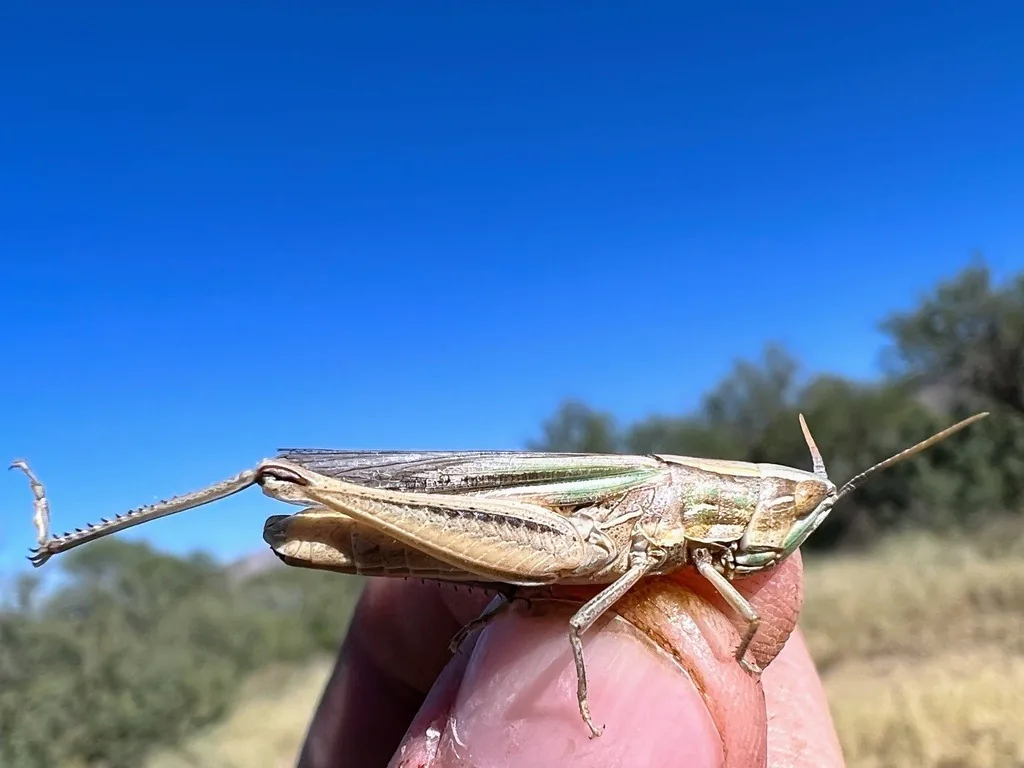
- A slim slant-faced grasshopper: males are small at 12 to 18 mm, females medium-sized at 18 to 24 mm. Color is pale tan or brown and tan; some are pale green, and females can be green and tan.[1][2]
- The antennae are flattened and taper like a sword blade (ensiform), a quick way to separate it from similar slant-faced grasshoppers.[1][2]
- The top of the pronotum is plain, without dark stripes or triangles, and its side ridges run nearly parallel.[1]
- Each forewing has a broken dark brown band running lengthwise down the middle. The hind wings are clear, and the hind shins are pale tan, gray or light brown.[1][2]
- Nymphs are pale tan with faint, low-contrast markings that darken in the last two stages.[1]
Look-alikes
| Look-alike | How to tell them apart |
|---|---|
| Velvet-striped grasshopper (Eritettix simplex) | Often found with it, and young nymphs of the two look alike. The velvet-striped grasshopper has thread-like antennae that look almost clubbed rather than sword-shaped, and a dark, velvety band along each side of the pronotum where the obscure grasshopper is plain pale tan.[1][2] |
| Brownspotted grasshopper (Psoloessa delicatula) | Its early nymphs also turn up alongside obscure grasshopper nymphs, but they have a nearly vertical face instead of a strongly slanted one.[1] |
Where it lives
Widely distributed in North American grasslands. It thrives where short grasses such as blue grama mix with patches of mid grasses, and in tallgrass prairie it keeps to short-grass ridgetops.[1][2]
Biology and life cycle
Blue grama made up 85 to 100 percent of the diet of grasshoppers examined from Colorado, Kansas, Nebraska and North Dakota. Needleandthread, buffalograss, sand dropseed, little bluestem, western wheatgrass and a few sedges are eaten in small amounts.[1][2]
It spends much of the day resting head-up on mid-grass stems. To feed, it sits on a blue grama leaf, cuts it near the middle, holds the cut piece with its front feet and eats it to the tip.[1]
There is one generation a year. Eggs overwinter 5/8 to 7/8 inch deep in pods holding 8 to 10 eggs, and hatch in June in Colorado, Montana and Wyoming. Nymphs pass through five stages in 36 to 50 days.[1]
Adults appear in late July or early August on the northern plains (as early as April in Arizona) and are most common through September. Parasites and predators thin them steadily, and few are left by October.[1][2]
Though long-winged, it makes only short flights and moves less than most rangeland grasshoppers.[1]
Damage and signs
- Because it feeds on blue grama, a key forage grass for livestock, and sometimes cuts leaves and drops them, it is potentially damaging on rangeland.[1][2]
- It does not reach outbreak numbers by itself, but it can add 0.3 to 3 grasshoppers per square yard to an outbreak and slightly increase the damage. In thinner grasshopper populations it can be the most common species, at up to 4 per square yard.[1]
- It is common in short grass and in overgrazed pastures.[2]
Health risk
Sources describe a small grass-feeding grasshopper and note no effects on people.[1][2]
Control
Prevention
On its own it seldom justifies treatment. Scout for hot spots where grasshoppers concentrate, and compare the forage at stake with the cost of control.[1][3]
Pesticides
This species recovers slowly from spraying: in Wyoming mixedgrass prairie where outbreaks were treated with insecticide, it was virtually wiped out for four years. Use only labeled products, applied as directed.[1]
Common questions
- What is the small pale grasshopper with a slanted face and flat antennae?
- On short-grass range it is often the obscure grasshopper. Its sword-shaped antennae, slanted face and plain pale pronotum are the marks to look for.[1][2]
- Does the obscure grasshopper cause outbreaks?
- Not by itself. It joins outbreaks of other rangeland grasshoppers and adds to their damage, mainly because it eats blue grama.[1]
Sources
- USDA Agricultural Research Service, Northern Plains Agricultural Research Laboratory, “Obscure Grasshopper, Opeia obscura (Thomas): species fact sheet, Grasshoppers: Their Biology, Identification and Management.” www.ars.usda.gov/plains-area/sidney-mt/northern-plains-agricultural-research-laboratory/pest-management-research/pmru-docs/grasshoppers-their-biology-identification-and-management/id-tools-apps/fact-sheets/gomphocerinae-subfamily/fs-obscure/ (accessed 2026-11-09)
- University of Nebraska-Lincoln Extension, “The Grasshoppers (Orthoptera: Acrididae and Romaleidae) of Nebraska, EB3 (M. L. Brust, W. W. Hoback and R. J. Wright).” extensionpubs.unl.edu/publication/eb3/2009/pdf/view/eb3-2009.pdf (accessed 2026-11-09)
- Utah State University Extension, “Grasshoppers (E. Evans and E. Hodgson, June 2008).” extension.usu.edu/planthealth/research/grasshoppers (accessed 2026-11-09)
- iNaturalist, “Opeia obscura taxon page (order and family).” www.inaturalist.org/taxa/155247 (accessed 2026-11-09)